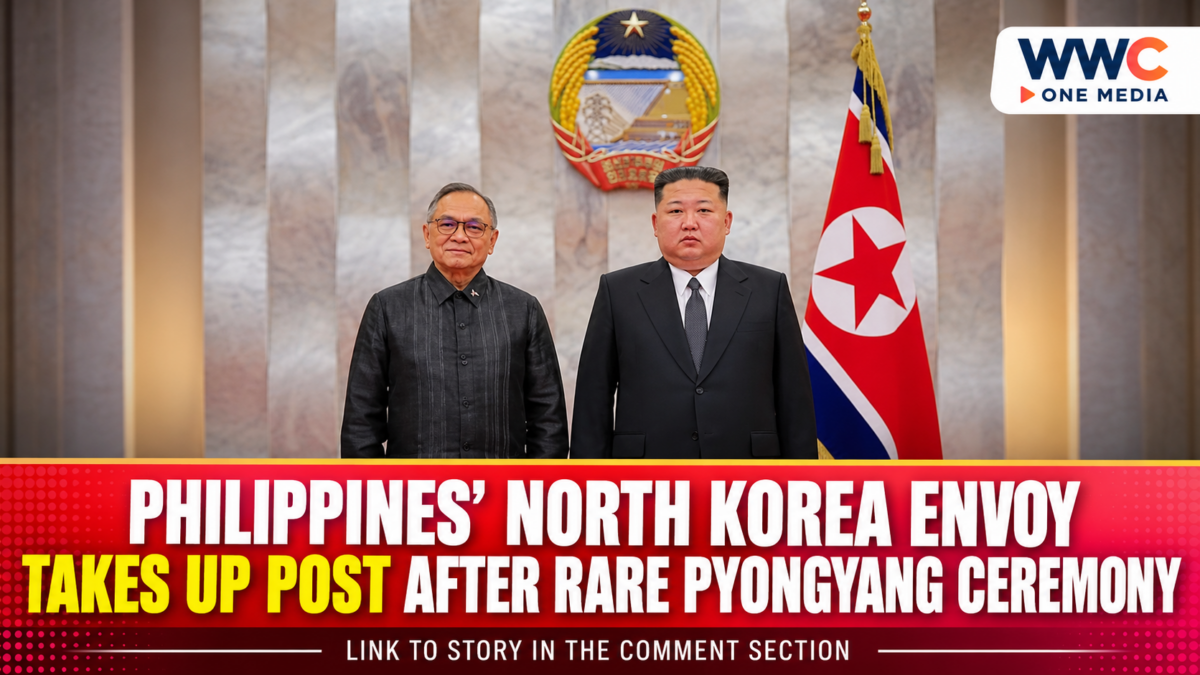
Philippine Ambassador Jaime FlorCruz presented his Letters of Credence to North Korean leader Kim Jong Un in Pyongyang on November 22, 2026, formally beginning his assignment as the Philippines’ ambassador to the Democratic People’s Republic of Korea (DPRK).
The ceremony included representatives from nine other countries, placing the Philippine diplomatic appointment within a wider group of newly accredited foreign envoys.
The event is notable not simply because a Filipino diplomat presented credentials in Pyongyang, but because of the level at which the ceremony was conducted. It provides a public indication that the Philippines’ diplomatic channel with North Korea remains active, even as the relationship operates within a complicated regional security environment.
A diplomatic appointment with a Beijing base
FlorCruz is based in Beijing, where he serves as the Philippine ambassador to China. His diplomatic jurisdiction also covers North Korea and Mongolia, according to the University of the Philippines Asian Center’s institutional account of his appointment.
That arrangement means the Philippine government does not necessarily need a resident ambassador physically stationed in Pyongyang to maintain formal diplomatic representation. A non-resident ambassador can be accredited to more than one country while operating from a principal diplomatic post elsewhere.
The distinction matters because diplomatic representation is not measured only by the location of an embassy building. Accreditation establishes the formal relationship between an envoy and the receiving state, while the ambassador’s place of residence describes where the diplomat is based.
FlorCruz’s presentation of credentials therefore represents a formal step in the conduct of Philippine relations with North Korea. It does not, by itself, establish that the two governments have agreed to a new programme, signed a bilateral deal or changed their positions on regional security.
Ten countries were represented at the ceremony
The North Korean state-media account identified ambassadors from Indonesia, Sweden, Vietnam, Russia, Brazil, the Czech Republic, India, the Philippines, Thailand and Bangladesh as participants in the November 22 ceremony.
The account placed the event at the headquarters building of the Central Committee of the Workers’ Party of Korea. It also said Kim received the credentials from the ambassadors and had photographs taken with each of them.
In his remarks, Kim expressed the expectation that the ambassadors would promote confidence-building between their countries and North Korea and strengthen friendly relations in line with mutual interests.
The speech also set out North Korea’s stated foreign-policy priorities, including independence, peace, friendship, sovereignty and security. Those positions should be understood as the North Korean government’s own presentation of its policy, not as an independent assessment of the country’s conduct or intentions.
For the Philippines, the presence of its envoy among the participating diplomats confirms that Manila remains represented in the formal diplomatic process with Pyongyang.
What presenting credentials actually means
Letters of Credence are formal documents through which a sending state introduces its ambassador to the receiving state. Their presentation is a diplomatic protocol step that allows the envoy to take up the functions of the office.
The ceremony should not be confused with a treaty signing or a high-level negotiation. It is a formal recognition of an ambassador’s appointment by the receiving government.
That distinction is important when interpreting the significance of the event. The presentation establishes a diplomatic channel and gives the ambassador formal standing in the receiving country. It does not automatically produce new trade arrangements, security commitments, consular agreements or political concessions.
For readers following regional affairs, the difference between diplomatic contact and a negotiated outcome is essential. A credential ceremony can be a meaningful development while leaving the substance of bilateral policy unchanged.
WWC has previously examined how regional diplomatic engagement can be measured by what governments implement, not only by the meetings they announce, in its report on Korea–Philippines ties and the challenge of delivering on cooperation commitments.
The wider Korean Peninsula context
The Philippine envoy’s assignment takes place against a broader regional backdrop involving competing security priorities and diplomatic relationships.
North Korea’s own statement at the ceremony placed sovereignty and security at the centre of its foreign-policy position. Kim said the country was prepared to strengthen relations with states that respected its sovereignty, on principles including mutual respect, equality and mutual benefit.
Those remarks are the government’s declared position. They do not amount to a new commitment to resolve disputes with other countries or to take part in a particular negotiating process.
The Philippines has an interest in developments affecting regional peace and stability. Its diplomatic representation provides a channel through which official communication can take place, although the existence of that channel should not be mistaken for evidence of a breakthrough.
WWC has also followed North Korea’s diplomatic engagement with Russia, including the meetings involving senior North Korean and Russian officials, in its report on North Korea’s senior aide meeting Vladimir Putin. Separately, its coverage of Kim Jong Un’s public activities in North Korea provides additional context on the country’s official announcements.
What happens next
The next meaningful measure of the Philippine assignment will be whether the two governments announce substantive follow-up activities.
That could include official meetings, exchanges between foreign-ministry officials, consular coordination or publicly documented agreements. Any claim that the ceremony has produced a new policy or bilateral undertaking should wait for an official announcement or published record.
For now, the documented development is specific: FlorCruz presented his credentials in Pyongyang, and the Philippines was among the countries represented at a ceremony involving 10 newly appointed ambassadors.
The diplomatic channel is active. What that channel delivers in practical terms remains to be established through future official records.
Frequently asked questions
Who is the Philippine ambassador to North Korea?
Jaime FlorCruz is the Philippine ambassador to the Democratic People’s Republic of Korea. He is based in Beijing and also serves as Philippine ambassador to China.
When did Jaime FlorCruz present his credentials?
He presented his Letters of Credence to Kim Jong Un in Pyongyang on November 22, 2026.
What are Letters of Credence?
They are formal documents through which a government introduces its appointed ambassador to another country. Their presentation is part of the diplomatic accreditation process.
Did the ceremony produce a new agreement between the Philippines and North Korea?
The public records reviewed for this report establish the credential presentation. They do not establish that a new bilateral treaty, trade agreement or security arrangement was signed at the ceremony.
Why is the Philippine ambassador based in Beijing?
FlorCruz’s diplomatic assignment covers China, North Korea and Mongolia. His Beijing residence allows him to serve as a non-resident ambassador to the other countries.