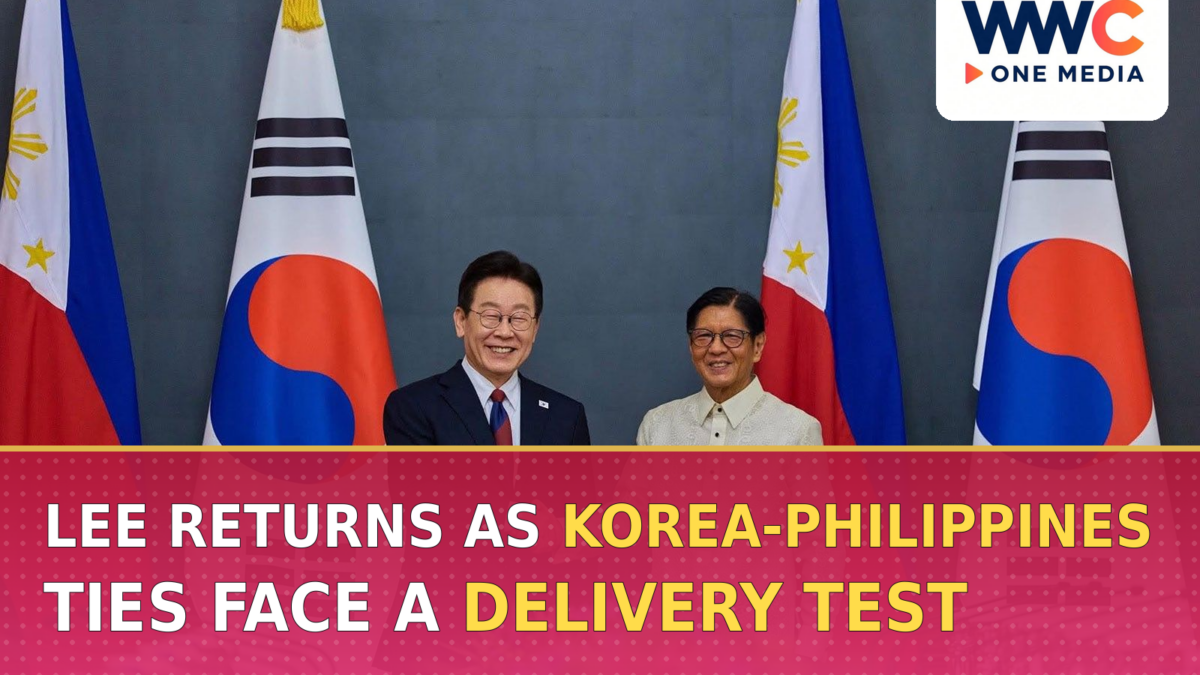
President of the Republic of Korea Lee Jae Myung is scheduled to meet President Ferdinand Marcos Jr. in Manila on November 16, as the Philippines hosts the 49th ASEAN Summit and related meetings. The planned talks come eight months after the two governments signed 10 cooperation agreements covering defence procurement, agriculture, trade, digital technology, education, culture and law enforcement.
The timing gives the two leaders an opportunity to assess how their existing strategic partnership is progressing. For the Philippines, the central question is no longer simply how many agreements can be signed, but how those commitments translate into trade opportunities, industrial capacity, security cooperation and benefits for Filipino workers.
The two countries elevated their relationship to a strategic partnership in 2024. Their March 2026 agreements added specific areas of cooperation to that framework, while the Philippines-Korea Free Trade Agreement has already moved into implementation through Philippine customs rules. Presidential Communications Office+2
Korea-Philippines ties return to the leaders’ agenda
The Korean presidential office’s November 13 schedule listed a bilateral meeting between Lee and Marcos for the afternoon of November 16, alongside a separate meeting with Thai Prime Minister Anutin Charnvirakul.
Lee’s wider regional trip runs from November 16 to 19. The programme includes the ASEAN-related meetings in Manila before his onward travel to Shenzhen, China, for the Asia-Pacific Economic Cooperation summit. 대한민국 청와대+1
The planned meeting is significant because the two governments have already identified several areas where their interests overlap. These include maritime and defence cooperation, trade and investment, infrastructure, digital development and people-to-people exchanges.
The Korean Embassy in Manila also recorded a September 7 meeting between Ambassador Lee Dong-gy and Philippine Foreign Affairs Secretary Ma. Theresa P. Lazaro. The embassy’s September 14 account said both sides agreed to follow through on the outcomes of the March summit and expand cooperation in diplomacy, security, the economy, people-to-people exchanges, artificial intelligence and the digital economy. mofa.go.kr
That earlier follow-through commitment gives the November meeting a practical benchmark: whether the agreements signed in March are progressing beyond their initial announcement.
Ten agreements created a broad cooperation framework
During Lee’s March 3 state visit, the two presidents witnessed the exchange of 10 memoranda of understanding and related arrangements.
The agreements covered:
- Digital cooperation between the Philippine Department of Information and Communications Technology and South Korea’s Ministry of Science and ICT.
- Technology, digitalisation and innovation cooperation involving the Philippine Department of Economy, Planning, and Development.
- An amendment to an implementing arrangement on the procurement of certain defence materials.
- Cooperation on veterans and patriots affairs.
- Agricultural cooperation.
- Trade, investment and economic cooperation.
- Intellectual property cooperation.
- Korean-language training in Philippine schools.
- Cultural cooperation.
- Police cooperation between the Philippine National Police and the Korean National Police Agency. Presidential Communications Office
The range matters because it takes the relationship beyond a narrow focus on imports, construction and defence equipment.
For example, the digital cooperation arrangements could support exchanges in technology and innovation. The agriculture agreement provides a formal channel for cooperation between the two countries’ agriculture agencies. The police agreement creates a basis for closer institutional coordination.
However, the signing of an MOU should not be confused with proof that a project has been completed, a technology has been transferred or a new investment has already entered the country. Those outcomes require implementation, resources and follow-up arrangements.
The free trade agreement has moved into customs implementation
Trade is one of the clearest areas where the relationship has moved from diplomacy into administrative procedures.
The Philippines-Korea Free Trade Agreement was signed on September 7, 2023, during the 43rd ASEAN Summit. The Philippine President ratified it on May 13, 2024, and the Senate concurred through Senate Resolution No. 1188 dated September 23, 2024.
The Bureau of Customs’ Circular No. 208-2024, dated December 30, 2024, sets out the Philippine tariff commitments under the agreement and refers to Executive Order No. 80. It provides for preferential tariff treatment on qualifying goods originating from South Korea, subject to the required proof of origin and applicable rules. customs.gov.ph
In practical terms, the agreement can reduce or eliminate customs duties on goods covered by the tariff schedules. But not every product automatically qualifies. Importers must satisfy the rules of origin and documentary requirements before claiming preferential treatment.
That distinction is important for Filipino businesses. The existence of a trade agreement creates an opportunity, but companies still need to understand the product-specific tariff schedule, documentation and customs procedures.
The agreement also gives the two governments an established framework for addressing trade and investment issues beyond the summit calendar.
Defence, shipbuilding and technology remain important sectors
The March 3 presidential statement identified Korean support for the modernisation of the Armed Forces of the Philippines and the strengthening of the Philippine Coast Guard.
It also referred to Korean investment connected with the Philippine shipbuilding industry and the semiconductor value chain, alongside infrastructure and development projects. Presidential Communications Office+1
These sectors have strategic importance for the Philippines because they connect national security with industrial development.
Shipbuilding, for example, is not limited to acquiring vessels. A stronger domestic industry can also involve skilled workers, maintenance, repair, supply chains and technical training.
The defence procurement arrangement signed in March provides one formal channel for cooperation, but it does not establish that every future procurement or joint-production proposal has already been finalised.
WWC has previously examined the proposed government-to-government fire-truck procurement involving South Korea. That separate programme illustrates why the details of procurement, delivery schedules and public accountability matter when foreign cooperation involves government purchases.
The same scrutiny should apply to larger industrial and technology partnerships.
Filipino workers and agricultural cooperation are part of the relationship
The relationship also has a direct people-to-people dimension.
In his March 3 statement, Marcos cited the protection of the rights and welfare of more than 70,000 Filipinos living and working in South Korea as one area of bilateral cooperation. Presidential Communications Office+1
That community gives the relationship a practical dimension beyond official meetings. Consular support, labour protection, access to services and people-to-people exchanges affect Filipino families with members living and working abroad.
Agriculture is another area covered by the March agreements. The two governments signed an MOU between the Philippine Department of Agriculture and South Korea’s Ministry of Agriculture, Food, and Rural Affairs.
The agreement creates a formal basis for cooperation in the sector, although the public record reviewed here does not establish specific new agricultural projects or funding commitments arising from it.
South Korea has also provided rice assistance to the Philippines through separate humanitarian and food-security initiatives. WWC has covered the 400-metric-ton rice assistance delivered to communities affected by the southwest monsoon. Such assistance is distinct from the March agriculture MOU, but it illustrates another practical dimension of bilateral cooperation.
What happens next
The November 16 bilateral meeting is an opportunity to review the strategic partnership while both leaders are in Manila for ASEAN-related events.
The official schedule confirms that the meeting is planned. It does not, by itself, establish that new agreements will be signed or that specific projects will be announced.
The next important documents will be any joint statement, government readout, signed agreement or implementation announcement released after the meeting.
Those records will help determine whether the two governments have agreed on new deliverables, advanced existing projects or simply reaffirmed earlier commitments.
For the Philippines, the value of the partnership will ultimately be measured through results: trade that businesses can use, projects that move forward, skills and technology that reach local industries, effective security cooperation and stronger protection for Filipinos overseas.
The March agreements provide a substantial framework. The next stage is demonstrating what that framework can deliver.
Frequently asked questions
1. Why is South Korean President Lee Jae Myung visiting the Philippines on November 16, 2026?
Lee is in Manila for ASEAN-related meetings and is scheduled to hold a bilateral meeting with President Ferdinand Marcos Jr. during the visit.
2. How many agreements did the Philippines and South Korea sign in March 2026?
The Philippine government listed 10 memoranda of understanding and related arrangements signed during Lee’s March 3 state visit.
3. What areas do the Philippines and South Korea cooperate on?
The agreements cover defence procurement, veterans affairs, agriculture, trade and investment, intellectual property, digital cooperation, innovation, education, culture and police cooperation.
4. Is the Philippines-Korea Free Trade Agreement already being implemented?
The Bureau of Customs issued Circular No. 208-2024 to implement the Philippine tariff commitments under Executive Order No. 80. Preferential treatment applies to qualifying goods that meet the agreement’s requirements.
5. Have the November 16 talks produced new agreements?
The official Korean presidential schedule confirms that the bilateral meeting is planned. A post-meeting official statement or signed document is needed to verify any new commitments.