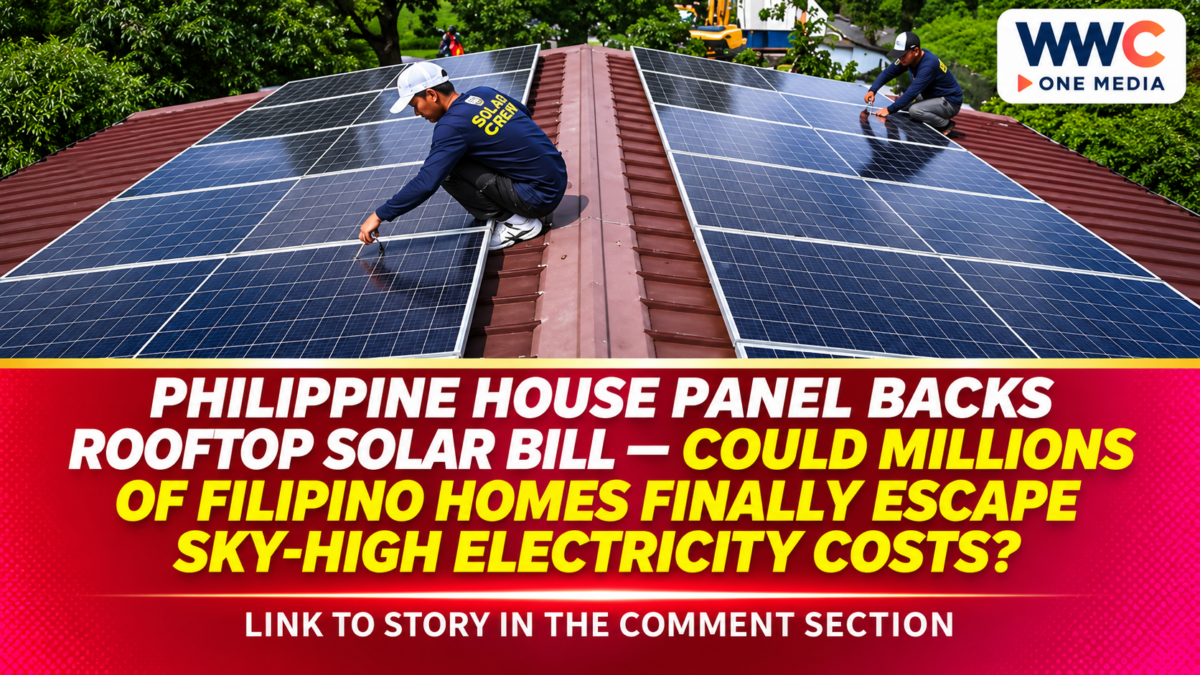
MANILA, PHILIPPINES — The Philippines is moving closer to expanding household access to renewable energy after the House Committee on Ways and Means backed legislation seeking to remove unnecessary regulatory barriers to rooftop solar panels and battery storage systems.
The Philippine rooftop solar bill builds upon House Bill No. 10431, or the proposed Sariling Kuryente Act, introduced by Representatives Faustino “Bojie” G. Dy III and Ferdinand Alexander A. Marcos.
The original measure, filed on July 29, 2026, seeks to amend Republic Act No. 9136, otherwise known as the Electric Power Industry Reform Act of 2001 (EPIRA).
Its objective is to make it easier for electricity consumers to generate and store energy for their own consumption without facing regulatory requirements intended for commercial electricity producers.
If enacted, the legislation could create new opportunities for households, solar technology companies, equipment suppliers, installers and financial institutions.
But removing administrative barriers is only one part of the challenge. Can Filipino families afford the technology needed to reduce their dependence on conventional electricity suppliers?
Philippine rooftop solar bill targets unnecessary restrictions
The original Sariling Kuryente Act proposes a significant distinction between commercial power generation and electricity produced by consumers for personal use.
Under the filed version of House Bill No. 10431, qualifying consumers who install behind-the-meter electricity generation or energy storage systems would not automatically be classified as electricity generation companies.
Systems using certified equipment that prevents electricity from flowing back into the distribution network would qualify for exemptions from specified regulatory authorisations.
The proposal also seeks to remove unnecessary requirements imposed by distribution utilities on qualifying zero-export installations, potentially replacing prior approval procedures with a notification process.
These changes could reduce the administrative burden associated with residential renewable energy projects.
However, they would not eliminate the need for safe electrical installations, appropriate equipment and compliance with applicable technical standards.
The proposed legislation remains subject to further legislative procedures, and its final provisions could differ from the original bill.
Some rooftop solar restrictions have already been eased
The legislative initiative follows separate regulatory reforms introduced earlier in 2026.
On Aug. 20, the Department of Energy (DOE) announced simplified rules for own-use solar installations under Department Circular No. DC2026-08-0017.
The policy establishes two categories of covered solar installations:
- Self-Generating Facility Zero-Export Solar Systems (SGF ZESS), which generate electricity for on-site consumption without exporting surplus power to the distribution network.
- Micro-Solar Systems (MSS), covering smaller consumer-grade installations of up to one kilowatt.
Qualifying micro-solar installations are exempt from building permits and Energy Regulatory Commission (ERC) certificates of compliance, subject to technical requirements and notification procedures.
Certain zero-export installations in residential properties, clinics and hospitals also qualify for regulatory exemptions.
The significance of the Sariling Kuryente Act is that it seeks to establish broader statutory protection for own-use electricity generation rather than relying exclusively on administrative reforms.
For households, the distinction between existing regulations and proposed legislation remains important.
Own-use solar versus net-metering: What is the difference?
Not every rooftop solar installation operates in the same way.
An own-use zero-export system is designed to generate electricity for consumption within a property while preventing excess electricity from entering the distribution network.
Net-metering, meanwhile, allows qualified electricity consumers to receive bill credits for surplus renewable electricity supplied to the grid.
The Philippine net-metering programme operates under Republic Act No. 9513, or the Renewable Energy Act of 2008.
In April 2026, the DOE identified systems with generating capacity of up to 100 kilowatts as eligible under the programme, subject to applicable requirements.
Households considering renewable energy must evaluate which arrangement is appropriate for their electricity consumption, available roof space and financial resources.
Battery storage introduces another option by allowing consumers to retain some of their solar-generated electricity for later use.
The growing commercial importance of these technologies is explored in WWC ONE MEDIA’s coverage of TCL’s expansion into residential solar and battery storage solutions.
The most appropriate configuration will vary between households. A larger or more expensive system does not necessarily provide a better financial outcome.
Financing remains a major obstacle for Filipino households
Simplifying the installation process could encourage wider rooftop solar adoption, but administrative reform alone cannot eliminate equipment and installation expenses.
The original Sariling Kuryente Act proposes assigning the DOE additional responsibilities involving consumer access to financing, reputable installers and suitable equipment.
This could provide a foundation for stronger coordination between government institutions and private-sector participants.
However, the filed bill does not establish a universal entitlement to free solar panels or guarantee loan approval for every household.
Consumers considering renewable energy investments must evaluate installation costs, borrowing expenses, maintenance requirements and expected electricity savings.
WWC ONE MEDIA’s guide to rooftop solar financing options available to Philippine households examines why financing structures and repayment obligations matter when evaluating residential installations.
The financial objective should be sustainable savings rather than simply obtaining the largest available solar system or loan.
If financing becomes more accessible alongside regulatory reform, solar companies could reach a broader segment of the residential electricity market.
Homeowners’ associations could face new limitations
Another significant provision in the original bill concerns restrictions imposed by residential property managers, subdivision developers and homeowners’ associations.
Section 5 seeks to prevent these organisations from prohibiting qualifying own-use electricity generation and storage installations on property owned or exclusively controlled by an electricity consumer.
Reasonable restrictions would remain permissible where structural integrity, public safety or shared property protection is involved.
This proposal could be particularly relevant to residents whose installation plans are affected by subdivision or property management rules.
However, it would not automatically resolve every dispute involving shared roofs, structural modifications or ownership rights.
The practical challenge will be developing clear and consistent requirements that protect residents while allowing responsible renewable energy adoption.
Can the electricity grid keep pace with rooftop solar?
The expansion of household electricity generation also creates new considerations for utilities and grid operators.
The DOE’s August policy requires distribution utilities to retain adequate service capacity for participating consumers and report installation numbers and generating capacity quarterly.
These requirements recognise that households with solar panels may still depend on the conventional electricity network when sunlight is unavailable or their systems cannot meet demand.
The wider infrastructure implications are examined in WWC ONE MEDIA’s coverage of rooftop solar monitoring and Philippine grid stability concerns.
The Philippines is pursuing renewable energy targets of 35% of the power generation mix by 2030 and 50% by 2040.
Renewable energy accounted for 25% of gross electricity generation at the end of 2025, compared with 22% in 2024.
Residential solar could contribute to these objectives, but its expansion must be accompanied by appropriate network planning, technical safeguards and consumer protection.
Similar challenges are emerging elsewhere in Southeast Asia, as explored in Thailand’s clean energy development and renewable infrastructure discussions.
What happens next for the Sariling Kuryente Act?
Committee approval represents progress for the proposed legislation, but the measure must still complete the applicable legislative process before becoming enforceable law.
The original House Bill No. 10431 proposes that implementing regulations be developed within 90 days of the law taking effect.
Whether the final legislation retains that timetable and the original proposed exemptions will depend on subsequent legislative decisions.
For households, the immediate opportunity lies in understanding existing solar policies and evaluating whether renewable energy investments are financially appropriate.
For businesses, the proposed reforms could create opportunities in equipment distribution, installation, financing and energy management.
The ultimate success of the legislation will not be measured solely by the number of solar panels installed.
It will depend on whether renewable electricity becomes genuinely accessible, financially sustainable and safe for consumers.
The Philippines is moving towards greater household participation in electricity generation. The bigger question is whether that opportunity can extend beyond families already able to afford the technology.
Frequently Asked Questions
What is the Philippine rooftop solar bill?
The proposed Sariling Kuryente Act seeks to simplify regulatory requirements for consumers installing own-use electricity generation and energy storage systems.
Has the Sariling Kuryente Act become law?
No. Committee approval is a legislative milestone, but it does not establish that the proposal has been enacted.
Do all rooftop solar installations require net-metering?
No. Own-use zero-export systems operate under a separate regulatory framework from installations that export surplus electricity to the distribution network.
Can homeowners’ associations prohibit solar panel installations?
The original House Bill No. 10431 proposes limiting such prohibitions while allowing reasonable structural, public safety and shared property protections. This provision is not presented as enacted law.
Will installing rooftop solar eliminate electricity bills?
Not necessarily. Actual savings depend on solar generation, electricity consumption, system configuration, financing costs and applicable utility charges.