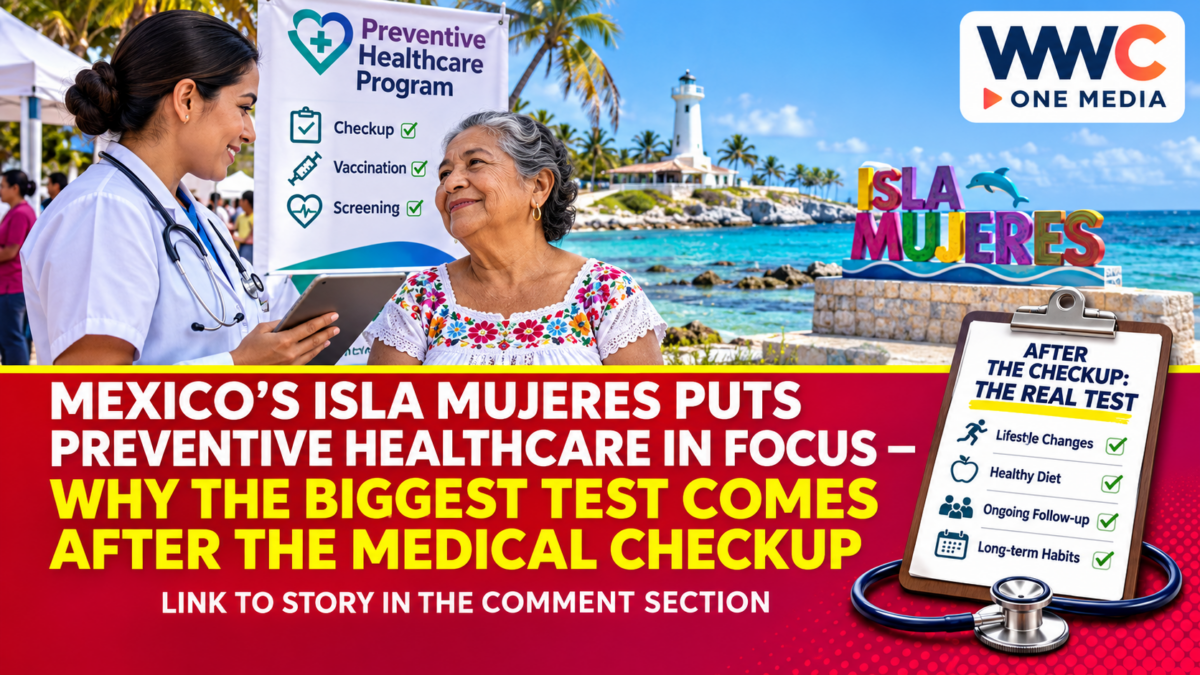
ISLA MUJERES, QUINTANA ROO, MEXICO — Preventive healthcare is becoming an important component of Isla Mujeres’ community health strategy, with documented municipal initiatives designed to improve access to medical services and encourage residents to seek appropriate screening before serious complications develop.
The municipal government, working with the Sistema DIF Isla Mujeres family welfare organisation, has previously introduced free cancer screening services and community awareness activities as part of its public health efforts.
The initiatives reflect a broader healthcare priority in Mexico, where national preventive programmes have delivered millions of medical checkups.
However, the value of community-based healthcare extends beyond making laboratory tests accessible.
The more important challenge is ensuring that patients receive appropriate medical interpretation, additional diagnostic procedures and treatment when necessary.
Isla Mujeres health screening puts prevention in focus
On Sept. 29, 2026, the municipal government of Isla Mujeres announced its October Mes Rosa, or Pink Month, programme under the leadership of Municipal President Atenea Gómez Ricalde.
The initiative included free mammograms on Thursdays, gynaecological services on Tuesdays and community activities promoting breast cancer awareness.
Registration was organised through municipal community centres and the Centro de Prevención y Atención a la Diabetes, commonly known as CEPAD.
The programme combined medical services with public awareness activities across the municipality’s island and mainland areas.
This approach illustrates how local governments can use existing community facilities to make preventive healthcare more accessible.
For residents who might otherwise postpone medical appointments, convenient registration arrangements and affordable services could help remove some barriers to seeking professional care.
However, the availability of screening does not establish that every resident requires the same medical examination.
Screening recommendations must consider individual circumstances and the applicable clinical guidelines.
Why preventive healthcare requires more than laboratory tests
Medical screening is intended to identify people who may have an increased likelihood of developing a health condition, including individuals who have not experienced noticeable symptoms.
When appropriately designed, screening programmes can support earlier medical intervention.
But a screening result is not necessarily a confirmed diagnosis.
An abnormal finding may require additional laboratory examinations, clinical assessment or specialist referral.
Conversely, a normal screening result does not guarantee that a person is free from every possible medical condition.
The distinction between screening and diagnosis is particularly important when public health campaigns offer multiple examinations through a single programme.
Different tests address different medical questions, and their usefulness depends on whether they are appropriate for the person receiving them.
WWC ONE MEDIA previously examined this issue in its coverage of community-based free health checks and the importance of medical follow-up after abnormal results.
A successful screening initiative should therefore provide an accessible route into the healthcare system rather than operate as an isolated testing activity.
Mexico’s preventive healthcare programme reaches millions
The importance of disease prevention extends beyond Isla Mujeres.
Mexico’s national social security institution, the Instituto Mexicano del Seguro Social (IMSS), operates a preventive healthcare strategy known as PrevenIMSS.
In January 2025, the institution reported that approximately 28.7 million preventive checkups had been conducted in 2023.
Its preliminary estimate for 2024 approached 32 million checkups, representing an increase of approximately 3.3 million.
The programme involved approximately 6,500 nurses and 3,900 preventive healthcare modules across Mexico.
Its services are organised around different population groups, including children, adolescents, adult men, adult women and older people.
The programme addresses healthcare priorities such as diabetes, hypertension, nutritional monitoring and selected cancer prevention services.
The national figures illustrate the potential scale of organised preventive healthcare.
However, these statistics do not establish how many people have received screening services specifically in Isla Mujeres or how many medical conditions have been detected through individual municipal campaigns.
Local programmes require their own performance evaluations.
Cancer screening requires appropriate medical guidance
Cancer prevention remains an important component of community healthcare, particularly when screening can identify abnormalities before they develop into more serious conditions.
Cervical cancer screening, for example, can help identify precancerous changes that may require treatment.
Nevertheless, different cancer screening methods have different benefits and limitations.
The possibility of incorrect positive results, unnecessary procedures and missed abnormalities means that screening programmes must be supported by appropriate clinical protocols.
Prostate-specific antigen, commonly known as PSA, also requires careful consideration because indiscriminate testing can contribute to unnecessary diagnosis and treatment.
The appropriate decision depends on individual risk factors, medical history and professional guidance.
Recent developments in cervical cancer research further illustrate the importance of interpreting screening findings carefully.
WWC ONE MEDIA previously examined research into HPV measurements and the identification of patients who may require closer medical follow-up.
Such research reinforces the distinction between identifying a potential health concern and establishing which medical intervention is appropriate.
Community healthcare partnerships face a sustainability test
Local governments can potentially expand healthcare access through partnerships involving laboratories, medical providers and community welfare organisations.
Such arrangements could help municipalities provide services that would otherwise require additional equipment, specialised personnel or administrative resources.
However, their effectiveness depends on clear responsibilities and dependable funding.
Important considerations include who conducts the medical examinations, who interprets the findings, how patients receive their results and whether additional diagnostic services are accessible.
Public-private healthcare partnerships also require transparent arrangements concerning service charges, patient eligibility and the continuity of care.
WWC ONE MEDIA previously explored these issues in its coverage of local government healthcare partnerships and the challenge of delivering sustained medical intervention.
For community healthcare initiatives, removing the initial cost of a screening examination may be valuable.
But affordable screening must be accompanied by realistic arrangements for any subsequent medical services that patients may require.
What happens next for Isla Mujeres?
Future municipal announcements should provide greater clarity about additional preventive healthcare services, appointment procedures, eligibility requirements and the availability of laboratory examinations.
Residents interested in screening should confirm current arrangements through official municipal or DIF Isla Mujeres channels before visiting a healthcare facility.
For public health administrators, the most meaningful performance indicators should extend beyond the number of medical examinations completed.
They could also include whether patients receive their results, whether appropriate referrals are completed and whether individuals requiring treatment can access the necessary services.
The broader opportunity for Isla Mujeres is to develop a community healthcare system that connects prevention with diagnosis and continuing medical support.
Early detection can be valuable, but its potential benefits depend on what happens after the initial examination.
That is where preventive healthcare must demonstrate its lasting impact.
Frequently Asked Questions
What preventive healthcare services has Isla Mujeres officially announced?
The municipal government announced free mammograms, gynaecological services and breast cancer awareness activities through its October 2026 Mes Rosa programme.
What is preventive health screening?
Preventive screening involves appropriate medical examinations intended to identify potential health concerns before noticeable symptoms develop.
Are all medical screening tests free in Isla Mujeres?
Universal free screening has not been established. Residents should confirm current fees, eligibility and appointment arrangements directly with municipal health authorities.
What is PrevenIMSS in Mexico?
PrevenIMSS is a national preventive healthcare programme operated by the Mexican Social Security Institute. It provides age-appropriate preventive services and supports the detection and management of selected health conditions.
Does an abnormal screening result mean a person has a disease?
Not necessarily. Abnormal findings may require additional medical examinations and professional assessment before a diagnosis can be established.