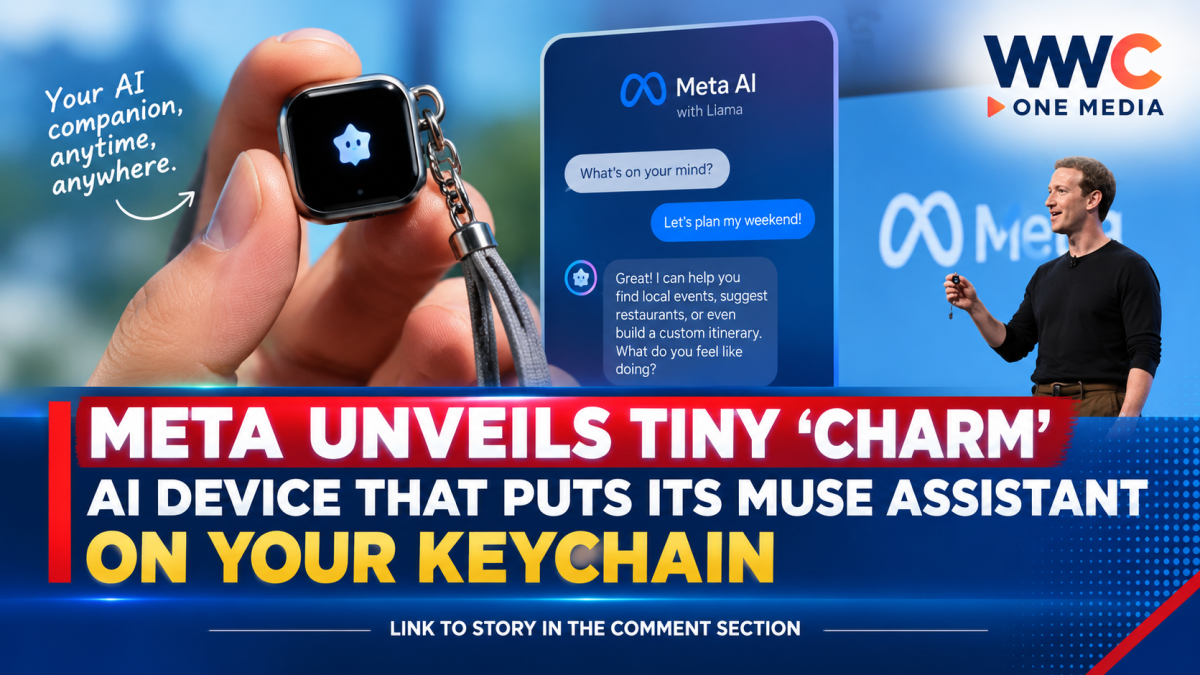
MENLO PARK, California — Meta has surprised the tech world with a device small enough to fit on a keychain but designed to give users direct access to an increasingly powerful AI assistant.
CEO Mark Zuckerberg unveiled Meta Charm, a compact handheld device built specifically around Meta’s new Muse AI assistant, during the company’s Meta Connect event on Sept. 23. The device is roughly the size of an Apple AirPods case and is expected to ship in time for the holiday season in December. Meta has not yet announced a price.
The announcement adds another piece to Meta’s expanding hardware-and-AI strategy, as the company looks beyond smartphones and traditional computers toward smaller devices that keep AI constantly within reach.
A tiny device for Meta’s Muse AI
Charm is designed to make accessing Muse faster without requiring users to take out a smartphone or open an app.
Meta demonstrated the concept at Connect as a dedicated physical gateway to Muse. Technology publications reported that the device includes a small display and connectivity features, while Zuckerberg emphasized that the company had packed the Muse experience into a form factor that can be carried like a keychain accessory.
That makes Charm different from conventional smartphones and tablets. Rather than functioning as a general-purpose computer, its central purpose is to provide quick access to Meta’s AI agent.
Meta says Muse is being developed as a personal AI assistant capable of handling tasks for users. Recent capabilities include helping with emails, shopping and travel-related tasks, while the company has also been expanding voice interactions and integrations with outside services.
Meta is betting on AI beyond the smartphone
The Charm announcement is part of a much larger hardware push.
At the same event, Meta introduced new virtual-reality glasses, additional AI-glasses products and a camera-free version of its smart glasses. The company is increasingly positioning AI as the interface connecting its different devices.
Meta’s new VR Glasses are designed to provide immersive entertainment, gaming and a portable multi-screen workspace. The glasses weigh about 100 grams and are scheduled for spring 2027, with a listed price of $1,299.
The company also introduced Ray-Ban Meta Audio, glasses without cameras that focus on audio and AI interaction. They are scheduled to begin shipping in October at a starting price of $349, according to Reuters.
Together, the products show Meta’s attempt to create an ecosystem in which AI can follow users across glasses, wearable devices and other forms of hardware.
Privacy remains a major issue
Meta’s push into AI hardware comes as the technology industry faces increasing scrutiny over privacy.
AI-powered wearables can become more useful by gaining access to information about their surroundings, but that also creates questions about recording, consent and how personal information is processed.
Reuters reported that Meta’s camera-equipped smart glasses have faced growing privacy concerns, including lawsuits and restrictions at some venues. Other technology companies are experimenting with camera-free or user-controlled devices in response to similar concerns.
Meta has said privacy is built into its AI glasses. For its camera-equipped models, the company says a front-facing capture light signals when photos or videos are being recorded.
Charm itself represents a different approach because it is primarily an interface for Muse rather than a camera-equipped pair of glasses.
Meta wants Muse to become much bigger
The hardware launch comes as Meta rapidly expands Muse.
Reuters reported that Muse had surpassed 2.5 million downloads within two weeks of its launch, according to Sensor Tower data. Meta has described the assistant as a central part of CEO Mark Zuckerberg’s long-term vision for personal AI.
Meta is also testing more ambitious capabilities, including AI-assisted phone calls. Reuters reported that the company has been testing a “human concierge” system in which trained human agents can handle some calls placed by Muse, although Meta says the feature remains in testing and has not been released broadly.
The strategy suggests that Meta sees AI not simply as a chatbot but as an agent that can interact with services and complete tasks on behalf of users.
The bigger bet behind the tiny Charm
The striking part of Meta Charm may not be its size but what it represents.
Meta is experimenting with a future in which people do not necessarily have to reach for a phone every time they want to interact with an AI assistant. Instead, AI could be accessed through glasses, a pocket-sized device or other wearable hardware.
Charm is still an announced product rather than a proven replacement for smartphones. Meta has not disclosed its price, and many details about availability and capabilities remain limited.
But by putting Muse into a device that can be carried almost like a keychain accessory, Meta is making its broader strategy increasingly clear: the company wants AI to become something users can access almost anywhere, without necessarily reaching for a traditional screen.
WWC ONE MEDIA G,A