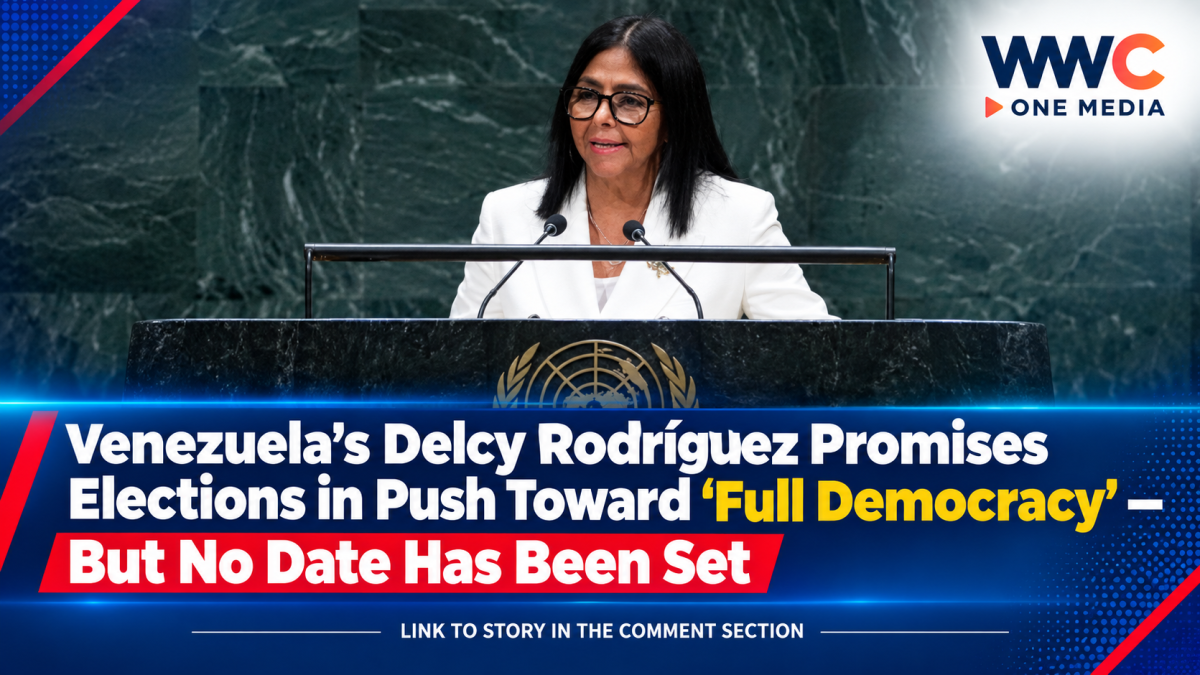
NEW YORK — Venezuela’s interim President Delcy Rodríguez has promised that the country will hold elections as part of a transition toward what she described as “full democracy,” making the pledge during her address to the United Nations General Assembly on Sept. 23.
But one major question remains unanswered: when will Venezuelans actually vote?
Rodríguez did not provide a specific election date in her UN speech. Instead, she said Venezuela had begun political dialogue with opposition groups and was preparing its institutions for an electoral process.
“I want to make this very clear at this General Assembly: there will be elections in Venezuela,” Rodríguez said, according to Reuters.
She also said the government was working toward a process in which political forces would have equal opportunities to participate.
Rodríguez Signals Political Opening
The announcement comes as Venezuela undergoes a major political transition following the removal of former President Nicolás Maduro in a U.S. operation in January, after which Rodríguez assumed the interim presidency.
Rodríguez said her administration had opened dialogue with opposition sectors and was working to prepare national institutions for elections.
She also framed the political transition as part of a broader effort to rebuild Venezuela, saying the country was entering a period in which economic recovery, political reconciliation and institutional change would be pursued simultaneously.
However, the absence of a timetable leaves significant questions over how and when the promised elections will take place.
Trump Also Raises the Election Issue
Rodríguez’s UN announcement came shortly after she met U.S. President Donald Trump on the sidelines of the UN General Assembly.
According to Axios, Trump emphasized during the meeting that elections need to take place, although he did not press Rodríguez to announce a specific date.
The meeting marked a significant change in relations between Washington and Caracas following the U.S. operation that removed Maduro.
Reuters has also reported that Venezuelan officials and international institutions have been discussing issues including debt restructuring, energy investment and the country’s economic recovery during Rodríguez’s visit to New York.
Opposition Questions the Transition
The promise of elections has not ended concerns about Venezuela’s political future.
Reuters reported that critics argue Washington has placed greater emphasis on oil and investment agreements with the interim government while the question of free elections remains unresolved. Some U.S. lawmakers have likewise called for elections as part of the country’s political transition.
Opposition leader María Corina Machado, who has been living in exile, has separately been preparing for a possible return to Venezuela and has called for new elections. The Wall Street Journal reported that Machado’s political movement is working on a transition agenda and plans to rebuild its organization inside the country.
These competing political approaches highlight the uncertainty surrounding Venezuela’s next electoral process: Rodríguez’s interim government says elections are coming, while opposition figures and outside observers continue to focus on the timing, conditions and credibility of any eventual vote.
What Happens Next?
For now, Rodríguez’s statement establishes a political commitment rather than a confirmed election schedule.
The government says dialogue with opposition groups has begun and that preparations for elections are underway. But without a date, electoral calendar or publicly detailed framework for the vote, important questions remain about the next steps.
Venezuela’s political transition is also unfolding alongside negotiations over its oil industry, foreign investment and enormous debt burden, giving the country’s next electoral process significance well beyond the ballot box. Reuters reported that Venezuelan officials have been holding discussions with the International Monetary Fund, World Bank and Inter-American Development Bank during Rodríguez’s UN visit.
For Venezuelans, the immediate question is therefore no longer simply whether Rodríguez says elections will happen.
It is when the vote will be scheduled, who will be allowed to participate, and what rules will govern the transition toward the “full democracy” she promised at the United Nations.
WWC ONE MEDIA G,A