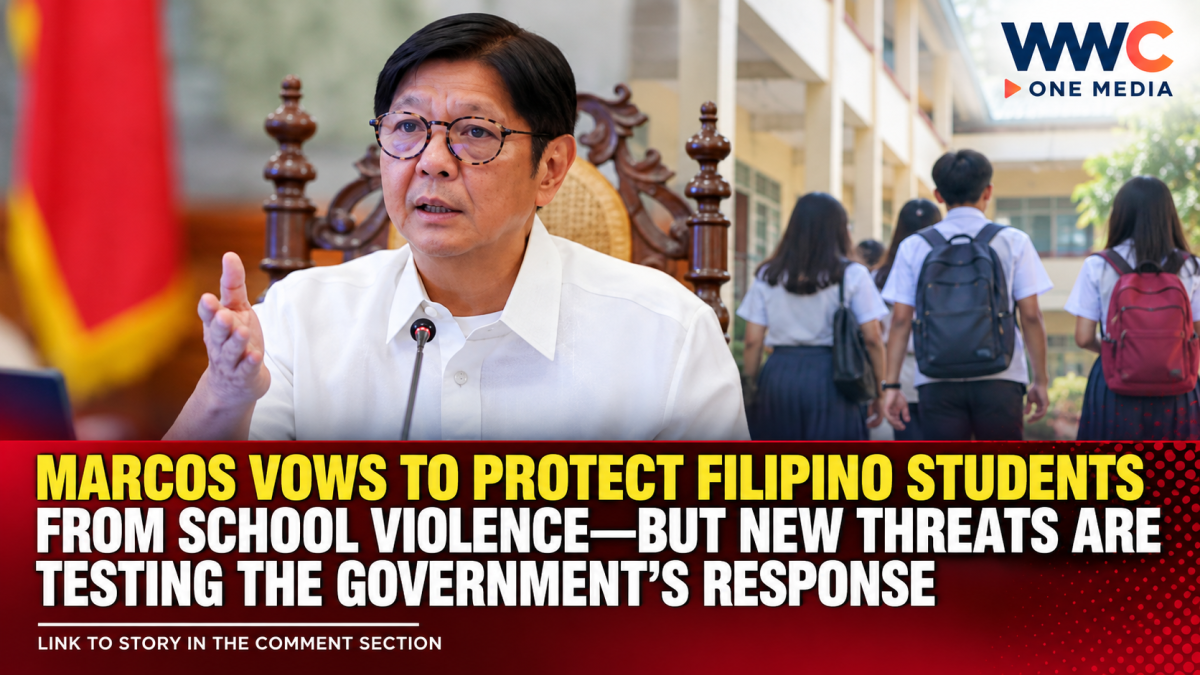
MANILA, Philippines — The Marcos administration is intensifying efforts to protect Filipino students as a series of violent incidents in and around schools pushes campus safety to the forefront of the national agenda.
President Ferdinand Marcos Jr. has directed government agencies to strengthen measures against school violence, while the Department of Education (DepEd), Philippine National Police (PNP), Department of the Interior and Local Government (DILG), local governments and communities have rolled out additional security and child-protection initiatives.
The renewed push follows several serious incidents involving students, including deadly shootings and other acts of violence that have raised questions about campus security, bullying, access to weapons and the availability of mental-health and counseling support for young people.
Marcos: Schools must remain safe spaces
Marcos has repeatedly emphasized that schools should be places where children can learn without fear.
Following recent school violence, the President called for stronger coordination among education officials, police, local governments, parents and communities to protect students and prevent similar tragedies.
The administration’s approach has increasingly moved beyond simply putting more security personnel inside school gates. It also includes stronger reporting systems, anti-bullying programs, counseling, emergency preparedness and cooperation between schools and local authorities.
In his 2026 State of the Nation Address, Marcos also highlighted the need for society to take greater responsibility for protecting young people from harmful influences, including violence and harmful online content.
DepEd tightens security nationwide
DepEd has launched a broader School Safety Campaign following the June 22 shooting at San Jose National High School in Tacloban City, where three students were killed and others were injured.
The department said the campaign includes stronger prevention, reporting, response and intervention mechanisms.
Among the measures being strengthened are:
- handheld metal detectors;
- stricter visitor-management systems;
- regular bag inspections;
- expanded CCTV coverage;
- additional security personnel;
- stronger perimeter security;
- improved emergency exits and access points; and
- closer coordination with police, LGUs and communities.
DepEd has also been conducting safety audits of public schools to identify vulnerable areas and determine where additional security measures are needed.
Safer School Zones expand protection beyond the campus gate
The government’s response also extends outside school grounds.
The DILG directed LGUs nationwide to establish Safer School Zones, with more than 277,000 barangay tanods identified to assist with public safety around schools.
The initiative covers threats such as crime, violence, traffic hazards, unsafe pedestrian areas and other risks encountered by students while traveling to and from school.
Under the program, barangay tanods are expected to provide visible presence, assist with traffic management, conduct patrols and report incidents to the appropriate authorities. Their role is primarily outside school premises unless school authorities authorize their involvement or immediate lawful assistance is required.
The move effectively recognizes that student safety does not end at the school gate.
PNP reviews school security protocols
The Philippine National Police has also been directed to strengthen its coordination with schools.
Following the Tacloban shooting, the PNP said it would review existing school security policies and support DepEd’s nationwide safety initiatives.
Among the recommendations discussed was limiting access points at schools with several entrances and exits so that movement into and out of campuses can be more closely monitored.
The objective is not only to respond to emergencies but also to reduce opportunities for dangerous incidents to occur in the first place.
Government response also targets bullying and mental health
Officials have increasingly stressed that school safety cannot be addressed through physical security alone.
DepEd has strengthened its learner-protection framework through Department Order No. 006, s. 2026, or the Guidelines on Ensuring a Safe and Motivating Learning Environment.
The guidelines provide disciplinary and intervention measures for different levels of violations, including bullying, harassment, physical assault and serious threats.
For severe violations, schools may impose stronger disciplinary measures and coordinate with authorities and social-welfare agencies when necessary.
The government is also expanding counseling capacity.
DepEd has begun preparations to hire nearly 10,000 School Counselor Associates, with schools identified as violence “hotspots” among those being prioritized, according to an Inquirer report earlier this month.
The emphasis reflects growing recognition that preventing violence requires identifying problems before they escalate.
The numbers behind the bullying problem
The challenge extends beyond highly publicized shootings.
A September report by BusinessMirror, citing the latest PISA data, said 47% of Filipino 15-year-olds reported experiencing at least one form of bullying several times a month or more in 2025, compared with an OECD average of 20%.
The figure highlights why government efforts increasingly include anti-bullying programs, counseling and early intervention rather than relying exclusively on guards, cameras and metal detectors.
The Department of Justice has likewise emphasized that students experiencing bullying should seek help from trusted adults and authorities instead of attempting retaliation themselves.
A proposed national school-safety framework
The government’s response could eventually receive a permanent legislative framework.
Senate Bill No. 2426, known as the Comprehensive School Safety Act, proposes a national framework covering three major areas: prevention, response and recovery.
The proposal includes hazard identification, security training, emergency protocols, communication systems, response procedures and psychosocial support following serious incidents.
Education Secretary Sonny Angara has expressed support for the measure, arguing that school-security, anti-bullying and mental-health initiatives need sustained institutional support and funding.
The bigger challenge
The recent measures show that the government’s response to school violence is expanding on several fronts—from campus security and police coordination to counseling, anti-bullying programs and safer routes around schools.
But implementation remains critical.
The effectiveness of these measures will depend on how consistently schools receive security equipment and personnel, how quickly students can access counseling and reporting mechanisms, and how effectively DepEd, police, LGUs, parents and communities coordinate when warning signs emerge.
For Filipino families, the central concern remains straightforward: children should be able to enter school, learn and return home safely.
The government’s latest actions are intended to move the country closer to that goal—but the continuing incidents of school violence show why the pressure for stronger prevention and protection measures remains high.