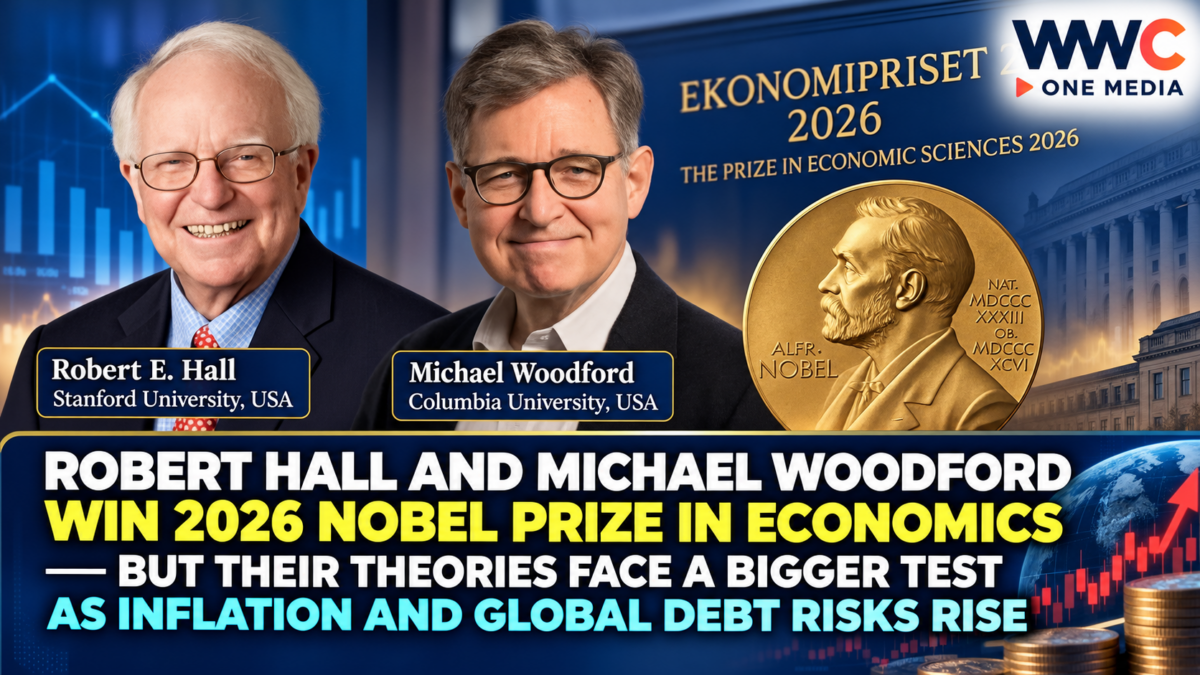
STOCKHOLM, Sweden — October 14, 2026 — Two American economists whose research helped reshape the way central banks fight inflation, manage recessions and guide financial markets have won the 2026 Nobel Memorial Prize in Economic Sciences.
Robert E. Hall of Stanford University and Michael Woodford of Columbia University were jointly awarded the prestigious honor on October 12 for developing economic models that explain how decisions made by households and businesses influence the wider economy.
The Royal Swedish Academy of Sciences recognized their contributions to the microeconomic foundations of macroeconomic stabilization — research that has influenced how governments and central banks respond to financial crises, unemployment and sudden economic shocks.
The economists will share a prize worth 12 million Swedish kronor, approximately $1.2 million.
Their achievements have helped transform modern monetary policy by showing that expectations about future income, prices and interest rates can shape economic activity long before actual policy changes take effect.
The announcement comes as the global economy faces renewed threats from elevated energy prices, geopolitical conflict, heavy government debt and uncertainty surrounding artificial intelligence investment.
But while Hall and Woodford have helped explain how central banks can prevent economic crises from becoming worse, a bigger question remains: Can the theories that transformed monetary policy still protect the world from its next major financial shock?
Robert Hall and Michael Woodford Win the 2026 Economics Nobel
The Royal Swedish Academy of Sciences announced the winners in Stockholm on October 12, recognizing decades of research that strengthened the theoretical foundations of economic policy.
The prize honors their work connecting individual economic decisions with broad changes in inflation, employment, production and economic growth.
Traditional macroeconomic analysis often examines large aggregates such as national income, investment, consumption and unemployment.
Hall and Woodford helped develop approaches that explain those outcomes through the decisions of households, workers and businesses.
This approach gives economists more structured ways to examine how people respond to changes in interest rates, government policy and expectations about the future.
Their research contributed to the development of modern macroeconomic models used by central banks and finance ministries.
The award is formally called the Sveriges Riksbank Prize in Economic Sciences in Memory of Alfred Nobel.
It was established by Sweden’s central bank in 1968 and first awarded in 1969, rather than being one of the five original Nobel Prizes established under Alfred Nobel’s will.
Who Is Robert E. Hall?
Robert E. Hall is an American economist associated with Stanford University and the Hoover Institution.
He is widely recognized for his contributions to macroeconomic theory, consumer behavior, labor markets and business cycles.
One of his most influential contributions came in 1978, when he developed a framework examining how expectations about future income influence household consumption.
Earlier economic models often placed substantial emphasis on changes in current income.
Hall’s research showed why spending decisions also depend on what households expect to earn in the future.
For example, a person expecting a stable increase in future income may make different spending decisions from someone receiving a temporary payment.
Similarly, households worried about job losses or declining income may reduce spending even before their earnings actually fall.
These relationships help explain why consumer confidence can influence economic activity.
Hall also contributed to research examining labor markets, unemployment and the causes of economic fluctuations.
His work helped create a stronger connection between economic theory and the behavior of people making everyday financial decisions.
Who Is Michael Woodford?
Michael Woodford is an American economist and professor at Columbia University.
He is internationally recognized for research involving monetary policy, inflation, interest rates and economic expectations.
Woodford is especially associated with the development of modern New Keynesian macroeconomics.
His influential 2003 book, Interest and Prices: Foundations of a Theory of Monetary Policy, helped establish a framework for analyzing how central banks influence economies through interest-rate decisions and expectations.
One of Woodford’s central arguments is that monetary policy works partly through what households and businesses believe will happen in the future.
For example, a central bank’s credible signal that interest rates will remain low may encourage spending and investment even before rates change.
Likewise, warnings that monetary policy will become more restrictive may influence borrowing and pricing decisions.
These insights contributed to the growing importance of communication in modern central banking.
They also helped support policies used during periods when conventional interest-rate adjustments became difficult.
Why Their Research Changed Modern Economics
Hall and Woodford addressed one of the most important problems in economic policymaking.
Governments want to stabilize economic activity, but their decisions influence millions of people who respond differently to changing conditions.
If households expect inflation to rise, they may alter spending and wage demands.
If companies anticipate higher borrowing costs, they may postpone investments.
If consumers fear unemployment, they may increase precautionary savings.
These individual decisions can influence the entire economy.
The research recognized by the Nobel committee provided tools for connecting such behavior to inflation, production and employment.
By incorporating these relationships into formal economic models, economists gained a more systematic way to analyze stabilization policy.
This was particularly important following the economic disruptions of the 1970s, when inflation and unemployment increased simultaneously.
Those developments exposed weaknesses in earlier approaches and encouraged economists to develop new frameworks.
What Is New Keynesian Economics?
New Keynesian economics is a major framework used in modern economic analysis.
It combines individual decision-making with the idea that wages and prices do not always adjust immediately to changing economic conditions.
Economists describe this as price and wage stickiness.
For example, a company may be reluctant to change its prices every time demand rises or falls.
Businesses may also set prices through contracts or planning processes that are difficult to adjust quickly.
Workers’ wages can be subject to agreements that remain in place for months or years.
As a result, changes in demand can affect production and employment before prices fully adjust.
This helps explain why interest-rate changes and government spending can influence real economic activity.
Woodford’s research played an important role in developing this framework.
Hall’s work on consumption and business cycles helped strengthen the broader effort to connect macroeconomic outcomes with individual behavior.
However, the development of New Keynesian economics involved many researchers over several decades.
The 2026 Nobel Prize should not be interpreted as crediting Hall and Woodford with inventing every component of the framework.
How Central Banks Use Their Economic Theories
Central banks are responsible for managing monetary conditions within their respective mandates.
Their decisions influence borrowing costs, saving incentives, investment and inflation.
Models associated with Hall and Woodford help policymakers examine how such changes may affect economic activity.
Consider a hypothetical example.
If inflation rises significantly above a central bank’s target, policymakers may raise interest rates.
Higher borrowing costs can reduce demand for loans and discourage some spending.
Over time, weaker demand may help reduce inflationary pressure.
However, the strength and timing of these effects depend on household behavior, business expectations and other economic conditions.
Conversely, when an economy enters a recession, lowering interest rates may encourage borrowing and investment.
The models help policymakers evaluate these trade-offs.
But they do not provide a mechanical formula guaranteeing that a particular rate decision will produce a precise economic result.
Woodford Helped Make Forward Guidance a Major Central Bank Tool
One of Woodford’s most influential contributions involves expectations about monetary policy.
His work helped explain why central bank communication can influence financial conditions.
This principle is closely associated with forward guidance.
Forward guidance occurs when a central bank provides information about how it expects monetary policy to evolve.
Such communication can affect market interest rates, investment decisions and business expectations.
During the 2008 global financial crisis, major central banks reduced policy interest rates close to zero.
With limited room for further conventional cuts, policymakers explored additional methods of supporting economic activity.
Communication about future interest-rate policy became an important tool.
Woodford’s research helped provide the theoretical foundation for understanding how such commitments could influence current economic behavior.
However, forward guidance works best when markets regard central bank commitments as credible.
If economic conditions change unexpectedly, policymakers may need to revise their plans.
The 2008 Financial Crisis Tested Their Ideas
The global financial crisis demonstrated why traditional interest-rate policy may not always be sufficient.
When major financial institutions experienced severe losses and confidence collapsed, governments and central banks introduced extraordinary measures to stabilize the financial system.
Interest rates were cut dramatically.
Central banks also used unconventional policies, including large-scale asset purchases and communication about future monetary conditions.
Woodford’s research on expectations helped inform debates about how monetary policy could remain effective when conventional interest rates approached zero.
Hall’s work also contributed to understanding economic fluctuations and household behavior.
However, the crisis exposed weaknesses in economic models that did not fully capture financial-sector vulnerabilities, leverage or sudden disruptions to credit markets.
The experience encouraged further research into how financial institutions and debt interact with the wider economy.
Their Research Also Helps Explain Pandemic-Era Economic Policy
The COVID-19 pandemic created another extraordinary challenge for policymakers.
Restrictions on travel, business activity and movement disrupted economic production and employment.
Governments introduced financial support programs, while central banks lowered interest rates and implemented measures intended to maintain functioning financial markets.
Economic models examining consumer behavior, spending and expectations helped inform policy assessments.
However, the pandemic was unusual because it simultaneously disrupted production and demand.
Its effects could not be understood entirely through conventional business-cycle models.
The pandemic highlighted the importance of incorporating public health, supply chains and sudden changes in behavior into economic analysis.
Hall and Woodford’s contributions formed part of the broader theoretical background available to policymakers.
Their research did not independently determine or guarantee the success of pandemic-response policies.
The Nobel Comes as Global Economic Risks Increase
The timing of the award is significant.
The International Monetary Fund’s October 2026 economic outlook projects global growth of approximately 3.1% this year.
However, the IMF has warned of risks involving geopolitical conflict, high energy prices and growing public debt.
Artificial intelligence investment is helping support some economies, but expectations surrounding the sector could also create financial vulnerabilities.
These challenges create difficult choices for central banks.
Raising interest rates may help contain inflation but increase borrowing costs.
Lowering rates may support economic activity but risk allowing price pressures to persist.
Government debt also limits the room available for large fiscal responses.
The research recognized by the Nobel Prize offers policymakers tools for understanding these competing risks.
But the effectiveness of economic policy ultimately depends on the quality of the data, institutional credibility and the ability to adapt when conditions change.
A Nobel Prize Amid Debate Over the Federal Reserve’s Future
The award also arrives during a period of debate about central bank communication.
According to Financial Times reporting, US Federal Reserve Chair Kevin Warsh has questioned aspects of extensive forward guidance and has favored changes in how policymakers communicate.
That debate is relevant to Woodford’s research because expectations and communication are central to his approach.
Some economists argue that detailed guidance can help stabilize markets by reducing uncertainty.
Others warn that excessive guidance can create misleading expectations when economic conditions are unpredictable.
The disagreement is not simply about whether central banks should communicate.
It concerns how much information they should provide and whether their statements create expectations they may later struggle to fulfill.
The Nobel recognition highlights the lasting influence of Woodford’s work even as policymakers reassess specific tools and practices.
Economists Say Nobel-Winning Models Have Limitations
Despite the importance of the laureates’ work, some economists argue that modern stabilization models should not be treated as complete descriptions of the economy.
Reuters Breakingviews noted that the framework associated with Hall and Woodford helped reconcile competing economic theories.
However, it also identified weaknesses involving financial constraints, household balance sheets and economic behavior during periods of severe stress.
Traditional models sometimes assume that households and businesses form expectations in ways that are more consistent or sophisticated than actual behavior.
They may also have difficulty capturing differences between wealthy households and people living from paycheck to paycheck.
Financial crises demonstrate why debt, liquidity and banking conditions can matter as much as interest rates.
These concerns do not invalidate the laureates’ achievements.
Instead, they show how economic research continues evolving as new evidence exposes limitations in earlier models.
The Nobel Prize recognizes the lasting significance of their contributions, not a claim that their theories can predict every recession or inflation shock.
Hall and Woodford Share a Connection to MIT
Both economists studied at the Massachusetts Institute of Technology.
According to MIT’s October 12 announcement, Hall earned his PhD in 1967, while Woodford completed his doctorate in 1983.
Their academic careers subsequently developed at Stanford and Columbia.
The connection highlights MIT’s influence in training economists whose research has shaped international economic policy.
Stanford celebrated Hall’s award, emphasizing his contributions to economic volatility and stabilization.
The American Economic Association also congratulated both scholars.
The recognition reflects decades of academic research and collaboration across institutions.
New York Federal Reserve Praises Their Influence
The New York Federal Reserve also welcomed the announcement.
On October 13, New York Fed President John C. Williams issued a statement acknowledging the influence of Hall and Woodford on monetary policy research.
Williams highlighted Woodford’s previous work as a monetary policy adviser and Hall’s influence on his own academic development.
The statement reflected the importance of the laureates’ ideas within the central banking community.
Their research has influenced not only academic discussions but also the analytical frameworks used by economists working inside policy institutions.
However, central banks use multiple models and sources of information.
The Nobel winners’ research is one important influence among many, rather than the exclusive foundation of every interest-rate decision.
What Their Research Means for Ordinary Consumers
Although macroeconomic theory can seem highly technical, the ideas recognized by the Nobel Prize have practical implications.
Interest rates and borrowing: Central bank policy affects the cost of mortgages, business loans and other credit products.
Inflation: Expectations about prices influence spending, saving and wage negotiations.
Employment: Changes in demand and economic conditions can affect companies’ hiring decisions.
Consumer confidence: Expectations about future income influence household spending.
Economic crises: Stabilization policies seek to reduce the severity of recessions and financial disruptions.
The research helps explain how these individual decisions combine to influence the broader economy.
However, the models do not imply that central banks can completely eliminate unemployment, inflation or recessions.
They provide tools for understanding risks and evaluating policy choices.
Why the 2026 Economics Nobel Matters for the Philippines
The Nobel-winning research is also relevant to economic policy in the Philippines.
The Bangko Sentral ng Pilipinas uses monetary policy to maintain price stability and support a sound financial system.
Changes in policy interest rates affect borrowing conditions and economic activity.
Expectations about future inflation also influence how households and businesses make financial decisions.
For example, companies expecting higher costs may adjust their prices or investment plans.
Consumers concerned about rising food and fuel prices may reduce discretionary spending.
Businesses anticipating lower financing costs may become more willing to expand.
These relationships are central to the broader economic principles developed by Hall, Woodford and other macroeconomists.
However, the Philippines faces additional challenges involving imported energy, exchange-rate movements, weather disruptions and global financial conditions.
Those factors require policymakers to evaluate more than any single economic model.
The research is therefore useful as part of a broader evidence-based approach to monetary policy.
Asia’s Central Banks Face Similar Inflation and Growth Challenges
The influence of Hall and Woodford’s work extends across Asia.
Central banks in Japan, South Korea, India, Singapore, Thailand and other economies must continually assess inflation, employment and growth.
Their policy frameworks differ, but expectations and economic behavior remain important considerations.
A country facing high inflation may need tighter monetary conditions.
Another economy experiencing weak demand may require a more supportive policy approach.
However, policies appropriate for one country may be unsuitable for another.
Exchange-rate systems, economic structures and domestic financial conditions can produce different outcomes.
The Nobel-winning research helps illuminate these relationships but does not prescribe identical policies for every economy.
The Nobel Prize Will Be Presented in December
The 2026 prize was announced on October 12 by the Royal Swedish Academy of Sciences.
The formal award ceremony is scheduled for December 10, consistent with the traditional Nobel ceremony date.
Hall and Woodford will share the 12-million-krona award.
The prize recognizes work accumulated over several decades rather than a single discovery made during 2026.
Their selection highlights the enduring importance of macroeconomic research at a time when inflation, interest rates and financial stability remain major global concerns.
The Bigger Question: Can Economic Theory Keep Up With the Next Global Crisis?
The 2026 Nobel Prize in Economic Sciences recognizes two researchers who helped change the way policymakers understand economic stability.
Robert Hall strengthened the relationship between individual economic decisions and broader business cycles.
Michael Woodford developed influential frameworks showing how monetary policy, expectations and communication can affect inflation and economic activity.
Together, their contributions helped modernize the analytical tools available to central banks and governments.
But the global economy continues to present new challenges.
Financial markets are increasingly influenced by technology investment.
Geopolitical conflicts can trigger sudden supply disruptions.
Government debt creates fiscal constraints.
And households respond to uncertainty in ways that may differ from theoretical assumptions.
The lasting importance of Hall and Woodford’s research lies not in promising perfect economic forecasts, but in providing a stronger foundation for understanding how policy affects real people and businesses.
Robert Hall and Michael Woodford have won the Nobel Prize for helping the world understand how to manage economic instability. But as inflation, debt and geopolitical shocks threaten global growth, the biggest test is whether today’s policymakers can use those ideas — while adapting to their limitations — to prevent the next crisis from becoming a catastrophe.