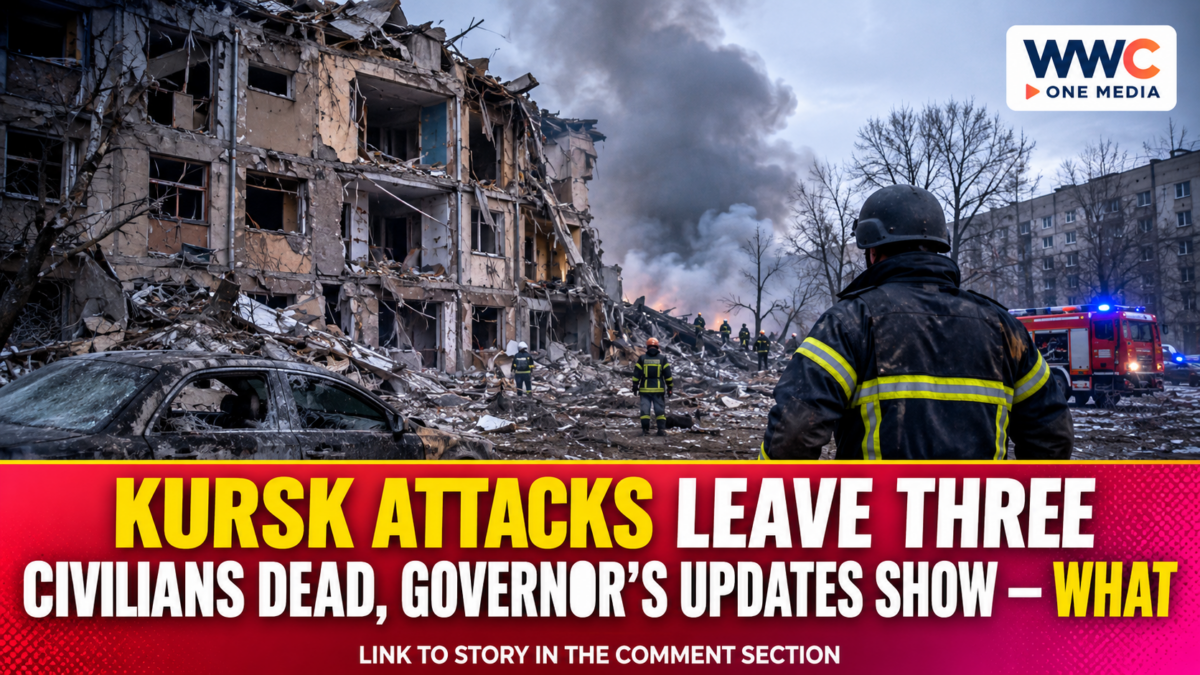
Three civilians were killed in attacks in Russia’s Kursk Region on November 27, regional Governor Alexander Khinshtein reported in two public updates the following day. The reported victims included a 48-year-old man working on a snow-clearing tractor, a 22-year-old man travelling in a vehicle, and a 68-year-old man killed near a railway crossing in the village of Giryi.
The sequence of official updates matters: the governor’s morning situation report initially listed two deaths, while a later post added the man killed near Giryi and raised the reported toll to three. Two other people were also reported injured in the vehicle attack. The accounts provide a location-by-location picture of the incidents, but do not amount to an independent investigation of responsibility.
Kursk attacks: Three deaths recorded in separate incidents
The first two deaths appeared in the governor’s November 28 situation report covering the 24-hour period from 9 a.m. on November 27 to 9 a.m. on November 28.
The report identified a 48-year-old man who was clearing snow with a tractor in the village of Ilek, in Belovsky District. It also described a drone attack on a vehicle along the Olkhovka–Krasnaya Polyana road in Khomutovsky District, where a 22-year-old man died.
The same update said two other occupants of the vehicle were injured. They were identified as a 29-year-old man and a 19-year-old man, both taken to Kursk for medical treatment. The governor described the older of the two injured men as being in serious condition.
The morning bulletin therefore documented two deaths and two injuries linked to the incidents it listed. It did not yet include the fatality later reported in Giryi.
Later update adds the Giryi railway-crossing death
In a separate post published at 6:48 p.m. on November 28, Khinshtein reported that a drone had struck near a railway crossing in Giryi, a village in Belovsky District, on the evening of November 27.
The governor said a 68-year-old man died in the incident. He added that the victim’s body could only be evacuated on November 28.
The later statement described the man’s death as the third civilian fatality from attacks in the region on November 27. This explains why the morning situation report and the evening total differ: the third case was disclosed after the initial daily bulletin.
The public updates do not provide the victim’s name, the precise circumstances that prevented earlier evacuation, or a detailed account of the damage at the railway crossing. Those details should not be inferred from the fact that the recovery took place the following day.
What the regional situation report says about drone activity
The governor’s morning bulletin also reported that 202 drones of various types had been shot down during the 24-hour reporting period. It separately said drones had attacked the region using explosive devices on 13 occasions.
Those numbers are the regional authorities’ operational claims. The post does not publish a technical breakdown of the aircraft, interception locations, evidence supporting each interception, or a detailed list matching each reported drone incident to a specific casualty or damage site.
The figures should therefore be read as the governor’s account of the security situation, not as independently audited totals.
The same report recorded damage in several locations. In Kursk city, it listed damage to the glazing and façades of four apartment buildings, the façade and glazing of the MegaGRINN complex, and one vehicle. It also reported damage to two apartments in Kolachek, a snow-clearing tractor in Ilek, the roof of a summer kitchen in Peschanoye and a house in Zvyagin.
These property reports describe separate locations. The bulletin does not establish that all the damage occurred in the same incident or that every damaged property was connected to one particular drone.
Why the timing of the updates matters
Emergency reporting often changes as authorities receive information from affected areas, identify victims and complete evacuations. A first situation report is a snapshot of what officials know at the time it is issued, not necessarily a final account of every incident during the reporting period.
That distinction is visible in the Kursk updates. The morning report gave two deaths for the stated 24-hour period. The governor’s later post added the Giryi fatality and explicitly revised the reported total to three for November 27.
For readers, the important distinction is between the time an incident happened and the time authorities reported it. The Giryi drone strike was described as having occurred on the evening of November 27, but the death was included in the governor’s public accounting on November 28.
WWC ONE MEDIA has previously examined how Russian regional casualty claims should be distinguished from independently verified totals in its report on Russia’s reported civilian deaths and injuries over a one-week period. A separate report on Russia’s announced drone interceptions across multiple regions explains why interception figures should be attributed to the authority that releases them rather than treated as independently confirmed counts.
The same reporting standard applies across the conflict. WWC’s coverage of the deadly drone strike in Ukraine’s Dymer community also shows why confirmed deaths, injured people and people whose whereabouts remain unknown must be reported as separate categories.
What remains unconfirmed
The governor’s posts establish the regional administration’s account of three civilian deaths, two injuries in the vehicle incident, reported drone activity and damage to properties. They do not provide independent forensic findings, a full incident-by-incident evidence file or confirmation from an independent monitoring organisation.
The posts attribute the attacks to Ukrainian forces. The records reviewed for this report do not include a response from Ukrainian authorities or independent verification of responsibility for each incident. The attribution should therefore remain clearly identified as the regional governor’s account.
The available posts also do not establish the identities of all three people who died, the full medical outcomes of the two injured men, or the total financial cost of the reported property damage.
What happens next
Further updates from Kursk’s regional authorities or emergency services could clarify the circumstances of the three deaths, the condition of the two injured men and the extent of damage to homes and commercial property.
Any revised casualty count should be checked against the date and reporting period attached to the update. Additional claims about responsibility, weapon type or the wider operational picture would require supporting records before they could be presented as independently established facts.
For now, the official regional account is that three civilians died in attacks on November 27, with the third death disclosed in the governor’s later update on November 28.
Frequently asked questions
How many civilians were reported killed in Kursk Region on November 27?
Governor Alexander Khinshtein reported three civilian deaths from attacks on November 27. The third was included in a later update on November 28.
Where did the three fatal incidents occur?
The governor identified the village of Ilek, the Olkhovka–Krasnaya Polyana road in Khomutovsky District, and an area near a railway crossing in the village of Giryi.
Who was the oldest victim identified in the updates?
The governor said the man killed near the railway crossing in Giryi was 68 years old. The other two victims were reported as 48 and 22.
Were other people injured?
Yes. The governor’s morning report said two other occupants of the vehicle attacked on the Olkhovka–Krasnaya Polyana road were injured and taken to Kursk for treatment.
Did the governor report how many drones were intercepted?
Yes. His November 28 morning bulletin said 202 drones of various types had been shot down during the 24-hour period from 9 a.m. on November 27 to 9 a.m. on November 28. That figure is an official regional claim and was not independently verified in the records reviewed.