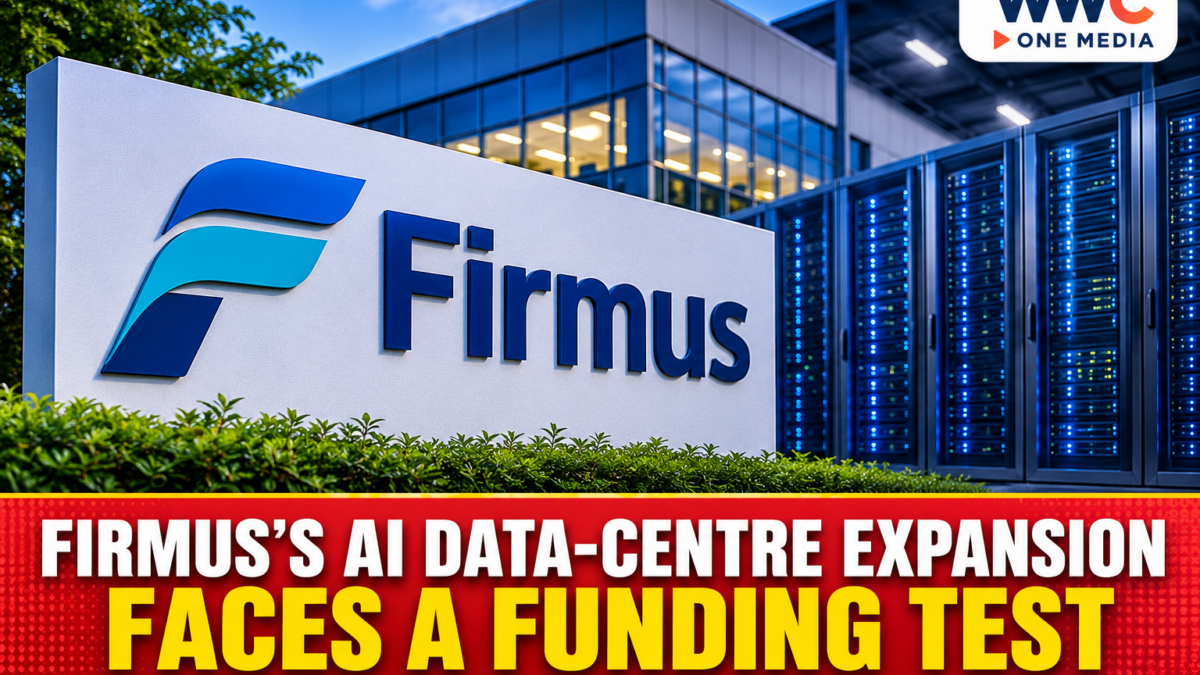
Australian AI infrastructure developer Firmus Technologies is pursuing a large expansion across Australia and Asia-Pacific, backed by financing commitments and partnerships involving major technology and investment companies. Its expansion plans are ambitious, but the challenge is converting financing arrangements, contracted computing capacity and construction projects into operating facilities that generate enough income to support their costs.
The company’s financial position deserves closer examination after its proposed Australian stock-market listing was withdrawn in October. Public records establish that Firmus has announced major debt and equity financing arrangements, while government planning documents show that some of its proposed infrastructure remains subject to approval processes. The precise daily interest figure circulating around the company, however, cannot be independently confirmed from the primary records reviewed.
Firmus AI infrastructure depends on more than investor commitments
Firmus Technologies Pty Ltd is an Australian private company registered in Tasmania. Its business centres on developing artificial-intelligence computing facilities and providing computing capacity to other organisations. ABN Lookup
The company announced in February that it had secured a US$10 billion debt-financing facility led by funds managed by Blackstone, with support from Coatue. Firmus said the financing would support Project Southgate, its planned national rollout of AI factories using NVIDIA’s data-centre architecture.
That announcement described a financing facility, not a public disclosure of the amount already drawn or the outstanding balance at a later date. The distinction matters because a financing commitment establishes access to a potential funding source, while actual borrowing depends on the terms and conditions governing each drawdown.
Firmus announced another major funding development on August 7, when it said it had received full commitments for a US$2 billion strategic equity investment round. The company identified Coatue and NVIDIA as follow-on participants, alongside funds managed by Blackstone and additional participation from Jane Street. Firmus+1
Debt and equity serve different purposes. Borrowing creates repayment obligations, while equity investment provides capital in exchange for ownership interests. Both can finance construction, but they affect the company’s financial structure in different ways.
The scale of the announced funding shows the resources being assembled for Firmus’s expansion. It does not, by itself, establish that all planned facilities are fully funded or that the company can meet every future payment without additional capital.
The abandoned listing changes the financing picture
Firmus’s proposed initial public offering was withdrawn during October, according to an October 20 announcement by ASX-listed investment company WAM Active. The announcement said WAM held an investment in unlisted Firmus Technologies and that the withdrawal had not resulted in an adjustment to WAM’s estimated net tangible assets. ASX Announcements
A stock-market listing could have provided another route to raising capital and created a public market for shares. Without that route, the company must rely on other sources, such as private investment, debt financing, customer arrangements and potential strategic partnerships.
This does not automatically mean the company is insolvent or unable to finance its projects. Private companies can raise substantial amounts without a public listing. However, investors and lenders may demand clearer evidence that construction schedules, customer commitments and future operating income justify the capital required.
The Reserve Bank of Australia’s September analysis offers useful context. It estimated that Australian data-centre operators had raised at least A$35 billion during 2026 through the funding markets covered by its research. Debt represented 85% of new funding in that period, with syndicated lending accounting for much of the borrowing.
The RBA also identified Firmus among the companies that had undertaken significant private equity fundraising. It cautioned that its estimates did not capture every private transaction, meaning the figures should be treated as a lower bound rather than a complete account of all industry financing. RBA+1
For Firmus, the central issue is therefore not simply whether investors remain interested. It is whether the funding structure can keep pace with the company’s construction and equipment commitments.
NVIDIA and major AI customers underpin the expansion strategy
Firmus’s expansion is closely connected to the demand for high-performance computing. In June, the company announced a strategic partnership with NVIDIA running through 2034, centred on a planned 360-megawatt AI factory campus in Batam, Indonesia.
The announcement described a 170,000-GPU campus and a commercial arrangement under which Firmus would provide NVIDIA-powered cloud services to AI-native businesses, enterprises and software developers. NVIDIA would receive product revenue and a share of cloud revenue on supported capacity. Firmus
In September, Firmus and OpenAI announced a multi-year partnership under which OpenAI would contract dedicated computing capacity from two Firmus AI factory sites in Malaysia.
Firmus said the agreement brought its total contracted customer capacity above 900 megawatts. It also described a regional portfolio of seven AI factories across Australia, Singapore, Indonesia and Malaysia, with two sites operational and five under development at the time of the announcement. These capacity and portfolio figures are company disclosures, not independent confirmation that every planned facility is already built or generating revenue. Firmus
These partnerships provide an important commercial foundation. Large customers can give infrastructure developers a clearer indication of future demand, while technology partnerships can help secure access to equipment and computing platforms.
But a contract for future capacity is not identical to cash already received. The facilities must be constructed, supplied with electricity, equipped with processors and brought into service before their capacity can generate operating revenue.
Tasmania’s projects show how construction and approvals can affect delivery
Firmus’s expansion also faces practical development requirements in Tasmania.
The Tasmanian State Planning Office’s Wesley Vale project page identifies Firmus Technologies as the proponent of a proposed advanced computing infrastructure development. The project is part of a cumulative capital investment of approximately A$2.1 billion by Firmus across projects in northern and north-western Tasmania.
The Wesley Vale proposal was referred to the state government by Latrobe Council for consideration under the major-project planning process. The planning office said the Minister would decide whether to declare it a major project, with a decision expected in early January 2027. Planning in Tasmania+1
That status is important. A proposal being considered for major-project treatment is not the same as receiving final approval to proceed through that process. The planning office’s published timetable also shows why project development cannot be measured solely by announced investment values.
Environmental review is another part of the process. Tasmania’s Environmental Protection Authority records describe the proposed Wesley Vale AI factory, including a data hall, administration facility, cooling equipment and approximately 40 diesel generators. The EPA Board’s delegate determined on August 7 that a separate EPA Board assessment was not required under the relevant provision, with planning controls considered an appropriate level of assessment for the proposal. EPA Tasmania+1
The approval pathway, electricity arrangements and construction timetable all influence when a project can begin operating. Those factors can affect how quickly a developer turns capital expenditure into revenue.
What the funding debate means for the wider AI industry
The Firmus case reflects a broader feature of the AI infrastructure boom: computing capacity requires enormous upfront investment before a facility can produce its intended commercial returns.
Data-centre developers must coordinate financing, land, electricity, cooling systems, processors, network connections and customer contracts. A delay in any one of these areas can affect the timetable for the entire project.
The Reserve Bank’s analysis found that data-centre operators have increasingly relied on debt because their facilities can be supported by physical assets and long-term customer arrangements. However, borrowing still creates repayment obligations, and lenders must assess whether future income will be sufficient to meet them.
For readers following the international infrastructure race, WWC has examined how data-centre financing can expose lenders to construction, leasing and refinancing risks.
The same infrastructure constraints also extend beyond financing. WWC’s coverage of AI data-centre expansion and local opposition examines how power, land use and planning decisions can influence projects.
For the Philippines, the issue is relevant as local companies explore ways to connect electricity supply with digital infrastructure. WWC previously reported on MGEN and VITRO’s exploration of renewable-powered data centres, highlighting the importance of reliable power in attracting high-density computing investment.
The lesson is that AI infrastructure is not financed by technology demand alone. It requires projects that can be built, powered, connected and operated on commercially sustainable terms.
What happens next
The next indicators to watch are the financing actually drawn by Firmus, the status of its construction commitments, the timing of customer capacity deliveries and the progress of outstanding planning decisions.
The company’s announced debt facility and equity commitments demonstrate access to significant potential funding. Its customer partnerships also indicate a strategy built around supplying computing capacity to major AI users.
But neither financing announcements nor contracted megawatts should be mistaken for completed facilities or realised revenue. The company’s ability to deliver its expansion will depend on whether capital, equipment, electricity and approvals arrive in the right sequence.
The reported daily interest estimate should remain unconfirmed until the relevant loan balance, interest terms and calculation basis can be checked against primary financial documents.
Firmus’s expansion is a substantial bet on the future demand for AI computing. Whether it becomes a durable infrastructure business will depend on execution, not just the size of the commitments announced.
Frequently asked questions
1. What does Firmus Technologies do?
Firmus develops AI data-centre infrastructure and provides computing capacity to other organisations. It operates in Australia and is expanding across Asia-Pacific.
2. How much financing has Firmus announced?
Firmus announced a US$10 billion debt-financing facility in February 2026 and a separate US$2 billion strategic equity investment round in August 2026. These are different financing arrangements.
3. Did Firmus withdraw its planned stock-market listing?
Yes. An October 20 ASX announcement by WAM Active stated that unlisted Firmus Technologies had withdrawn its proposed initial public offering during October.
4. Does Firmus already have major AI customers?
Firmus announced a multi-year partnership with OpenAI in September 2026 and a strategic computing partnership with NVIDIA in June 2026. The company has also reported more than 900 MW of contracted customer capacity.
5. Is Firmus’s Wesley Vale data centre fully approved?
The Tasmanian State Planning Office said the proposal was being considered for major-project eligibility, with a decision expected in early January 2027. That is not the same as final approval for construction.