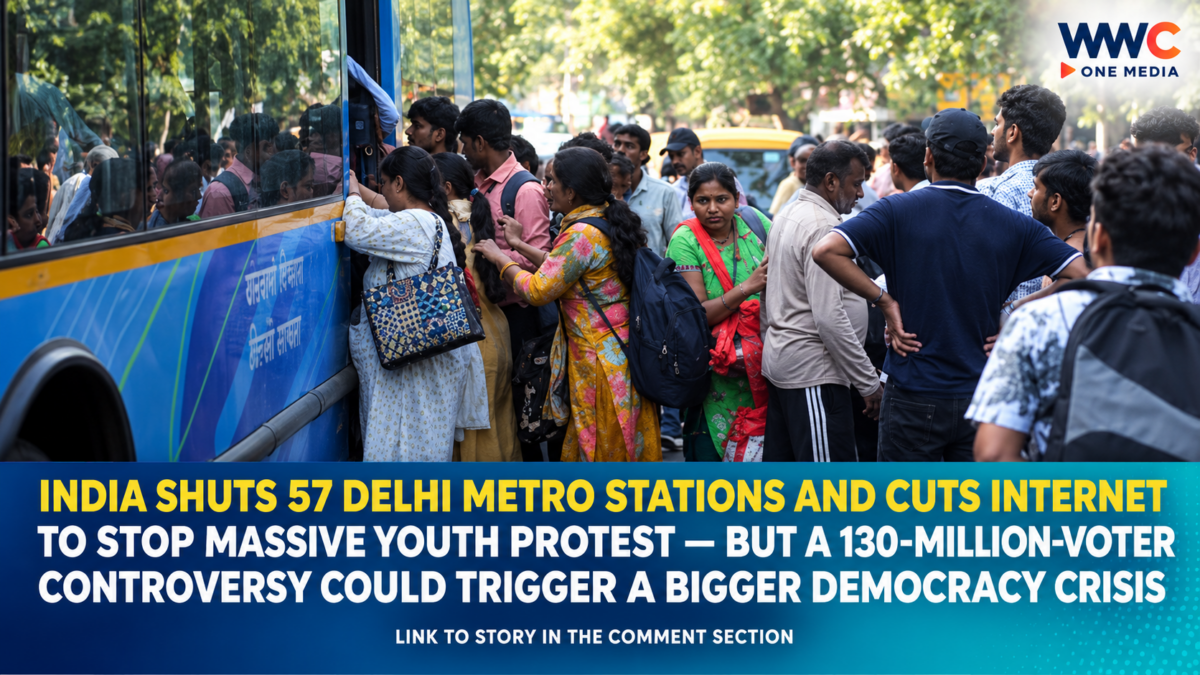
NEW DELHI, INDIA — Indian authorities shut 57 Delhi Metro stations, suspended mobile internet around a planned protest site and deployed thousands of security personnel in an extraordinary operation to prevent a youth-led demonstration demanding the resignation of Chief Election Commissioner Gyanesh Kumar. The restrictions followed mounting allegations surrounding the removal of approximately 130 million entries from electoral rolls. But as protesters accuse Prime Minister Narendra Modi’s government of undermining democratic accountability, the bigger question is whether India’s most populous democracy can restore public confidence in its election system before crucial state elections in 2027.
India’s capital became the center of a major political confrontation on Saturday, October 10, as authorities imposed sweeping security restrictions ahead of a demonstration organized by the youth-led Cockroach Janta Party.
The measures disrupted public transportation, internet connectivity and commercial activity across parts of New Delhi.
According to Reuters, in reporting carried by Channel NewsAsia, 57 Delhi Metro stations were shut, several long-distance rail services were cancelled, and mobile internet services were suspended near the planned protest location.
Thousands of police officers and paramilitary personnel were deployed as authorities sought to prevent demonstrators from gathering at Jantar Mantar, a traditional site for political protests in the capital.
The demonstration targeted Chief Election Commissioner Gyanesh Kumar amid controversy over India’s Special Intensive Revision of electoral rolls.
Opposition parties and campaigners allege that the exercise removed legitimate voters and may have unfairly benefited Modi’s ruling Bharatiya Janata Party, or BJP.
The Election Commission and BJP deny those allegations.
What began as a dispute over voter registration has now become a national debate about the fairness of elections, citizens’ right to protest and the government’s use of security powers.
Delhi Closes 57 Metro Stations Ahead of Protest
The security operation was among the most extensive measures imposed in response to the latest demonstrations.
According to CNA and The Indian Express, authorities ordered restrictions affecting 57 metro stations beginning on Friday night, October 9.
Police said the restrictions were necessary to prevent large crowds from entering the protest area.
The affected stations included transportation points across different parts of Delhi, rather than only stops immediately surrounding Jantar Mantar.
The measures complicated commuting for residents who were not necessarily participating in the demonstration.
Some long-distance train services were also cancelled.
Markets in affected areas were closed, while police established road barricades and checkpoints.
The restrictions were concentrated on the capital’s protest-related security operation.
They did not amount to a nationwide shutdown of India’s rail network or internet services.
Nevertheless, the scale of the response reflected the government’s concern about the movement’s ability to mobilize large numbers of supporters.
Mobile Internet Suspended Around Jantar Mantar
Authorities also ordered a temporary suspension of mobile internet services around the planned demonstration.
According to Reuters, citing the ANI news agency and a government order, the restriction covered a radius of approximately four kilometers around the protest area.
The order was scheduled to operate from Friday night through Saturday night.
Internet restrictions can complicate the ability of demonstrators to coordinate, communicate with families, access transport information and document events.
They may also affect residents and businesses with no connection to the protest.
Authorities argue that restrictions during volatile public gatherings can help prevent disorder and maintain public safety.
Critics contend that such measures can interfere with peaceful assembly, public communication and freedom of expression.
The dispute illustrates the challenge of balancing security responsibilities with constitutionally protected rights.
It is important to note that the available reporting describes a geographically limited mobile internet suspension, not an internet blackout across all of India.
Police Deny Permission for Cockroach Janta Party Rally
The Cockroach Janta Party, commonly known as CJP, planned to gather at Jantar Mantar at 10 a.m. on October 10.
Organizers promoted the event as part of a campaign to defend democratic accountability.
However, Delhi Police refused permission for the rally.
Police said the application had not been submitted within the required timeframe.
Authorities also alleged that organizers had violated undertakings given during previous demonstrations.
They maintained that enforcing restrictions was necessary to protect public order.
CJP leaders rejected the decision and said they intended to proceed.
The movement argued that peaceful assembly is a fundamental democratic right.
The confrontation turned what was originally planned as a public demonstration into a wider dispute over whether authorities were imposing justified security restrictions or preventing legitimate political dissent.
Thousands Detained as Crackdown Intensifies
Later reporting revealed that authorities detained thousands of people in connection with the planned protest.
Reuters reported that more than 2,000 people were detained in Delhi, citing a Home Ministry official.
Other outlets published higher estimates.
Financial Times reporting referred to claims by CJP organizers that more than 15,000 people had been detained, while local reporting also described widespread police operations.
These figures are not necessarily directly comparable.
Some were official accounts, others were movement estimates, and they may cover different groups or periods.
The available reports do not establish one definitive, independently verified total for all detentions.
The crackdown nevertheless demonstrated that large numbers of demonstrators attempted to mobilize despite transportation restrictions and the refusal of police permission.
Subsequent reporting also described the detention of activists, opposition figures and some journalists.
The events increased public scrutiny of the government’s response to peaceful political dissent.
Cockroach Janta Party Founder Abhijeet Dipke Detained
One of the most prominent developments involved Abhijeet Dipke, the founder of the Cockroach Janta Party.
Dipke, a 31-year-old political strategist and Dalit activist, was detained upon arriving in New Delhi.
Reuters reported that his detention occurred before the planned rally.
The move attracted attention because Dipke has emerged as a recognizable figure in India’s youth protest movement.
His supporters argue that the authorities were attempting to disrupt the group’s leadership and discourage participation.
The government and police maintain that restrictions surrounding the protest were related to public order and the organizers’ failure to obtain permission.
No final judicial finding establishing that Dipke’s detention was unlawful was confirmed in the reporting reviewed.
His detention nevertheless became a symbol of the confrontation between the movement and Indian authorities.
How a Viral ‘Cockroach’ Post Sparked a Youth Movement
The Cockroach Janta Party began as an online satirical movement.
Reuters reported that Dipke’s political activism gained momentum after a remark comparing unemployed young people to cockroaches.
He responded by asking what would happen if the people described in those terms united.
The message resonated with young Indians frustrated by unemployment, educational problems and perceived political indifference.
The movement adopted the cockroach identity as a symbol of solidarity and resistance.
Despite its name, CJP describes itself as a pressure movement rather than a conventional political party seeking electoral office.
Its earlier campaigns focused on examination paper leaks, employment opportunities and the quality of public education.
The latest protests expanded its agenda into electoral transparency and democratic rights.
The group’s ability to move from online satire to nationwide political mobilization has attracted increasing attention from analysts and established opposition parties.
What Is India’s 130-Million-Voter Controversy?
At the heart of the demonstrations is India’s Special Intensive Revision, or SIR, of electoral rolls.
The exercise is intended to verify voter registration records and remove entries that do not meet applicable requirements.
Election authorities say such revisions are necessary to maintain accurate rolls and prevent duplicate or otherwise invalid registrations.
However, the scale of the exercise has generated serious political controversy.
Reporting from Reuters and Associated Press indicates that approximately 130 million voter-list entries were removed during the revision process.
Opposition parties argue that eligible citizens may have been excluded and that vulnerable communities could be disproportionately affected.
They also allege that the changes may benefit the ruling BJP.
The Election Commission and the BJP reject wrongdoing.
A vital distinction must be maintained: the removal of 130 million voter-roll entries is not proof that 130 million eligible people lost their votes unlawfully.
Records can be removed for different reasons, including death, relocation, duplicate registration or disputed eligibility.
The central unresolved question is how many eligible voters, if any, were wrongly excluded and whether appropriate opportunities for correction were available.
Chief Election Commissioner Gyanesh Kumar Faces Resignation Demands
Chief Election Commissioner Gyanesh Kumar has become the focus of the protest movement.
The immediate demand is his resignation.
According to CNA and Reuters, the controversy intensified after The Indian Express reported that Kumar’s fellow election commissioners had questioned aspects of the voter-roll revision.
The reported internal disagreement strengthened opposition calls for further scrutiny.
Critics argue that electoral administration must be transparent, consistent and independent of political pressure.
They also maintain that large-scale voter-list changes require adequate safeguards to protect citizens’ registration rights.
The Election Commission denies allegations that the process was designed to favor the BJP.
As of October 11, the reported concerns had not produced a final judicial finding establishing that Kumar had deliberately manipulated election results.
The allegations remain politically serious but contested.
BJP Denies Manipulating Electoral Rolls
Prime Minister Narendra Modi’s ruling BJP has rejected accusations of electoral manipulation.
The party argues that its political success reflects public support, government policies and India’s economic performance.
BJP representatives also accuse opposition groups of promoting allegations because they have struggled to defeat the ruling party in elections.
From the ruling party’s perspective, maintaining accurate electoral records is an essential part of protecting election integrity.
Opposition parties disagree with that assessment.
They argue that the removal of large numbers of names without sufficiently transparent checks can undermine public confidence.
Both positions are central to understanding the dispute.
The core public-interest question is not simply whether electoral rolls should be revised, but whether the process is accurate, impartial and accessible to every eligible voter.
Rahul Gandhi and Opposition Leaders Increase Pressure
The protests have attracted the support of major opposition figures.
Congress leader Rahul Gandhi has repeatedly criticized the voter-roll revision and called for greater accountability.
Other opposition parties have joined demonstrations demanding answers from election authorities.
According to Reuters, near-daily protests have created an additional political challenge for the Modi government.
The timing is especially sensitive because India is approaching important state elections beginning in 2027.
The unrest has also highlighted the growing political visibility of young activists outside conventional party structures.
Whether these protests translate into lasting changes in voting behavior remains uncertain.
Much will depend on the government’s response, court proceedings, future electoral decisions and the ability of activists to sustain public support.
United Nations Raises Concerns Over Protest Restrictions
The United Nations human rights office has expressed concern about India’s response to the demonstrations.
According to subsequent Reuters reporting, UN representatives called for respect for the right to peaceful assembly.
India rejected the criticism and argued that the international response interfered with domestic affairs.
The disagreement reflects competing interpretations of the security operation.
Indian authorities insist that maintaining law and order is a legitimate responsibility.
Human rights advocates contend that restrictions on assembly and expression must be necessary, proportionate and consistent with legal protections.
The distinction matters because the existence of public-order concerns does not automatically justify every restrictive measure.
At the same time, the legality of any particular detention or security decision requires examination of the relevant facts and law.
Delhi’s Transport Restrictions Affect Ordinary Residents
The shutdown of metro stations and temporary suspension of mobile internet services affected more than protest organizers.
Delhi is one of the world’s largest metropolitan areas, with millions of residents relying on public transportation.
Restrictions on access to metro stations can complicate journeys to work, medical appointments and other essential activities.
Market closures can also disrupt local businesses.
Temporary internet suspensions may interfere with digital payments, communication and transport applications.
However, the available reporting does not provide a verified monetary estimate of the economic losses associated with the October 10 restrictions.
It would therefore be premature to assign a specific financial cost to the operation.
The wider significance lies in how security responses to political protests can also affect residents who are not directly involved in demonstrations.
Why the Crisis Matters Before India’s 2027 State Elections
India is preparing for a series of state elections in 2027, including contests with significant political implications.
Electoral credibility becomes particularly important when authorities revise registration lists on a large scale.
Accurate voter records are essential for preventing errors and ensuring that only eligible voters participate.
Equally important is preventing eligible citizens from being excluded.
The current dispute raises questions about how India can pursue both objectives while maintaining confidence in the independence of its election institutions.
For the government, a transparent explanation of the revision process could help address public concerns.
For opposition parties, evidence of wrongful exclusion would strengthen demands for corrective action.
For voters, the practical issue is whether their registration information is accurate and whether accessible procedures exist to resolve mistakes.
The longer the dispute remains unresolved, the greater the risk that questions about electoral administration will dominate the political agenda.
India’s Youth-Led Protests Signal a Broader Political Challenge
The Cockroach Janta Party’s rise reflects broader frustration among sections of India’s younger population.
Unemployment, educational opportunities, examination integrity and political accountability have emerged as recurring concerns.
The group’s ability to organize through social media has also changed how political mobilization can develop.
Movements no longer need to begin as established political parties to attract national attention.
Online communities can become organizing networks capable of staging demonstrations and influencing public debate.
However, their long-term effectiveness depends on organizational capacity, public support and the political environment.
The latest restrictions may disrupt individual protests, but they do not necessarily resolve the grievances that motivated supporters.
The Modi government now faces the challenge of responding to those concerns while defending its administration’s record.
What the Delhi Crisis Means for Asia and the Philippines
India’s political developments attract attention across Asia because of the country’s population, economy and geopolitical importance.
A prolonged confrontation over election administration can influence public debate about democratic institutions and political accountability.
For the Philippines and other democracies, the controversy illustrates why transparent voter registration procedures matter.
Election management requires safeguards against both fraudulent registrations and the wrongful exclusion of legitimate voters.
Likewise, public confidence depends on credible institutions, accessible remedies and clear communication from authorities.
However, India’s electoral system and legal framework are distinct from those of the Philippines.
The controversy should not be used as proof that the same problems exist in other countries.
Its wider significance lies in the importance of protecting both accurate voter lists and the public’s right to question election decisions.
The Bigger Picture: Security Crackdown Deepens India’s Electoral Dispute
The October 10 shutdown of metro stations and mobile internet services was intended to prevent a major youth-led demonstration in New Delhi.
The operation involved thousands of security personnel, major transport restrictions and widespread detentions.
But instead of settling the dispute, the crackdown has intensified scrutiny of India’s electoral institutions.
The Cockroach Janta Party continues to demand the resignation of Chief Election Commissioner Gyanesh Kumar.
Opposition parties remain concerned about the removal of approximately 130 million electoral-roll entries.
The Election Commission and BJP maintain that the allegations of political manipulation are unfounded.
The central questions remain unresolved.
Were legitimate voters improperly excluded?
Were sufficient safeguards and appeal mechanisms available?
And were the restrictions on demonstrators proportionate to the public-order concerns cited by authorities?
India succeeded in heavily restricting access to the planned Delhi demonstration, but the country’s dispute over electoral transparency has not disappeared.
The bigger test will be whether authorities can establish public confidence in the voter-roll revision process while protecting the right to peaceful political participation.
With important state elections approaching in 2027, the outcome could influence India’s political climate long after the metro stations reopen and internet services return.