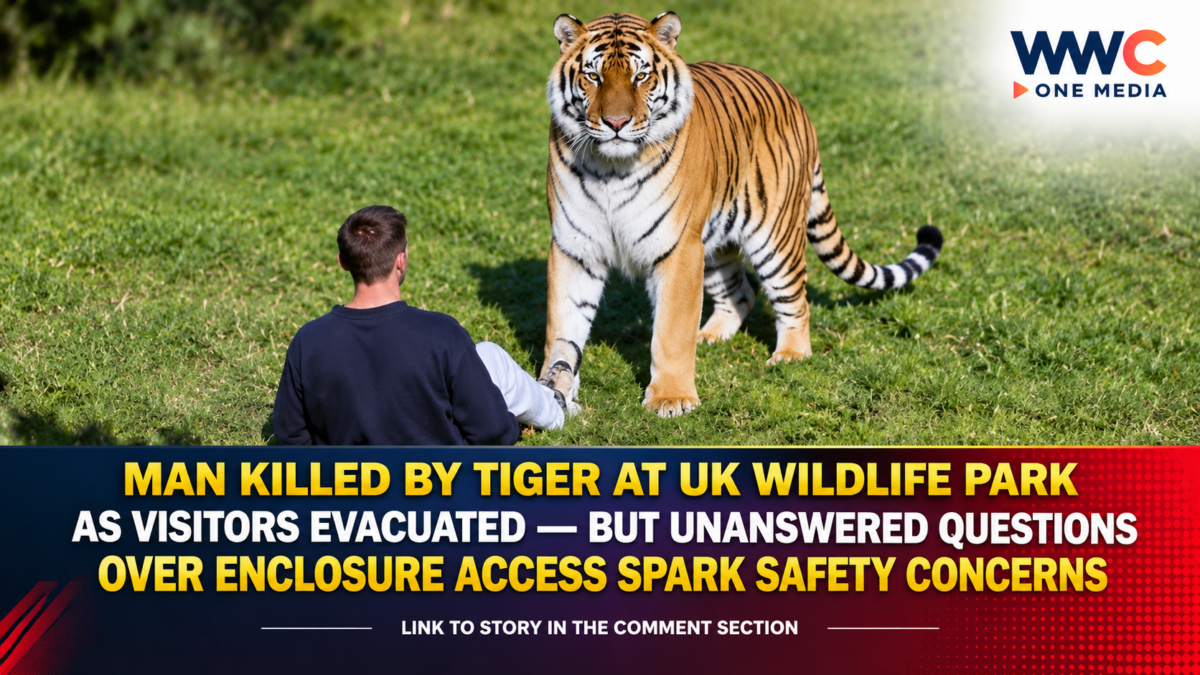
DONCASTER, ENGLAND — A man has died after entering a tiger enclosure at Yorkshire Wildlife Park in northern England, triggering a major emergency response and the evacuation of visitors. Despite efforts by medical teams to save him, the victim was pronounced dead at the scene. Police confirmed that the tiger was unharmed and remained inside its enclosure. But the tragedy has raised an urgent question: How did a person gain access to an area designed to separate visitors from one of the world’s most powerful predators?
A fatal tiger attack at a British wildlife park has prompted a police investigation and renewed attention to visitor safety at zoological attractions.
The tragedy occurred on Saturday, October 10, 2026, at Yorkshire Wildlife Park, near Doncaster in South Yorkshire.
South Yorkshire Police received a report at precisely 1:35 p.m. local time that a man had entered a tiger enclosure.
The animal subsequently attacked him, causing serious injuries.
Emergency personnel rushed to the scene, but the man died despite attempts to save his life.
The park was evacuated as authorities secured the area and began investigating the circumstances.
In an official statement issued on Saturday evening, police confirmed that the victim’s relatives had been informed and were receiving specialist support.
The case has attracted international attention, not only because of the fatal encounter but also because questions remain about how the man entered the enclosure and whether any additional safety measures are needed.
What Happened at Yorkshire Wildlife Park?
According to South Yorkshire Police, the incident was reported at 1:35 p.m. on October 10.
A man had entered an enclosure housing tigers at the wildlife park.
After entering the restricted area, he was attacked by one of the animals.
Emergency services responded to reports of serious injuries.
Medical personnel attempted to save him, but he was pronounced dead at the scene.
The man’s identity and age were not disclosed in the initial official police statements.
Authorities also did not establish publicly what led him to enter the enclosure.
Some media outlets and witnesses described him as having climbed or jumped into the restricted area.
However, the precise route of entry and the circumstances of the incident remain matters for investigation.
There is no verified basis at this stage to conclude that the man was an employee, that he entered the enclosure accidentally or that he intended to harm himself.
Those possibilities should not be presented as established facts.
Emergency Crews Rush to the Scene, but Victim Dies
The attack prompted a major emergency response.
Yorkshire Ambulance Service dispatched two road ambulances and an air ambulance to the wildlife park.
Emergency medical personnel attended the scene alongside police officers and park staff.
Despite their efforts, the victim could not be revived.
ITV News and Associated Press independently confirmed that he died at the scene rather than later in hospital.
Police subsequently contacted his family and arranged specialist support.
The fatality transformed what would ordinarily have been a busy weekend at the attraction into a major emergency.
Visitors were evacuated, and officers remained at the site as inquiries continued.
Authorities have not publicly released a comprehensive timeline showing precisely when the man entered the enclosure, when the attack began and how long the emergency response lasted.
Such details may become clearer as investigators review witness accounts and other available evidence.
Police Confirm Tiger Was Not Injured
One of the most important details in the official investigation concerns the animal.
South Yorkshire Police confirmed that the tiger was not injured during the incident.
The animal also remained within its enclosure.
Police emphasized that there was no wider risk to members of the public.
The clarification was issued partly in response to speculation circulating online about the animal’s condition.
The police statement did not indicate that the tiger had escaped or roamed through public areas.
This distinction matters because some readers may mistakenly assume that the attack involved an animal breaking out of its enclosure.
The official account describes the opposite situation: a person entered the tiger’s restricted space.
As of the information available on October 11, authorities had not announced that the tiger would be euthanized.
Nor had they established that the animal’s behavior reflected an unusual act of aggression beyond the encounter itself.
Yorkshire Wildlife Park Evacuated and Temporarily Closed
The wildlife park implemented emergency procedures following the attack.
Visitors were evacuated while police and medical crews attended the scene.
The attraction confirmed that a serious incident had occurred in its tiger enclosure.
It subsequently announced a temporary closure, including Sunday, October 11.
The decision allowed investigators to continue their work and gave the park an opportunity to assess the circumstances surrounding the fatality.
Sky News, ITV News and other British outlets reported that the attraction would remain closed for the rest of the weekend.
The park said the safety of visitors, employees and animals remained its highest priority.
It also pledged to cooperate fully with the relevant authorities.
The closure was an emergency response measure.
It should not be interpreted as proof that the park had already been found responsible for a safety violation.
Any such conclusion would require evidence from the ongoing investigation.
Witnesses Describe Distressing Scenes
Several news organizations reported that visitors witnessed parts of the attack.
The Guardian and other British media documented accounts of distress among people at the park.
Some witnesses described seeing the man inside the enclosure and hearing attempts to distract or deter the tiger.
However, individual witness accounts may differ, especially during a fast-moving and traumatic event.
Investigators will need to determine which details can be supported by reliable evidence.
Police also acknowledged that footage of the attack had circulated on social media.
They asked members of the public not to share the videos.
The request was made out of concern for the deceased man, his relatives and others affected by the incident.
Responsible coverage should therefore focus on verified facts rather than graphic descriptions or repeated circulation of disturbing footage.
Why the Park’s Tiger Enclosure Is Drawing Attention
Yorkshire Wildlife Park is home to an exhibit known as Land of the Tigers.
The attraction houses Amur tigers, also commonly called Siberian tigers.
Its habitat was developed to give the animals space to move through a naturalistic environment containing grassland, woodland and a waterfall pool.
Visitors can normally observe the animals from a raised walkway approximately 300 meters long.
The enclosure is designed to keep people physically separated from the big cats.
The layout has attracted attention because investigators must now establish how the victim crossed from an area accessible to people into the space occupied by the tiger.
The existence of a raised viewing walkway does not, by itself, establish that a particular barrier or gate failed.
Investigators will need to examine the actual point of entry, signage, access controls and any relevant witness or surveillance evidence.
Determining what happened is essential before conclusions can be drawn about the adequacy of the park’s precautions.
What Are Amur Tigers?
Amur tigers are among the world’s largest living wild cats.
They are native primarily to the forests of the Russian Far East and northeastern China.
The subspecies is endangered and has been the focus of conservation and breeding efforts.
Channel NewsAsia reported that approximately 500 Amur tigers remain in the wild, reflecting the broad conservation concern surrounding their population.
Exact population estimates vary by survey method, year and geographical coverage.
Adult Amur tigers are extremely powerful predators.
Their size, strength and natural hunting behavior make close encounters dangerous even when an animal is accustomed to living in a managed zoological environment.
Captive tigers are not domesticated animals.
That is why accredited wildlife facilities rely on physical separation, trained personnel and carefully controlled access arrangements.
The fatal attack should not be used to suggest that the animal had escaped or deliberately sought out visitors.
Police confirmed that the tiger remained in its enclosure.
The Biggest Question: How Did the Man Enter?
The central issue now facing investigators is access.
Wildlife enclosures housing dangerous predators generally require layered precautions to prevent direct contact between animals and unauthorized people.
These may include physical barriers, controlled gates, staff procedures, warning signs and monitoring arrangements.
However, each facility has its own design and operating systems.
Investigators must determine which arrangements were in place at Yorkshire Wildlife Park and what occurred on October 10.
Potential lines of inquiry include the precise point of entry, witness observations, relevant camera footage and the sequence of emergency actions.
The purpose of examining these issues is to understand the incident and identify any steps that could reduce the likelihood of similar tragedies.
It would be premature to accuse the park of negligence, equipment failure or inadequate staffing without investigative findings supporting such claims.
Similarly, it would be inappropriate to assign a motive to the deceased man before authorities establish the circumstances.
Could the Tragedy Lead to Changes in Zoo Safety Procedures?
The incident may prompt renewed scrutiny of the precautions used at wildlife parks across Britain.
Facilities housing dangerous animals must balance visitor access, animal welfare and the prevention of direct human-animal contact.
The United Kingdom has an established framework for zoo licensing, inspections and animal welfare responsibilities.
Relevant regulators may examine whether additional steps are appropriate following a serious incident.
Possible responses could include reviews of access arrangements, emergency plans and visitor management.
But no nationwide policy change had been announced in the initial reporting available on October 11.
Nor had authorities publicly established that the park failed to comply with a particular legal requirement.
The investigation, rather than speculation, should determine whether specific corrective action is needed.
The Park’s Conservation Work Continues to Matter
The fatality has also drawn attention to the role wildlife parks play in conservation.
Yorkshire Wildlife Park opened in 2009 and has developed habitats for various animal species.
Its tiger exhibit opened in 2011.
Amur tigers face threats in the wild, including habitat loss, prey depletion and poaching.
Managed breeding programs and conservation partnerships can contribute to maintaining genetically diverse populations and supporting broader awareness of endangered animals.
However, conservation value does not remove a facility’s obligation to protect staff and visitors.
The two priorities must operate together.
An effective wildlife park must provide appropriate living conditions for animals while ensuring that people cannot inadvertently or improperly enter dangerous areas.
The investigation will need to focus on the circumstances of the tragedy without overlooking either public safety or animal welfare.
Why the Incident Matters to Wildlife Parks Worldwide
The Yorkshire Wildlife Park fatality has wider relevance because close contact with large predators can result in catastrophic injuries.
Wildlife facilities across the world face the challenge of allowing educational observation while maintaining reliable physical separation.
Visitors may not always appreciate the speed and strength of animals such as tigers.
Facilities therefore need precautions that take foreseeable human behavior into account.
At the same time, there is no evidence in the initial reporting that similar facilities worldwide face an immediate or widespread safety failure.
The responsible lesson is not that all wildlife parks are unsafe.
It is that serious incidents warrant careful investigation, and any relevant findings should be shared so other facilities can evaluate their own procedures.
The Bigger Picture: A Tragedy With Critical Questions Still Unanswered
The death of a man at Yorkshire Wildlife Park is a devastating event for his family and a distressing experience for visitors and staff who were present.
Police have confirmed the essential facts.
A man entered a tiger enclosure on October 10.
The animal attacked him.
Emergency teams attempted to save his life, but he was pronounced dead at the scene.
The park was evacuated and temporarily closed.
The tiger remained unharmed and contained, with no wider danger to the public.
What has not yet been established is why the man entered the enclosure or whether any preventable weakness contributed to the incident.
Those questions will now shape the investigation.
The fatal attack has ended one life and raised serious questions about how people and powerful wild animals are kept safely separated.
But the biggest unresolved issue is not whether the tiger escaped — police say it did not — but how a person reached the restricted habitat in the first place.
Until investigators provide answers, allegations about negligence, deliberate intent or failures by individual staff members should be treated as unverified.