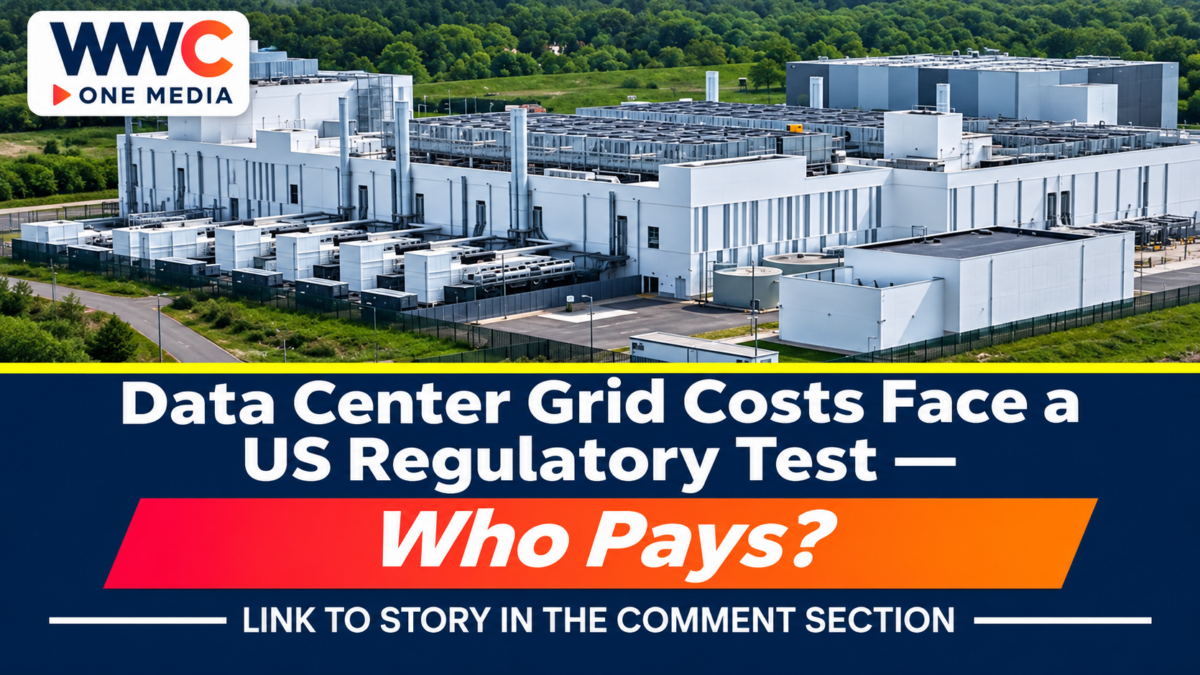
WASHINGTON — Nov. 15, 2026. US electricity regulators face important deadlines this week over the rules for connecting massive data centres and other industrial users to the power grid. The Federal Energy Regulatory Commission (FERC) has required six regional grid operators to defend or propose changes to their large-load connection tariffs, with responses due Nov. 16 for five operators and Nov. 20 for the Southwest Power Pool.
The debate over data center grid costs has a simple question at its heart: when new computing facilities require transmission upgrades, how much of that bill should be borne by the companies creating demand and how much could reach households and other businesses? The process is underway, but the regulatory orders have not themselves imposed a nationwide surcharge on technology companies.
Data center grid costs: What regulators are reviewing
FERC opened six separate proceedings on June 18 under Section 206 of the Federal Power Act. Each concerns whether current grid-connection rules adequately address large new electricity loads in a regional transmission market.
The commission described preliminary concerns about the treatment of large loads. Operators were asked to justify their existing tariffs or submit reforms. That is a regulatory examination, not a final finding that each operator unlawfully charged households for data-centre construction.
FERC’s public guidance generally describes the relevant large-load category as demand of at least 20 megawatts. A single facility’s connection can entail more than adding a meter: substations, transmission reinforcements, power supply and reliability studies may be needed.
Why ordinary electricity customers have a stake
A grid upgrade can benefit several users, even if one new facility helps trigger the project. That makes identifying who caused a cost—and who benefits from the investment—a difficult regulatory task.
Under the existing division of authority, federal regulators approve interstate transmission tariffs and their cost-allocation methods. State utility commissions oversee how many of those charges are ultimately reflected in regulated retail electricity bills.
FERC has also raised the possibility of cost-recovery agreements designed to protect customers if a proposed large-load development is cancelled or leaves before the infrastructure paid for on its behalf is fully used.
If a utility builds for a customer that never arrives, someone must still service the investment. Safeguards such as advance commitments, security deposits or appropriately designed contracts may reduce that exposure, depending on the applicable rules.
WWC previously examined how lawmakers approached the power bills associated with AI data centres. The current federal proceedings address a related but separate question: how transmission operators must account for big new customers within their filed tariffs.
A growing electricity system problem, not just an AI debate
The US Department of Energy’s July 9 draft National Transmission Needs Study identified pressure to expand the grid because of data centres, domestic manufacturing and other large industrial electricity users. The agency described transmission investment as relevant to managing congestion and maintaining reliability.
Industrial expansion, changing patterns of generation and the location of new demand also affect network planning.
In a separate federal rulemaking process, officials are considering whether large users should pay the full cost of interconnection upgrades, and whether any payments could be credited back over time. Those are questions under consultation, not final nationwide rules.
For electricity consumers, the useful test will be whether any resulting rules make costs more transparent and prevent unsupported transfers to other customers without undermining reliable service.
Why the political debate has become sharper
The argument is taking place alongside congressional consideration of energy permitting and electricity affordability. But a political commitment to protect ratepayers does not change a utility’s bill by itself.
WWC’s report on the Senate’s November energy-bill debate explains the separate legislative route. A Senate procedural vote is not final passage, and congressional proposals must not be confused with FERC’s ongoing tariff proceedings.
Likewise, the post-election discussion of technology stocks and grid pressure provides market context, not proof that particular companies have already received new regulatory invoices.
In analysis, a tougher cost-allocation framework could make some data-centre projects more expensive or require stronger financial commitments before construction. Equally, clearer rules could reduce uncertainty for responsible investors. The outcome depends on specific approved tariffs, not campaign rhetoric alone.
What the November deadlines actually mean
FERC’s public timetable sets Nov. 16 for responses from five regional operators and Nov. 20 for the Southwest Power Pool. These are filing deadlines, not dates on which a uniform national data-centre fee automatically begins.
PJM, the grid operator serving a broad eastern US region, has already submitted proposals connected with large-load registration and grid reliability. Its filings demonstrate how technical and regional the rulemaking can be.
A proposal can address a load registry, a cost-recovery mechanism or the use of transmission service without immediately fixing what an individual customer owes. Filed changes may require further regulatory review, and interested parties can respond in the dockets.
What happens next
The first question is what each grid operator files, followed by whether FERC considers the proposed treatment of large loads just and reasonable. State regulators may then have their own decisions to make about retail tariff design.
For large technology customers, the decisive details will be the required financial security, responsibility for network reinforcements and the consequences if a proposed facility is delayed or abandoned.
For households, the question is whether those arrangements meaningfully protect them from costs they did not cause. No primary record reviewed establishes a nationwide reduction in electricity bills, nor a fixed new liability for Amazon, Microsoft, Oracle or another named company.
The wider lesson is that the AI infrastructure race has become an electricity-policy test. Its result will be measured not only in faster grid connections but also in how fairly new costs are shared.
Frequently asked questions
Are US data centres already required to pay all grid upgrade costs?
No universal federal requirement was established by the June FERC show-cause orders. The commission is examining regional tariffs and possible reforms, with separate state rules also relevant.
What is a large load in the FERC proceedings?
Federal materials generally discuss electricity demand above approximately 20 megawatts, although exact applicability depends on the proceeding and tariff provisions.
Will the November deadlines increase household electricity bills?
The deadlines concern submissions to regulators. They do not establish an automatic rate increase or decrease for retail customers.
Why does a cancelled data centre matter to electricity prices?
A utility may already have invested in new infrastructure for the project. Cost-recovery protections can help determine who bears that exposure if the customer does not proceed.
Did the 2026 election itself create a national data-centre fee?
No. Election results do not independently enact new transmission tariffs. The outcome depends on regulator-approved rules and any legislation that completes the lawmaking process.