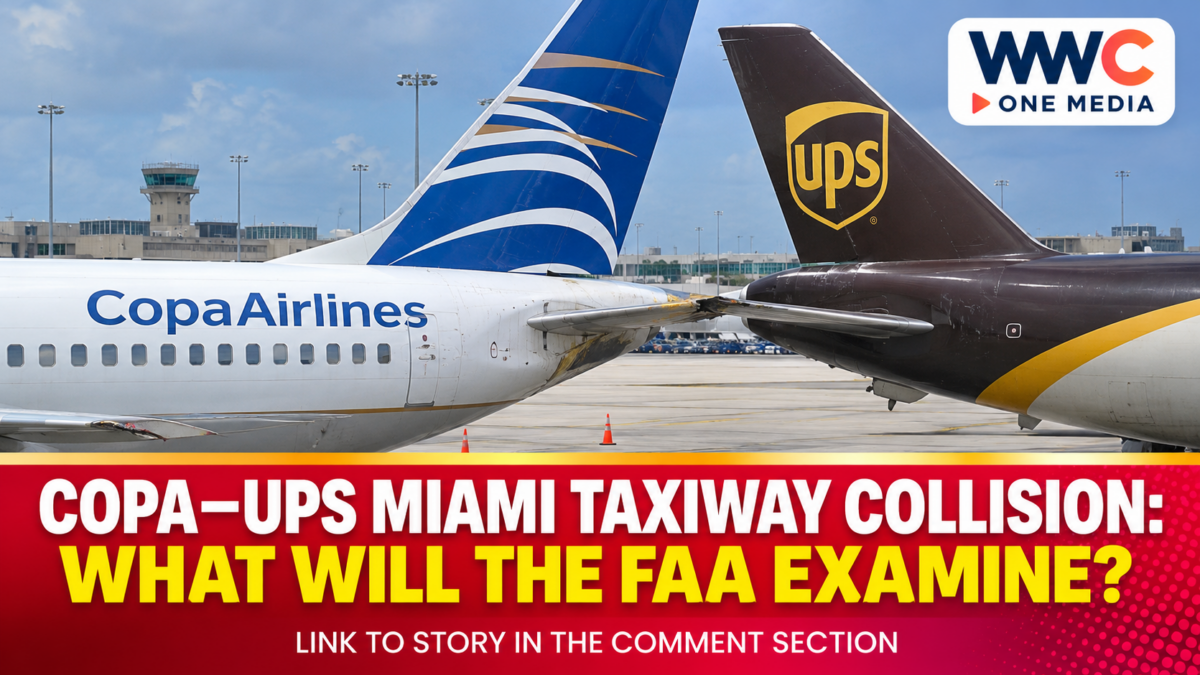
MIAMI, United States — Nov. 15, 2026. A Copa Airlines Boeing 737 struck a UPS Boeing 767 while both aircraft were taxiing at Miami International Airport on Saturday, Nov. 14, US aviation regulators confirmed. The Federal Aviation Administration (FAA) said the passenger jet’s wingtip made contact with the cargo aircraft’s nose at around 9 p.m. local time and opened an investigation.
The Copa–UPS Miami collision brings attention to an easily overlooked part of air safety: the movement of aircraft after landing and before takeoff. The public notice establishes the contact and the aircraft movements, but it does not identify a final cause or disclose a verified injury count, damage assessment or return-to-service timetable.
What the FAA confirmed about the Copa–UPS Miami collision
The FAA’s preliminary incident statement identifies a Copa Airlines Boeing 737 and a UPS Boeing 767. It says the Copa aircraft was taxiing towards its gate while the UPS aircraft was taxiing for departure to Bogotá, Colombia.
The regulator also says air traffic controllers had instructed the UPS crew to give way to the Copa flight. The statement establishes that the aircraft made contact while taxiing, not during takeoff, approach or landing.
That distinction matters for readers following early accounts of an aviation incident. The location and stage of flight affect which operating procedures investigators may examine. A taxiway event cannot automatically be evaluated as though it involved an airborne collision or a runway landing manoeuvre.
The FAA’s description is preliminary. It confirms the sequence at a broad level without publishing the precise taxiway location, aircraft registration numbers, cockpit recordings or a finding that any particular person was responsible.
Why movement on the ground requires careful coordination
Aircraft taxiing between gates and runways share a network of paved routes. Crews must follow instructions, maintain situational awareness and keep clear of other aircraft, vehicles and restricted operating areas.
The FAA’s published guidance for tower-controlled airports describes the use of air traffic instructions to manage appropriate ground routes. Its controller procedures also emphasise the role of known traffic and airport conditions when providing service.
For this incident, one question is how the instruction to give way was understood and carried out. Other questions may concern aircraft position, visibility from the cockpit, available clearance and the timing of movements. These are investigative questions, not findings about either crew.
A statement that controllers gave a particular instruction is not, by itself, a complete determination of fault. Establishing responsibility requires a fuller factual record than an initial public notice.
Why Miami’s airport traffic makes the review important
Miami International Airport combines substantial passenger traffic with major cargo operations. Its airport authority reported 55.3 million passengers and nearly 3.5 million tons of cargo in 2025, illustrating why passenger and freight aircraft regularly use the same airport operating environment.
Those figures describe the airport’s annual scale; they do not show that congestion contributed to Saturday’s incident. It would be misleading to infer that a busy airport caused the contact simply because many aircraft use its facilities.
The distinction between operating context and causation also matters in aviation coverage. WWC has separately examined a Singapore Airlines diversion involving a reported cabin-smoke concern, a different kind of event requiring its own evidence and technical review.
From a safety perspective, the immediate task is to determine exactly what happened on the ground in Miami rather than draw conclusions from the airport’s size or earlier incidents elsewhere.
What the incident does not yet establish
The FAA has not supplied a confirmed public injury count in the incident notice reviewed for this article. It also has not identified the full extent of aircraft damage, the number of people aboard either plane, or the inspection results.
The agency has not named a final cause. That means assertions about crew error, controller error, mechanical faults or poor airport design would go beyond the available primary record.
The FAA directs questions about passengers, crews, flights and schedules to the airlines. Any claims about whether a particular traveller was rebooked or whether cargo was transferred would therefore require further direct confirmation.
Aviation investigations can evolve as flight records, aircraft positions and operational communications are reviewed. A preliminary statement is useful because it fixes some essential facts, but it should not be mistaken for a final safety report.
Did the US ground stop play a role?
The Miami contact came one day after a separate nationwide US air-traffic disruption. The US Department of Transportation said telecommunications problems affecting the stability of air traffic control communications and radar systems prompted a precautionary ground stop on Nov. 13.
The department said airspace reopened at 8:15 p.m. Eastern Time that day. On Nov. 14, it warned that passengers could still face delays and cancellations as airlines restored schedules. WWC has documented the official timeline of the nationwide FAA ground stop and examined the aviation technology questions raised by that disruption.
However, the FAA’s Miami collision statement does not connect the taxiway contact with the earlier telecommunications problem. Their proximity in time is not evidence that they share a cause.
This is an important safeguard against a misleading narrative: a systemwide disruption and an aircraft ground collision may both concern aviation safety while still being operationally unrelated.
What happens next
The FAA has confirmed that it is investigating. The most useful next public update would clarify the ground movements, the condition of both aircraft, any operational restrictions and whether additional corrective measures are warranted.
In analysis, the incident underscores why airport safety depends on routine coordination as much as on aircraft performance in flight. Clear instructions, careful compliance and reliable information all matter on the surface. The investigation—not an early assumption—will determine which elements were relevant in Miami.
For passengers, the practical advice is straightforward: consult the operating airline directly for an affected booking. For everyone else, the central unanswered question remains what the complete record will reveal about how two aircraft came into contact during normal ground movements.
Frequently asked questions
What happened between Copa Airlines and UPS in Miami?
The FAA confirmed that the wingtip of a Copa Airlines Boeing 737 struck the nose of a UPS Boeing 767 while both were taxiing at Miami International Airport on Nov. 14, 2026.
Was the collision on a runway?
The FAA described a collision while taxiing. Its statement did not identify a runway collision or provide the precise taxiway location.
Were there injuries?
The FAA’s incident notice reviewed for this report did not give an injury count. An official confirmation from the airline or relevant emergency authority is needed before stating a figure.
Who was responsible for the collision?
No final responsibility determination was published in the FAA notice. It said controllers instructed the UPS crew to give way, but an investigation is still underway.
Was the incident caused by the nationwide FAA ground stop?
The FAA has not linked the two events. A connection should not be assumed merely because they occurred on successive days.