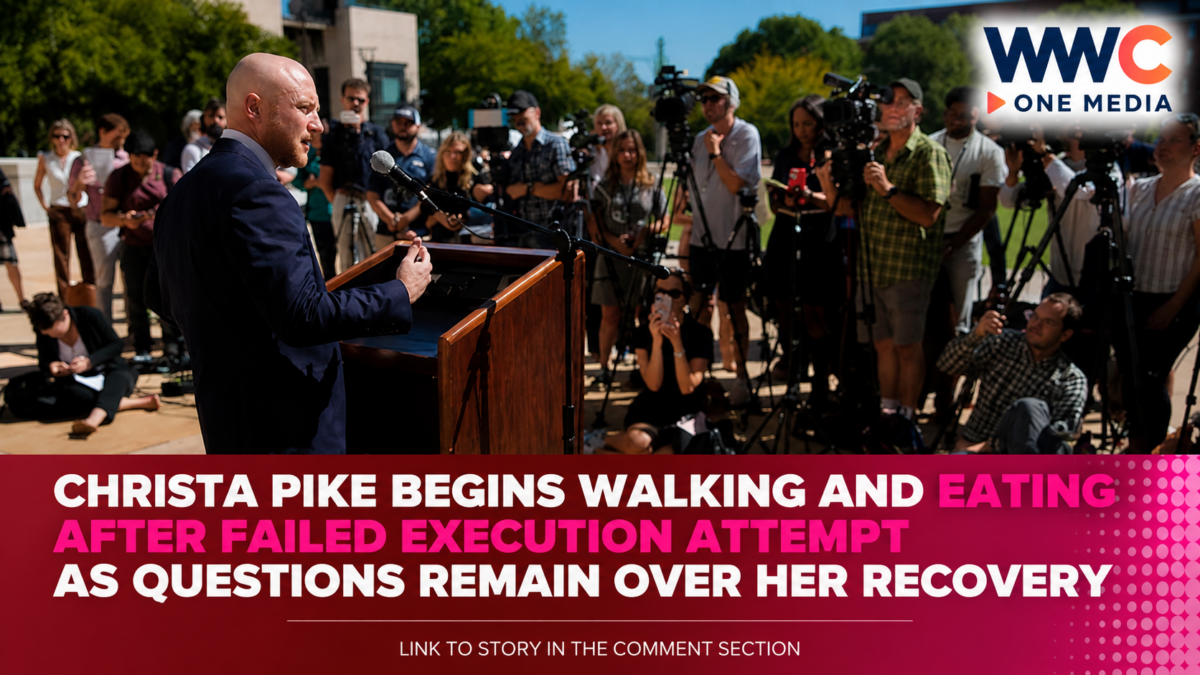
NASHVILLE, Tennessee — Christa Pike, a 50-year-old death row inmate who survived a failed lethal injection in Tennessee, has begun walking with assistance and eating again in hospital, marking a significant development in her recovery more than a week after the state attempted to execute her.
Pike’s attorneys said on Thursday (Oct. 8) that she had taken limited steps with help and regained some mobility in her arms after surviving two doses of the execution drug pentobarbital on Sept. 30.
The update represents a notable change from the first days after the attempted execution, when Pike was unconscious, placed on a ventilator and critically ill. Her lawyers said doctors had not yet determined whether she would suffer lasting physical or cognitive injuries.
Physical recovery improves, but long-term effects remain uncertain
Pike’s legal team described her physical recovery as remarkable but cautioned that it was too early to determine the full extent of the damage.
According to her attorneys, she was able to eat for the first time since the execution attempt and was beginning to regain movement in her arms. She continued to experience pain from burns and blistering around the injection sites.
Her lawyers said the injuries had caused substantial tissue damage, affecting her ability to use her hands. Even simple tasks, including holding a pen to sign documents, had reportedly become difficult.
Pike also continues to experience problems with concentration and memory. Her attorney Stephen Ferrell said she can lose track of her thoughts and struggle to remember what she intended to say.
Medical professionals have advised that it could take months to understand whether she has sustained permanent cognitive injuries. Her psychological recovery is another concern, with her legal team describing her as deeply traumatised by the experience.
Lawyers had feared she would not survive
The latest update follows several days of uncertainty over Pike’s condition.
After the Sept. 30 execution attempt, she was taken from Tennessee’s Riverbend Maximum Security Institution to a hospital in Nashville, unconscious and critically ill.
Her attorneys said they were told on Monday that Pike was believed to be brain-dead and that life support might be withdrawn. However, she regained consciousness on Tuesday and began speaking, surprising both her legal team and medical personnel, according to her lawyers.
When she first awoke, she reportedly appeared confused and asked people around her questions about where she was and who they were.
By Wednesday, her attorneys said she was aware that the state had attempted to execute her. They also described her as angry and confused about what had happened.
Her ability to speak, walk with assistance and eat has since offered signs of physical improvement, although the extent of her recovery remains unclear.
What went wrong during the lethal injection?
Pike was scheduled to be executed on Sept. 30 for the 1995 killing of 19-year-old Colleen Slemmer, a classmate she was convicted of torturing and murdering when she was a teenager.
During the execution procedure, officials administered two doses of pentobarbital, a drug used in lethal injections. Pike survived, but her attorneys say the drugs caused severe injuries to her arms.
The precise reason the procedure failed has not been publicly established.
Pike’s lawyers have raised concerns about whether the intravenous lines were correctly placed, arguing in court filings that the execution team may have failed to recognise problems with the lines. They suspect that some of the drug may have entered surrounding tissue rather than being properly delivered into her bloodstream.
That explanation remains an allegation by the defence, not a confirmed finding. Tennessee officials have not publicly provided a definitive account of what happened during the procedure.
Court orders preservation of execution evidence
Pike’s attorneys are pursuing legal action to establish what happened and preserve evidence from the failed execution.
On Wednesday, a Tennessee judge ordered state officials to preserve relevant physical and documentary evidence, including syringes, intravenous lines, needles, medical supplies, restraints and records connected to the procedure.
The order also covers relevant written and digital records that could help establish how the drugs were administered and whether execution protocols were followed.
The preservation order does not itself determine that officials acted improperly. It is intended to ensure that potentially relevant evidence remains available as the legal proceedings continue.
Pike’s legal team has argued that the incident raises serious questions about the treatment she received and whether the procedure violated constitutional protections against cruel and unusual punishment. Those claims have yet to be resolved in court.
Tennessee suspends further executions for the year
The failed attempt has also prompted wider scrutiny of Tennessee’s execution procedures.
Governor Bill Lee has postponed the state’s remaining scheduled execution for 2026 while officials review what went wrong. The state’s prison chief also resigned following the incident.
The case comes after another execution-related problem in Tennessee earlier in the year involving inmate Tony Carruthers. The incidents have renewed questions about the reliability of lethal-injection procedures and the safeguards used by prison authorities.
Meanwhile, Texas carried out an execution on Wednesday, marking the first execution in the United States since Pike survived Tennessee’s failed attempt.
Lawyers seek commutation to prevent another attempt
Pike’s legal team has said it will urge Governor Lee to commute her death sentence to life imprisonment without the possibility of parole.
Her attorneys argue that she should not be subjected to another execution attempt after the physical injuries and psychological trauma they say she suffered during the Sept. 30 procedure.
It remains unclear whether Tennessee will attempt to carry out the sentence again. State officials have not announced a new execution date.
The legal consequences of surviving a failed execution, including whether another attempt can proceed and what remedies may be available, remain unresolved in Pike’s case.
For now, her attorneys say the immediate priority is her recovery and understanding the long-term consequences of the procedure.
A recovery that remains far from complete
Pike’s progress from unconsciousness to speaking, eating and walking with assistance has been a significant development. But her lawyers have stressed that these improvements do not mean she has recovered fully.
She continues to face pain, impaired arm movement and difficulties with concentration and memory. Her doctors will need more time to assess whether those problems will persist.
The case has also left unresolved questions about how the execution was carried out, whether established procedures were followed and what will happen to Pike’s death sentence.
For the moment, the latest medical update offers signs of improvement while underscoring the uncertainty surrounding both her recovery and the legal fight that lies ahead.