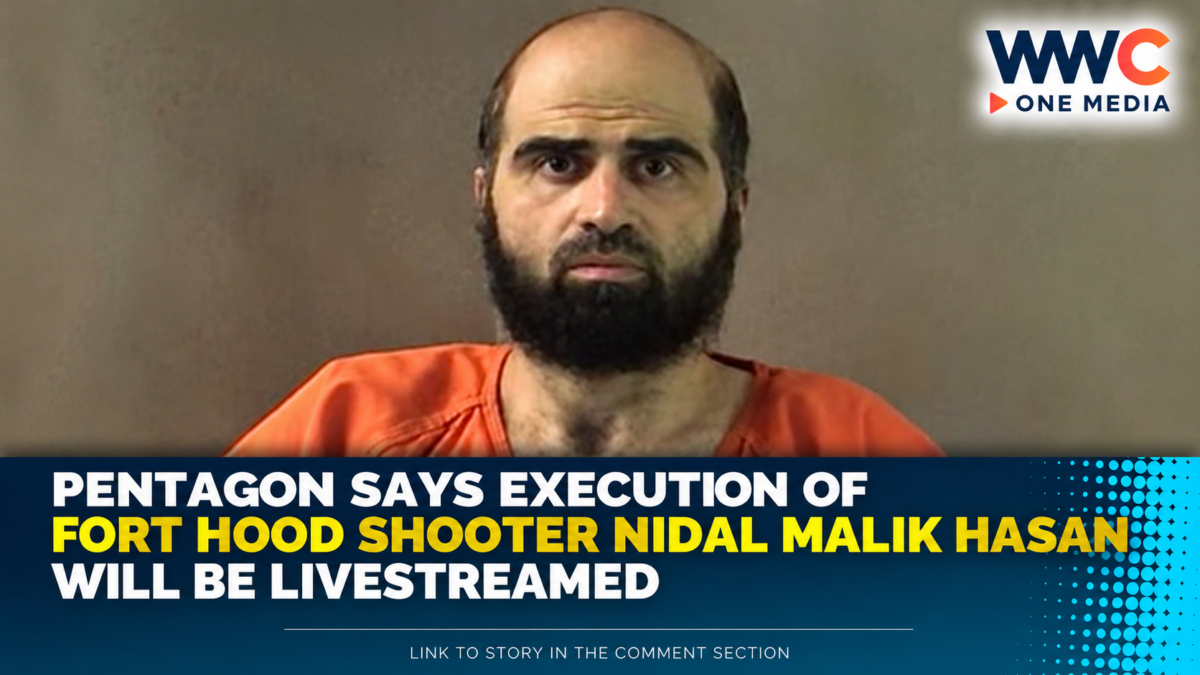
WASHINGTON, D.C. — The US military plans to livestream the execution of Nidal Malik Hasan, the former Army psychiatrist convicted of killing 13 people in the 2009 Fort Hood shooting, the Pentagon has confirmed, introducing an unprecedented element of public access to a military execution in modern American history.
Hasan is scheduled to be executed by firing squad at Fort Hood, Texas, on Dec. 3, 2026, following approval of the execution by US President Donald Trump earlier this week. The Pentagon said details of the planned livestream would be announced later.
The decision has drawn attention to the US military’s use of capital punishment, the legal questions surrounding public executions and the government’s rationale for broadcasting an event that has traditionally been conducted out of public view.
Pentagon confirms plans for public broadcast
The announcement followed remarks by Defence Secretary Pete Hegseth, who said the government intended to make the execution accessible to the public.
Hegseth said the broadcast would allow people to witness the consequences of serious crimes. A Pentagon official subsequently confirmed that the execution would be livestreamed, although officials have not yet disclosed the platform, viewing arrangements or whether access would be unrestricted.
The plan would mark a significant departure from modern US execution practices. Although executions are sometimes witnessed by selected officials, journalists and relatives of victims, the public has generally been excluded from viewing the procedures directly.
Legal experts have questioned whether broadcasting a government-sanctioned execution raises additional concerns about the dignity of the condemned prisoner, the purpose of public exposure and the limits of government authority.
Some argue that public access could provide transparency about how capital punishment is carried out. Others warn that livestreaming risks turning an execution into a spectacle rather than a legal procedure.
Hasan was convicted over the 2009 Fort Hood shooting
Hasan, a former US Army major and psychiatrist, was convicted by a military jury in 2013 for the shooting at Fort Hood, now known as Fort Cavazos, in Texas.
On Nov. 5, 2009, he opened fire inside a medical processing facility at the military installation, where soldiers were preparing for deployment. The attack killed 13 people and injured 32 others, making it one of the deadliest shootings ever to occur on a US military base.
Hasan was found guilty of 13 counts of premeditated murder and 32 counts of attempted premeditated murder. He was sentenced to death in August 2013.
During the court-martial, Hasan represented himself and acknowledged that he was responsible for the shooting. He argued that he had acted to prevent US soldiers from deploying to Afghanistan and fighting Muslim insurgents.
He was shot by law enforcement officers during his arrest and was left partially paralysed, later using a wheelchair.
His execution would follow more than 13 years on military death row, although further legal proceedings could affect whether the scheduled date proceeds as planned.
Trump approved execution by firing squad
The Trump administration approved Hasan’s execution earlier in October following a recommendation from Hegseth.
Under US military law, a president must approve a military execution by firing squad. The planned method is particularly notable because the US military has not carried out a firing-squad execution since 1945, according to historical records cited by news organisations.
The last execution by the US military occurred in 1961, when Army Private John Bennett was executed by hanging. If Hasan’s execution proceeds, it would be the first military execution in more than 65 years and the first by firing squad in more than eight decades.
Firing squads remain an authorised method of execution in a small number of US states. Their use has attracted renewed attention as some jurisdictions face difficulties obtaining lethal-injection drugs and carrying out injections reliably.
The planned military execution comes amid fresh scrutiny of execution procedures following a failed lethal-injection attempt in Tennessee in September that left death-row inmate Christa Pike alive and hospitalised. That separate case has intensified debate about the methods used by US authorities to carry out death sentences.
Legal experts question livestreaming decision
The Pentagon’s announcement has prompted questions about the legal and ethical implications of broadcasting an execution to a general audience.
Military-law experts have noted that Hasan could pursue further legal action to challenge aspects of the execution or seek to prevent a public broadcast. Such proceedings could delay the scheduled date, although it remains unclear whether he intends to file additional challenges.
The courts have previously blocked efforts to televise executions, and experts say a livestream would raise questions that have not been fully addressed by the US Supreme Court.
Among the concerns are whether the broadcast could violate the condemned person’s rights, how access would be controlled and what purpose public transmission would serve beyond allowing people to watch.
Supporters of greater transparency argue that allowing the public to see an execution could provide a clearer understanding of how the government administers capital punishment. Critics counter that transparency does not necessarily require a live broadcast and that public exposure could compromise the dignity of the person being executed.
No final details about the broadcast arrangements have been announced.
Questions over access to legal counsel
The announcement has also prompted scrutiny of how Hasan was informed that his execution had been approved.
A lawyer who has represented Hasan in civil matters said Hasan told him that he was notified of the decision without an attorney physically present. The lawyer questioned whether the notification process complied with military regulations.
An Army spokeswoman said officials had made multiple attempts to contact trial defence attorneys and had followed the applicable procedures. She said Hasan had not been prevented from contacting or communicating with his lawyers.
The competing accounts have not established that military officials violated the rules. The issue may nevertheless become part of any further legal challenge concerning the execution.
It also remains unclear whether Hasan will pursue a new appeal. His earlier conduct during the court-martial, when he dismissed his lawyers and represented himself, has led observers to question how he might approach the final stages of his case.
A rare return to public executions
Public executions were once conducted in the United States before being phased out over concerns about crowd behaviour, public order and the spectacle surrounding state-sanctioned deaths.
The last widely recognised public execution in the country took place in 1936, when thousands gathered to watch the hanging of Rainey Bethea in Kentucky. Since then, executions have generally been conducted in controlled settings, with access limited to authorised witnesses.
The proposed livestream would therefore represent a major change in how the US military presents an execution to the public. It would also place the United States among a small number of jurisdictions where authorities have made executions publicly visible, although the details and circumstances differ between countries.
The plan has prompted debate over whether a broadcast would serve a public-information purpose or risk making the execution a political and media event.
December execution date remains subject to legal developments
Hasan’s execution is currently scheduled for Dec. 3 at Fort Hood, with Hegseth indicating that the procedure is planned for approximately 1pm local time.
However, the date is not a guarantee that the execution will take place as scheduled. Further legal challenges or court orders could affect the timetable, and the Pentagon has yet to release full details about the livestream.
For now, the announcement has placed Hasan’s case back in the national spotlight, reopening debate over military justice, the death penalty and the public’s role in witnessing government actions.
The central questions remain whether the execution will proceed on schedule, what legal safeguards will apply to the broadcast and how the government will justify making a military execution available for public viewing.