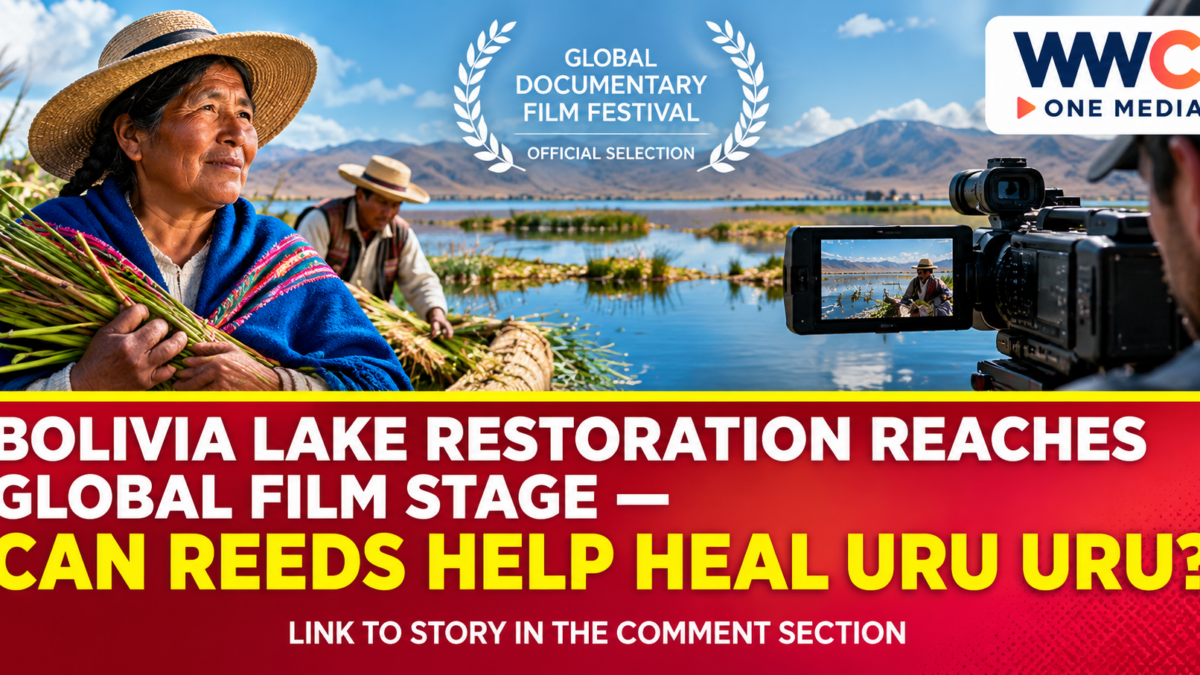
SINGAPORE — Nov. 14, 2026. A documentary about Bolivian conservation leader Dayana Blanco Quiroga and efforts to restore Lake Uru Uru was among five finalists screened at the Bloomberg Green Docs programme in New York on Nov. 13. How to Plant a Lake follows a community initiative using Indigenous knowledge and aquatic plants to address pollution in a high-altitude wetland.
The screening offers a chance to examine the distinction between undertaking an environmental intervention and proving that an entire ecosystem has recovered. Project organisations document planting, community involvement and bird monitoring, but do not establish that all contamination has been eliminated.
Bolivia Lake Restoration Reaches a Global Audience
The competition organiser announced How to Plant a Lake / Cómo plantar un lago as a finalist on Nov. 6 and identified Satomi Blair and CG Foisy as its filmmakers. It scheduled a screening of all five finalist documentaries during DOC NYC on Nov. 13, with a $25,000 grand prize to be announced at the event.
The film producer, The World Around, independently listed the New York screening and described the film as part of its Young Climate Stories series, produced with 4Hawk. The series documents young people addressing environmental challenges in their communities.
A distinction matters for the news record. The accessible official competition announcement confirms finalist status, not the result announced after the ceremony. No primary post-event results announcement establishing which film received the grand prize was accessible in this review. This article therefore does not claim the Bolivian film won that prize.
That limitation does not diminish the public significance of a film selected for an international climate programme. It does prevent an award from being described as a confirmed fact without the necessary record.
Who Is Dayana Blanco Quiroga?
The World Around identifies Blanco Quiroga as a young Aymara conservation leader working with Team Uru Uru and mentor Sebastián Acampante. The programme uses floating structures planted with totora reeds to help address the lake’s damaged environment.
A separate 2026 award profile from conservation organisation Future For Nature identifies Blanco Quiroga as a recipient of its own environmental award. It describes Uru Uru as a high-Andean wetland affected by mining runoff, plastic waste and climate change.
The film producer describes seven Indigenous communities connected to the lake and habitat associated with 76 bird species. Those figures indicate the stakes of the restoration effort; they do not measure the number of people already benefiting from safe water or prove that wildlife populations have recovered throughout the wetland.
Future For Nature identifies Andean, Chilean and James’s flamingos among the birds connected to the habitat. The project’s goals include preserving breeding and feeding areas and training community members to monitor changes across the shoreline.
How Totora Reeds Are Being Used
The conservation profile identifies totora as Schoenoplectus californicus and describes its use as a native plant that can help filter contaminants while offering habitat for birds. The team is applying a practice rooted in Indigenous knowledge to a modern water-quality challenge.
In a producer-published October discussion following a documentary screening, Blanco Quiroga explained that the team had partnered with a university to test water near planted areas. That adds an important scientific element to the story because visible plant growth is not, by itself, a laboratory measurement of contamination.
There is an essential distinction between a plant’s potential to absorb particular pollutants and the measured safety of a lake. Repeated water and sediment testing, suitable comparison locations and monitoring over time would be necessary to establish changes in contamination levels.
WWC’s earlier analysis of Philippine mining rehabilitation and ecological recovery examined why a count of planted vegetation cannot establish that an ecosystem has fully recovered. That Philippine case is unrelated to the Bolivian project but raises a comparable measurement problem.
What Has the Restoration Project Achieved?
Future For Nature’s profile credits Blanco Quiroga and her team with restoration work along 10 kilometres of shoreline and the planting of 6,000 totoras in degraded areas. It also reports observations of all three flamingo species returning to the restored sections.
Those figures are project-reported accomplishments published by a conservation award body, not independently audited evidence that the whole lake has recovered. The same profile describes plans to expand planting and monitoring, which should be distinguished from completed work.
An effective assessment would track reed survival, water quality, ecological conditions and the presence of wildlife across seasons. Those indicators answer different questions. A bird sighting may signal that usable habitat exists, while contamination levels require testing.
The distinction is familiar in Philippine habitat protection. WWC’s coverage of mangroves documented on Lawak Island described why repeated field verification is needed to understand how vegetation establishes and survives. Its marine setting is different from Lake Uru Uru, but both situations depend on monitoring beyond a single observation.
What This Could Mean for Philippine Environmental Action
Analysis: Community-led ecological repair can be valuable even before a complete restoration outcome is proven. This initiative brings together knowledge of local plants, practical collaboration and scientific checks. It does not remove the need for policies that stop additional pollution entering a waterway.
For communities near mines, rivers and coastlines, those are separate challenges. A cleanup project may address legacy waste, while enforcement and prevention must reduce new releases. Neither can substitute entirely for the other.
WWC’s report on monitoring after the Bataan oil spill similarly distinguished the removal of visible pollution from proof that every environmental risk has disappeared. The pollutants and locations differ; the need for evidence-based follow-up remains relevant.
An international film screening can attract attention to the work of people living with environmental damage. It cannot replace public data about water conditions, regulatory compliance and whether restoration continues after the cameras leave.
What Happens Next
The useful next milestones are repeated water-quality measurements, documented plant survival, further wildlife monitoring and official action addressing pollution sources. Such evidence would clarify whether community methods can be sustained and expanded.
As for the film competition, the public records inspected verify finalist status and the Nov. 13 screening. A separate official result is still required before reporting a Green Docs grand-prize victory. The longer-term story is whether Lake Uru Uru’s restoration can be sustained through community participation and lasting pollution controls.
Frequently Asked Questions
What is How to Plant a Lake about?
It follows Dayana Blanco Quiroga and Team Uru Uru as they use native reeds and community monitoring to rehabilitate a polluted Bolivian wetland.
Did the film win the 2026 Bloomberg Green Docs prize?
It was an officially announced finalist. The post-ceremony winner announcement was not independently verified from an original competition record in this review.
Can totora reeds clean polluted lake water?
The project uses the reeds to help filter contaminants and restore habitat. Confirmation that water quality has improved requires scientific measurements over time.
Why is Lake Uru Uru important?
The conservation organisations describe a high-altitude wetland linked to Indigenous communities and many bird species, including three flamingo species.