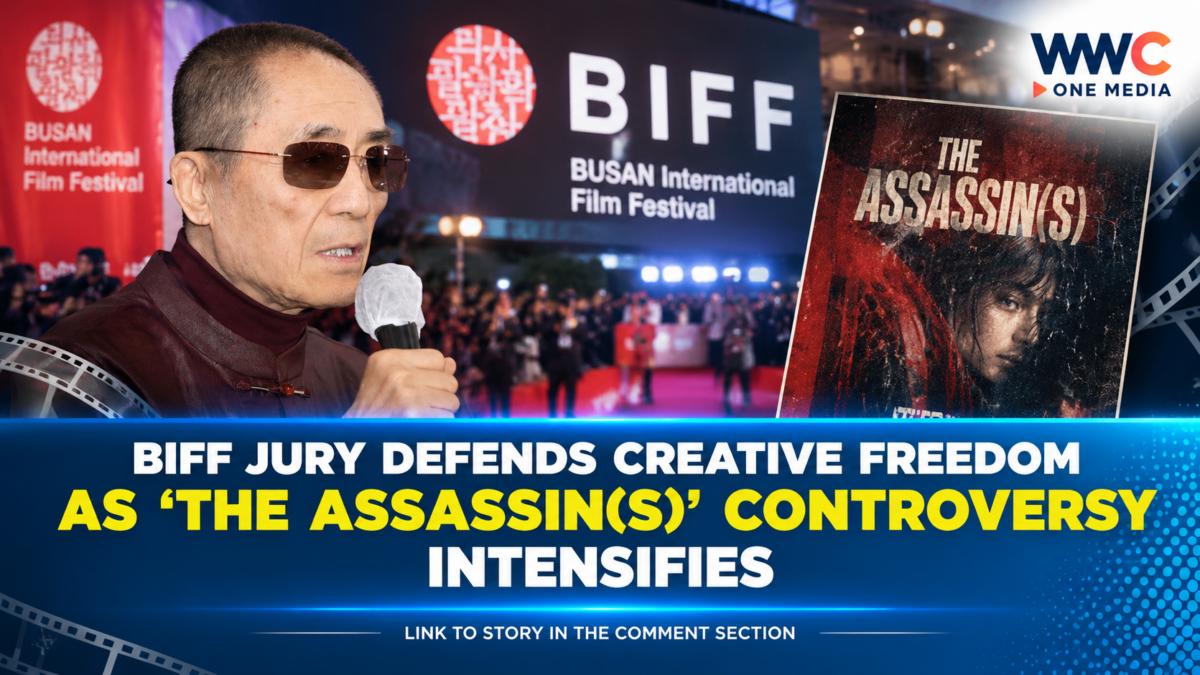
BUSAN, South Korea — The heated debate surrounding the Korean historical film “The Assassin(s)” has reached the Busan International Film Festival, where renowned director Zhang Yimou and fellow competition jurors urged audiences to protect artistic freedom while allowing room for criticism.
Speaking at a BIFF press conference on Wednesday, Zhang, who serves as president of the festival’s competition jury, addressed the increasingly blurred line between historical fact and cinematic interpretation.
Zhang emphasized that films should not necessarily be treated as strict reproductions of history, arguing that cinema can reinterpret the past and encourage audiences to form their own perspectives.
He also acknowledged that historical truth itself can sometimes become a subject of debate, making different interpretations part of what gives cinema its cultural value.
Importantly, Zhang said he had not watched “The Assassin(s)” himself, although he was aware of the controversy surrounding the movie.
The film dramatizes the 1974 assassination attempt against then-President Park Chung-hee, during which his wife, First Lady Yuk Young-soo, was fatally shot. The movie has faced strong criticism from conservative political groups and civic organizations, which accuse it of presenting a distorted interpretation of the historical incident.
The dispute has escalated beyond film criticism, with conservative groups filing a defamation complaint against the filmmakers. Police investigations followed, while some critics have called for the movie to be removed from theaters.
Filmmakers Warned Against Being Intimidated
Korean director July Jung, another member of the BIFF competition jury, said the backlash has created an uncomfortable atmosphere for filmmakers.
Jung stressed that movies are ultimately works of artistic creation, while acknowledging that directors remain responsible for the stories and fictional worlds they put before audiences.
She said filmmakers should be able to face criticism and differing opinions without being intimidated from creating new work.
Her comments echo concerns previously raised by Korean filmmaking organizations, which warned that personal attacks and threats against cast and crew had gone beyond legitimate criticism of the movie itself.
The controversy has already affected the film’s presence at BIFF. The cast and crew canceled scheduled festival appearances because of safety concerns, while lead actor Yoo Hae-jin has also faced protests connected to the dispute.
BIFF Competition Looks Beyond the Controversy
While “The Assassin(s)” has become one of the festival’s most politically charged talking points, BIFF’s competition jury is focused on a much broader mission: recognizing ambitious Asian filmmaking.
Chinese director Bi Gan, another juror, said he looks for films that are bold, emotionally direct and willing to push creative boundaries.
Vietnamese producer Tran Thi Bich Ngoc likewise highlighted BIFF’s role in helping emerging Asian filmmakers reach wider international audiences.
Now in its second year, BIFF’s main competition features 14 films competing for the Busan Award, with a seven-member jury led by Zhang Yimou.
The controversy surrounding “The Assassin(s)” therefore raises a question that extends well beyond one movie: how far can filmmakers go when transforming real historical events into fiction — and where should artistic freedom meet historical responsibility?
For BIFF’s jury, the answer appears to leave room for both creative expression and public debate, rather than shutting either side out.
WWC ONE MEDIA G,A