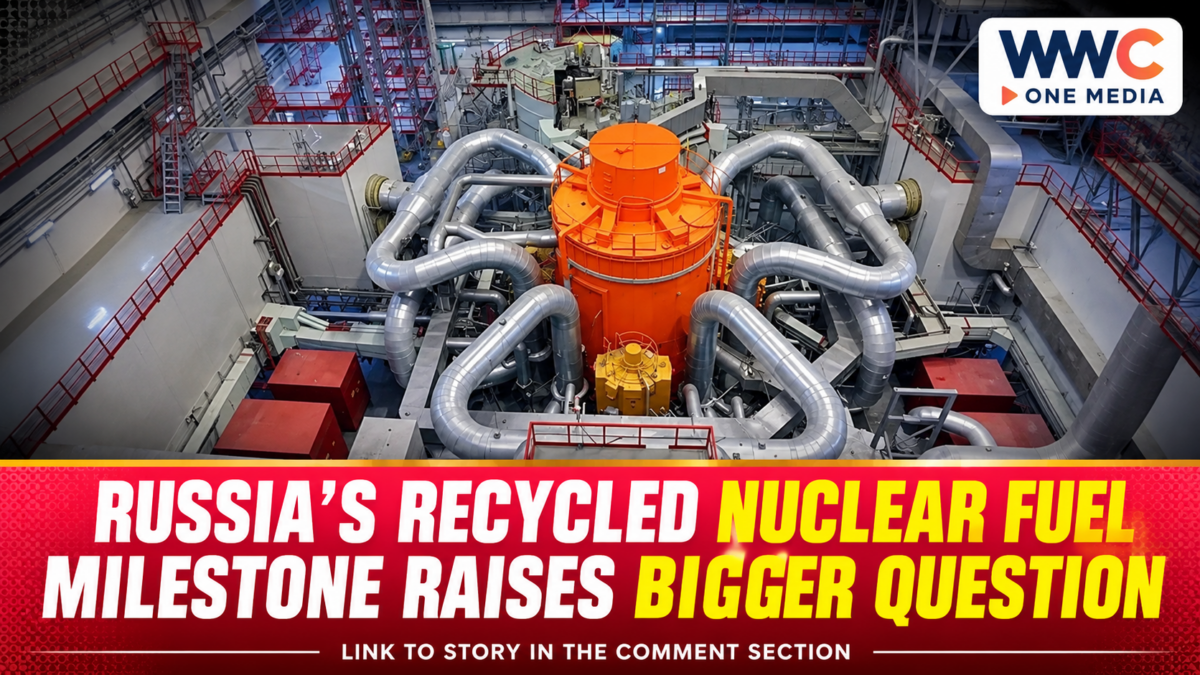
Russia’s state nuclear corporation Rosatom has started an operational phase for an experimental assembly of twice-recycled nuclear fuel in the BN-800 fast-neutron reactor at the Beloyarsk Nuclear Power Plant, according to a company press release dated Nov. 25, 2026. The development places renewed attention on whether advanced reactors can extract more energy from nuclear materials that would otherwise require further processing or storage.
The experiment is significant because the plutonium used in the new uranium-plutonium mixed-oxide, or MOX, fuel was recovered from an irradiated fuel assembly that had already completed a full operating cycle in the same reactor. Rather than simply introducing fuel made from material recovered from another reactor, the process sends recovered material through another stage of use.
The announcement comes as China continues expanding its nuclear power fleet and several countries pursue advanced reactor designs. But the milestone should be understood in its proper context: a successful experimental fuel assembly is not the same as proving that an entire national nuclear industry can operate indefinitely on a fully closed fuel cycle.
How Russia’s recycled nuclear fuel experiment works
The BN-800 is a sodium-cooled fast-neutron reactor located at Unit 4 of the Beloyarsk Nuclear Power Plant in Russia. Its fuel strategy uses MOX, a mixture of uranium and plutonium oxides.
In conventional nuclear power generation, fuel is irradiated inside a reactor and eventually removed when it can no longer be used in the same operating cycle. Some of the material in spent fuel can be recovered through reprocessing. That recovered material may then be used to manufacture new nuclear fuel.
Rosatom’s latest announcement describes another stage in that process. The plutonium used for the experimental assembly was recovered from a MOX assembly that had already completed a full cycle inside the BN-800 itself.
The distinction matters. It moves beyond the earlier practice of recovering plutonium from spent fuel produced by conventional thermal reactors and introducing it into a fast reactor. The latest process involves recovering material from fuel that has already been used in the fast reactor.
Rosatom says the new assembly was manufactured using an optimised plutonium-recovery process that reduced the number of processing steps while maintaining fuel quality. The company also said the loading work was coordinated with Russia’s nuclear regulator, Rostechnadzor.
The experimental assembly must still be evaluated through its operation. The announcement does not provide a complete public performance record covering multiple future fuel cycles.
Why fast reactors matter to the nuclear industry
Fast-neutron reactors are designed to use fast neutrons to sustain the nuclear chain reaction. Their fuel-cycle potential differs from that of conventional light-water reactors, particularly when combined with reprocessing and the reuse of uranium and plutonium.
The potential benefit is more efficient use of nuclear materials. Reusing recovered material could reduce demand for newly mined uranium and change the amount and composition of waste requiring long-term management.
However, recycling does not make radioactive waste disappear. Reprocessing creates additional technical, industrial and safety requirements. The fuel must be manufactured, transported, handled and used under strict controls. The economics also depend on the costs of reprocessing facilities, fuel fabrication, reactor operation and waste management.
The International Atomic Energy Agency has documented the wider technical development of fast reactors. In a 2026 technical presentation, researchers described Russia’s BN-800 as a commercial fast reactor and China’s CFR600-1 as an operating prototype. The same material identified the different reactor programmes as part of the global development of fast-reactor technology.
The comparison shows that Russia is not the only country pursuing this field. It also illustrates why a single fuel experiment should not be treated as proof that one country has an uncontested technological advantage.
China’s nuclear expansion adds another dimension
China’s nuclear programme is growing at a substantial scale.
The IAEA’s 2026 Country Nuclear Power Profile, using data from its Power Reactor Information System as of Nov. 27, lists 60 operating nuclear power reactors in China, with a combined net capacity of 58,721 megawatts. It also records 37 reactors under construction, representing 39,952 megawatts of net capacity.
Those figures demonstrate the size of China’s current construction pipeline. They do not, by themselves, establish that every project will be completed on schedule or that China leads in every advanced reactor technology.
Russia and China are developing different strengths. Russia has a long-running fast-reactor programme and is pursuing fuel recycling through the BN-800 and the planned BN-1200M. China, meanwhile, has a much larger number of reactors under construction and is developing its own fast-reactor technology.
The two countries therefore offer different examples of how nuclear development can proceed: through specialised fuel-cycle research and through large-scale deployment of power-generating capacity.
The industrial challenge extends beyond the reactor
A nuclear fuel-cycle breakthrough is only one part of a much larger industrial system.
To turn repeated recycling into a dependable energy strategy, a country needs facilities capable of reprocessing spent fuel, producing new fuel assemblies, maintaining reactor operations and managing radioactive waste. It also needs regulatory oversight, trained personnel, reliable supply chains and long-term financing.
These requirements are relevant to countries considering nuclear power for the first time. The Philippines, for example, is assessing how nuclear generation could fit into its future electricity mix. WWC’s earlier report on the country’s small modular reactor options and electricity planning examined the difference between studying reactor technologies and having a commercially approved, financed and operating facility.
The same distinction applies to advanced fuel recycling. A technical achievement may improve the prospects of a technology, but it does not automatically establish its commercial competitiveness or suitability for another country.
Nuclear projects also depend on the quality of safety oversight and infrastructure. The importance of those systems is evident in WWC’s coverage of the electricity connections needed to maintain nuclear safety in Ukraine. Reactor design and fuel efficiency cannot be assessed separately from the systems needed to operate a plant safely.
What this could mean for future nuclear energy
Rosatom presents the BN-800 experiment as a step towards a closed nuclear fuel cycle and future Generation IV reactors, including the BN-1200M. The company says pre-project work has begun for that planned unit at Beloyarsk.
If repeated recycling can be demonstrated reliably and economically at larger scale, it could help nuclear operators make greater use of recovered materials. That possibility is important as governments consider how to expand low-carbon electricity generation while managing fuel resources and radioactive waste.
But several questions remain. The public announcement does not establish how many repeated cycles the new assembly can complete, the commercial cost of the full process, or the amount of waste reduction achieved under sustained industrial operation.
It also does not establish that the technology can be transferred directly to conventional reactor fleets without major changes to infrastructure and regulation.
For China, the immediate challenge is different: managing a large construction programme while maintaining safety, quality and reliable operation across a growing fleet. For Russia, the test is whether its fast-reactor and fuel-recycling programme can move from technical milestones to repeatable, economically viable deployment.
The broader nuclear competition is therefore not simply about which country builds the most reactors. It is also about who can operate them safely, manage their fuel, finance the infrastructure and deliver dependable electricity over decades.
What happens next
The next meaningful test for Rosatom is the operating performance of the experimental fuel assembly in the BN-800 reactor. Further technical information would be needed to assess how the fuel behaves over time and whether the recovery and manufacturing process can be repeated at industrial scale.
The company has identified the BN-1200M as a future development target, but its commercial operation remains a future objective rather than an accomplished milestone.
China’s construction programme will also remain important to the global nuclear outlook. The IAEA’s reactor database provides a way to track how many projects move from construction into operation, rather than treating announced capacity as completed generation.
For now, Russia’s fuel experiment is a notable technical development. Its long-term importance will depend on evidence from continued operation, regulatory oversight and the economics of the complete fuel cycle.
Frequently asked questions
What is recycled nuclear fuel?
Recycled nuclear fuel is made using materials recovered from previously used nuclear fuel. Reprocessing can recover uranium and plutonium for use in new fuel assemblies.
What is the BN-800 reactor?
The BN-800 is a sodium-cooled fast-neutron reactor at Unit 4 of Russia’s Beloyarsk Nuclear Power Plant. It uses uranium-plutonium mixed-oxide fuel.
What makes Rosatom’s latest fuel experiment different?
The experimental fuel assembly uses plutonium recovered from an irradiated MOX assembly that had already completed a full operating cycle in the same BN-800 reactor.
Does nuclear fuel recycling eliminate radioactive waste?
No. Recycling can change how nuclear materials are used and the amount or composition of waste produced, but it does not eliminate radioactive waste or the need for safe management.
Is China also developing advanced nuclear reactors?
Yes. The IAEA’s 2026 technical material identifies China’s CFR600-1 as an operating fast-reactor prototype. The country also has a large nuclear construction programme, with 37 reactors listed as under construction in the IAEA’s Nov. 27, 2026 data.