LOS ANGELES, UNITED STATES — Google’s plan to expand artificial intelligence across its educational products is facing growing scrutiny as American school authorities and lawmakers seek greater control over the technology available to students.
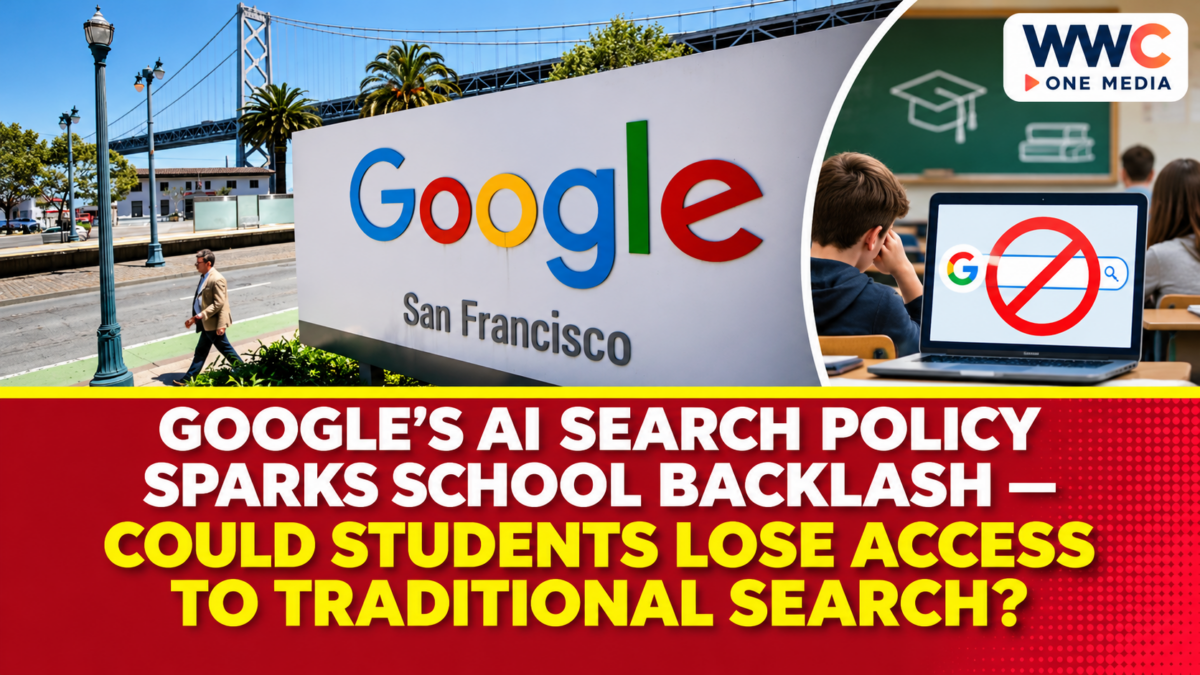
The technology company announced on Nov. 3, 2026, that access to Google Search, Gemini, Gemini Notebook and Gemini in Classroom would eventually be disabled by default for kindergarten through Grade 12 student accounts until school administrators explicitly activate them.
The Google AI search policy has raised concerns about whether educational institutions can retain access to conventional internet research tools without permitting generative AI features.
The debate presents a significant challenge for the global education technology industry: should technology companies determine how artificial intelligence is integrated into essential digital services, or should schools retain independent control over its use?
Google AI Search Policy Raises Questions About School Autonomy
Google is expanding its Guided Learning capabilities into Search and Google Classroom as part of its strategy to develop artificial intelligence products specifically designed for education.
The technology is intended to help students work through academic problems using interactive explanations and structured questions rather than immediately supplying complete answers.
However, the company’s simultaneous changes to administrative controls have created uncertainty about the availability of traditional search services for schools that restrict generative AI.
Google plans to provide further implementation details before the changes take effect.
For educational institutions, the distinction between a conventional search engine and a generative AI assistant is particularly important.
Traditional search allows students to locate websites and examine different publications. Generative AI can synthesise information into a direct response, potentially changing how students conduct research and assess evidence.
The growing importance of establishing appropriate boundaries for educational technology has also been examined in WWC ONE MEDIA’s coverage of AI adoption and unequal access to digital education.
Los Angeles Pushes for Greater Control Over Classroom Technology
The Los Angeles Unified School District, commonly known as LAUSD, has already established a broader policy direction aimed at regulating students’ exposure to digital technology.
On April 21, 2026, its Board of Education approved a resolution establishing more developmentally appropriate limits on instructional technology.
The resolution includes provisions concerning device use among younger students, student-led access to video streaming platforms and a review of existing classroom technology contracts.
The district’s Generative AI Ad Hoc Committee subsequently scheduled a meeting on Nov. 13 to examine artificial intelligence and student learning.
Research recommendations presented to the committee included maintaining restrictions on unrestricted AI tools and seeking a version of Google Search without AI-generated summaries.
The proposals reflect an educational approach that distinguishes learning assistance from technology that could perform substantial portions of a student’s academic work.
The central consideration is whether students are developing knowledge and independent reasoning rather than simply completing assignments more quickly.
US Senator Demands Answers From Google
The controversy has also attracted attention at the federal level.
On Nov. 9, US Senator Edward Markey sent a formal letter to Google Chief Executive Officer Sundar Pichai requesting clarification about the company’s plans for student access to its products.
Markey asked Google to allow schools to retain conventional search while disabling generative AI features, including AI Overviews, Gemini and Guided Learning.
He also requested information about the technical feasibility of separating these features and the research conducted into their effects on younger students.
Google was asked to respond in writing by Nov. 30, 2026.
The intervention reflects growing public-policy interest in the relationship between educational institutions and technology providers.
It does not, however, constitute a court order or an enacted federal requirement compelling Google to change its products.
The company’s response could provide greater clarity about the future options available to school administrators.
New York Raises Similar Concerns
New York City has also questioned the implications of Google’s educational technology changes.
On Nov. 12, New York City Council Speaker Julie Menin and Committee on Oversight and Investigations Chair Shekar Krishnan sent a letter to Pichai seeking clarification.
Their concerns follow a one-year moratorium on student-facing generative AI tools for children enrolled in programmes from 2-K through eighth grade, announced by New York City Public Schools in September 2026.
The council’s letter highlights concerns about academic integrity, student welfare, independent reasoning and schools’ ability to establish their own educational technology requirements.
The possibility that restricting one digital feature could affect access to another presents a wider issue for public institutions purchasing technology services.
Schools evaluating future procurement arrangements may increasingly need to consider the flexibility of administrative controls alongside hardware costs and software capabilities.
Google Presents Evidence Supporting Guided AI Learning
Google maintains that appropriately designed artificial intelligence can support learning rather than replace independent thinking.
On Nov. 3, the company published findings from a randomised controlled trial involving more than 300 University of Tokyo students.
Participants using conventional online study tools improved their statistics assessment scores by 5.3 percentage points.
Those who also received access to Guided Learning through Gemini improved their scores by 8.1 percentage points.
Google also conducted a four-week pilot involving three secondary schools in the United Kingdom, examining how teachers could incorporate Guided Learning into classroom activities.
These findings suggest potential educational benefits from structured AI assistance.
However, the University of Tokyo experiment involved university students during a short study period. Its findings cannot automatically be applied to younger children or interpreted as proof of long-term educational improvement.
The importance of establishing evidence-based boundaries for classroom technology is also evident in South Korea’s efforts to protect academic integrity amid AI-related examination concerns.
The Global Education Technology Industry Faces a Bigger Question
For educational technology providers, the debate highlights the importance of offering products that can accommodate different institutional policies.
Schools may wish to use artificial intelligence for teacher-supervised activities while restricting unrestricted chatbots or automated answers during independent assessments.
Providing flexible controls could allow technology companies to serve institutions with different educational priorities without requiring identical approaches to AI adoption.
The issue extends beyond the United States. Across Asia-Pacific, education systems are examining how artificial intelligence can support teaching while preserving appropriate safeguards.
China’s evolving approach, explored in WWC ONE MEDIA’s coverage of AI education and its emerging generation of digitally skilled students, represents another dimension of the international debate over technology integration.
For governments and educational institutions, student privacy, information accuracy, accessibility and academic independence remain important considerations.
What Happens Next?
The immediate milestone is the Nov. 30 deadline for Google’s written response to Senator Markey.
Future technical announcements will also help determine whether schools can independently manage generative AI features while retaining conventional search access.
For education authorities, the wider challenge is establishing procurement arrangements that preserve institutional control and meet students’ learning requirements.
The dispute is not simply about whether artificial intelligence belongs in classrooms. It concerns who determines when, where and how students should use it.
As educational technology becomes increasingly sophisticated, the ability of schools to exercise meaningful control over digital learning environments could become one of the most important considerations shaping the future of education.
Frequently Asked Questions
What is Google’s new AI search policy for schools?
Google has announced forthcoming changes that would require administrators to explicitly enable Google Search, Gemini, Gemini Notebook and Gemini in Classroom for K–12 student accounts.
Is Google Search already unavailable to all schools that restrict AI?
No universal shutdown has been established. Google has announced forthcoming administrative changes, with further implementation details expected.
Why is Los Angeles reviewing artificial intelligence in schools?
LAUSD is examining how digital technology affects student learning, independent thinking, academic integrity and age-appropriate educational experiences.
What is Google’s Guided Learning feature?
Guided Learning is an AI-assisted educational tool designed to help students understand academic concepts through structured explanations and interactive problem-solving.
When must Google respond to the US senator’s questions?
Senator Edward Markey requested a written response by Nov. 30, 2026.