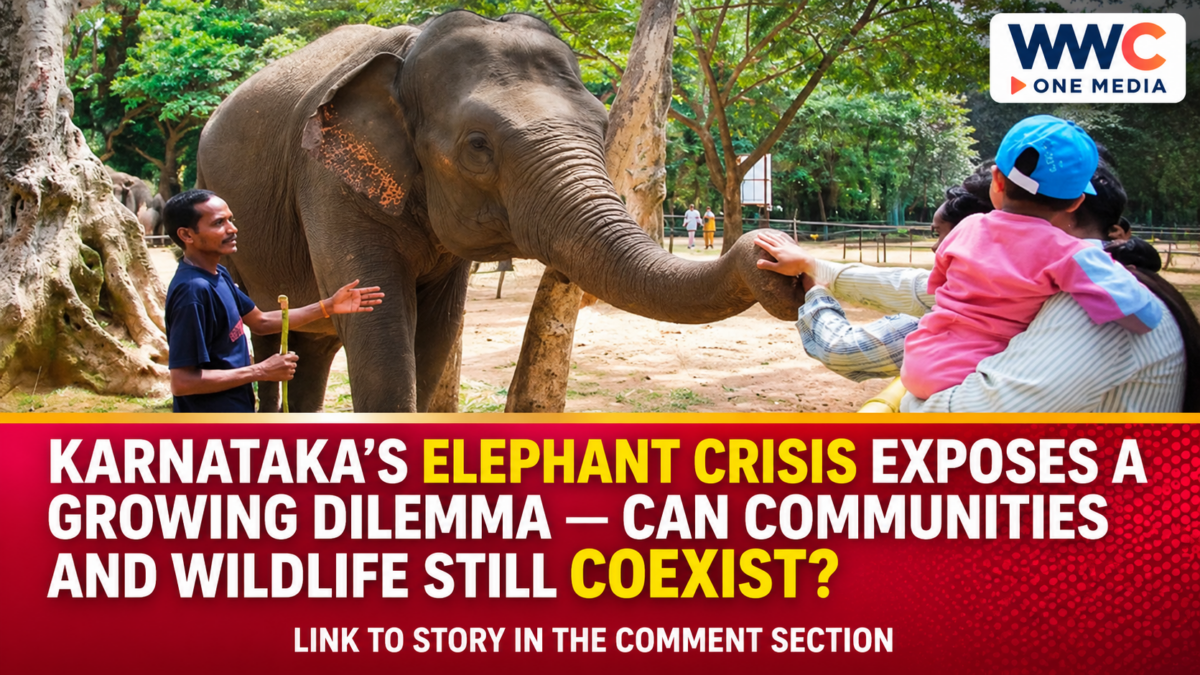
INDIA — Karnataka’s elephant crisis reflects a persistent environmental challenge confronting southern India: how to protect wild elephants while safeguarding communities living alongside their natural habitats.
A government-backed conservation assessment released in August 2026 examined human-elephant conflict in Karnataka between 2000 and 2025, identifying environmental fragmentation and infrastructure development among the pressures contributing to conflict.
The challenge extends beyond protecting an iconic animal. It involves the safety of rural communities, agricultural livelihoods, infrastructure planning and the long-term survival of India’s wildlife ecosystems.
Karnataka elephant crisis highlights the importance of connected forests
Wildlife conservation becomes increasingly complicated when natural habitats are divided into isolated areas.
Elephants require extensive landscapes to find food, access water and move between suitable habitats. Protecting individual forests without maintaining connections between them may therefore leave important conservation problems unresolved.
India’s 2026 conservation assessment examined geographical conflict hotspots, seasonal patterns, human casualties and elephant mortality.
These findings reinforce the importance of managing wildlife across entire landscapes rather than treating each encounter as an isolated emergency.
The challenge is particularly significant when wildlife protection must be balanced against the legitimate safety concerns of farming communities.
Similar concerns surrounding wildlife and public safety have emerged elsewhere in Asia, including the Perak tiger incident involving an endangered Malayan tiger.
India has identified 150 elephant corridors
India has validated 150 elephant corridors across 15 elephant-range states, including Karnataka.
These corridors provide connections between habitats, allowing elephants to move through wider landscapes.
Protecting such routes forms an important part of India’s conservation strategy. However, identifying a corridor and ensuring that it remains suitable for wildlife movement are different challenges.
Effective conservation requires attention to surrounding development, infrastructure and the needs of communities occupying neighbouring areas.
State governments carry primary responsibility for managing these wildlife habitats.
The policy challenge is to ensure that conservation measures protect elephants without placing an unfair burden on communities living near their movement routes.
Agriculture and wildlife must share increasingly complex landscapes
Agricultural development presents difficult choices for conservation planners.
Farmers depend on productive land for their incomes, while wild animals require sufficient space and natural resources to survive.
Where these needs intersect, conservation decisions must recognise the economic importance of agriculture alongside environmental protection.
Coffee-producing communities, in particular, illustrate why agricultural resilience deserves attention in wider environmental discussions.
Across Asia, agricultural production remains an important economic concern, as demonstrated by Indonesia’s changing coffee production outlook for 2026–2027.
While Indonesia’s production challenges are separate from Karnataka’s wildlife conflict, both issues illustrate the importance of protecting agricultural livelihoods when addressing regional environmental pressures.
A sustainable approach must consider farmers as participants in conservation rather than treating their concerns as obstacles to wildlife protection.
India strengthens its human-wildlife conflict strategy
India introduced 14 human-wildlife conflict mitigation guidelines on March 21, 2023.
The advisory framework includes measures addressing conflicts involving elephants and other wildlife species. It also covers emergency health concerns, occupational safety, communication and crowd management.
These guidelines provide a foundation for developing responses suited to individual locations.
India’s broader conservation framework also includes identifying conflict hotspots, strengthening emergency response capabilities and improving coordination between government agencies and affected communities.
Such measures highlight an important distinction: managing wildlife conflict requires more than responding to animals after they enter populated areas.
Preventive planning can help authorities identify risks before emergencies occur.
Why moving elephants alone may not resolve the underlying problem
Relocating elephants may appear to offer an immediate response when communities face serious wildlife-related risks.
However, from a conservation policy perspective, relocation should not automatically be treated as a permanent solution.
Authorities must consider whether a receiving habitat is suitable, whether surrounding communities could face additional risks and whether the conditions that contributed to the original conflict have been addressed.
Without these considerations, moving wildlife could potentially transfer an existing problem rather than resolve it.
This is why habitat restoration, wildlife monitoring, community engagement and coordinated land-use planning deserve consideration alongside emergency interventions.
India’s experience also belongs within a broader regional conversation about wildlife protection, including Hong Kong’s growing scrutiny of exotic animal regulation.
Although these challenges involve different circumstances, both raise questions about how governments can develop wildlife policies that are environmentally responsible and practically enforceable.
What happens next?
India’s regional elephant conservation action plans provide a framework for cooperation across administrative boundaries.
The priority is to translate these conservation principles into practical measures that protect both human communities and wildlife.
Early-warning systems, habitat connectivity, coordinated emergency responses and community consultation are among the approaches identified within India’s conservation framework.
For Karnataka, the long-term challenge is not simply determining where elephants should go. It is establishing conditions under which people and wildlife can occupy neighbouring landscapes with fewer dangerous encounters.
The effectiveness of future conservation decisions should ultimately be measured by their ability to reduce conflict while protecting the livelihoods of affected communities.
Frequently Asked Questions
What is the Karnataka elephant crisis?
It refers to the continuing challenge of managing encounters between wild elephants and human communities in the southern Indian state of Karnataka.
Why does human-elephant conflict occur?
Contributing pressures include fragmented wildlife habitats, expanding settlements and infrastructure that affects animal movement.
How many elephant corridors has India identified?
India has validated 150 elephant corridors across 15 elephant-range states.
Can elephant relocation permanently resolve human-wildlife conflict?
Not necessarily. Relocation may form part of a wider management strategy, but its suitability depends on habitat conditions, community safety and the underlying causes of conflict.
What measures can help reduce human-elephant conflict?
Habitat protection, wildlife monitoring, early-warning systems, coordinated emergency responses and community participation are important elements of India’s conservation approach.