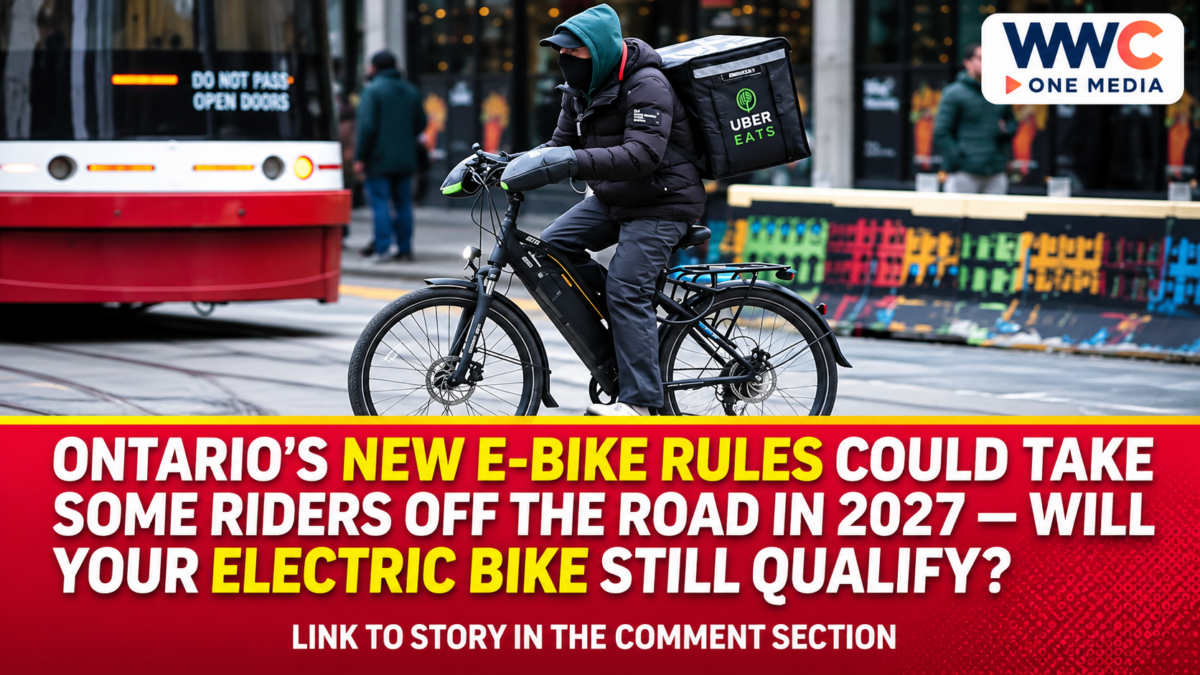
TORONTO, CANADA — Ontario is tightening its electric bicycle regulations beginning May 1, 2027, introducing stricter vehicle classifications that will prevent motorcycle-style and motor scooter-style electric vehicles from being operated as conventional e-bikes.
Announced on November 26, 2026, the updated Ontario e-bike rules will require certain electric vehicle owners to comply with motorcycle or moped licensing, registration and insurance requirements before legally operating their vehicles on provincial roads.
The changes establish a clearer distinction between electric bicycles and motor vehicles, with the objective of improving safety for pedestrians, cyclists and motorists.
For commuters, delivery workers, retailers and electric vehicle owners, the transition raises an important question: Does their vehicle actually qualify as an electric bicycle under Ontario’s updated requirements?
Ontario E-Bike Rules Introduce Two Vehicle Classes
Beginning May 1, 2027, Ontario will recognise two categories of electric bicycles: Class A and Class B.
Both categories must comply with a maximum motor-assisted speed of 32 kilometres per hour and a motor power limit of 500 watts.
However, their weight restrictions and methods of providing motor assistance differ.
Class A electric bicycles:
- Maximum weight of 55 kilograms.
- Motor assistance provided through pedalling.
- Walking assistance permitted at speeds of up to 6 kilometres per hour.
Class B electric bicycles:
- Maximum weight of 120 kilograms.
- May include throttle-assisted electric bicycles.
- Includes pedal-assisted bicycles weighing more than 55 kilograms, provided they meet the other requirements.
Both categories must retain a recognisable bicycle-style design and functional mechanisms that allow riders to propel the vehicle manually.
The distinction is important because having pedals attached to an electric vehicle does not automatically make it a legally recognised electric bicycle.
Ontario’s regulatory changes come alongside wider micromobility policy developments in Canada, including Alberta’s proposed e-scooter safety framework for 2027.
Motorcycle-Style Electric Vehicles Face Stricter Requirements
Electric vehicles that resemble or operate like motorcycles or motor scooters will no longer qualify for treatment as electric bicycles under the updated framework.
Vehicles falling outside the provincial e-bike definition cannot use cycling infrastructure on the basis of being electric bicycles.
To operate legally on public roads, affected vehicles must qualify under the applicable motorcycle or moped category.
This includes obtaining the appropriate vehicle registration and insurance, while operators must possess the required driving licence.
The vehicle must also carry the applicable federal certification demonstrating compliance with Canadian motor vehicle safety requirements.
This means owners cannot necessarily resolve a classification problem simply by purchasing insurance or applying for registration.
A vehicle that does not satisfy the applicable motor vehicle standards may remain ineligible for lawful road use.
Vehicle owners should therefore examine the technical specifications and certification of their electric two-wheelers before the new requirements take effect.
The importance of proper vehicle identification and registration also features in WWC ONE MEDIA’s previous coverage of regulatory enforcement involving an electric vehicle’s registration plate.
Riders Could Face Fines of Up to C$2,500
Operating an electric vehicle in violation of Ontario’s requirements could result in penalties reaching C$2,500 and vehicle impoundment, where applicable.
The penalties are intended to support enforcement of the provincial vehicle classification and road-safety framework.
Owners of compliant electric bicycles will remain exempt from the general requirements to obtain a driver’s licence, register their vehicle or purchase motor vehicle insurance.
However, electric bicycle operators must be at least 16 years old, use approved protective helmets and comply with traffic requirements applicable to cyclists.
Passengers must also wear approved helmets and travel using suitable seating arrangements.
Ontario’s approach reinforces the importance of protective equipment and vehicle compliance, issues also examined in WWC ONE MEDIA’s coverage of motorcycle helmet standards and road-safety enforcement.
The provincial government is also coordinating with municipalities, police, retailers, manufacturers, courier businesses and insurance industry representatives to improve awareness of the updated framework.
Battery Safety Becomes Another Regulatory Priority
Ontario’s electric mobility policy is not limited to vehicle speed, design and road access.
The provincial government is separately proposing amendments to its Fire Code covering lithium-ion battery safety, including storage and charging practices.
These proposed amendments should not be confused with the electric bicycle regulations scheduled to take effect in May 2027.
Under the updated bicycle framework, batteries must be installed and maintained in accordance with manufacturers’ instructions.
Electrical components must also satisfy applicable equipment safety requirements.
Battery-related risks represent another dimension of electric mobility regulation across APEC economies, as illustrated by WWC ONE MEDIA’s earlier coverage of a mobility scooter fire in Singapore.
Although mobility scooters and electric bicycles are different vehicle categories, both require responsible maintenance and appropriate electrical safety precautions.
What Electric Bicycle Owners Should Check Before May 2027
Owners should establish whether their electric vehicle satisfies Ontario’s updated requirements before continuing to use it as a bicycle after the implementation date.
Important considerations include:
- Whether the vehicle has a bicycle-style frame.
- Whether its pedals or hand cranks can effectively propel it.
- Whether its motor exceeds the permitted power limit.
- Whether its weight falls within the applicable vehicle category.
- Whether motor assistance ends at the prescribed speed.
- Whether its brakes, lights and electrical components meet safety requirements.
- Whether modifications have affected its regulatory compliance.
Consumers considering motorcycle-style electric vehicles should also verify whether those models can legally be registered and insured under the applicable motor vehicle classification.
Retail descriptions alone are not sufficient to establish a vehicle’s legal status.
Riders must additionally check municipal regulations, which may impose separate restrictions on local roads and pathways.
What Happens Next?
Ontario’s updated electric bicycle framework is scheduled to take effect on May 1, 2027.
The period before implementation provides an opportunity for owners, retailers and commercial operators to assess vehicle specifications and understand the requirements that apply to their equipment.
For qualifying electric bicycle owners, the changes preserve access to a form of transportation that does not require conventional motor vehicle registration or insurance.
For owners of motorcycle-style electric vehicles, continued road use will depend on whether their vehicles satisfy the relevant motor vehicle standards and administrative requirements.
The decisive question is no longer simply whether a vehicle runs on electricity or has pedals.
It is whether the vehicle meets the legal requirements of the category under which its owner intends to operate it.
Frequently Asked Questions
When do Ontario’s new e-bike rules take effect?
The updated provincial requirements are scheduled to take effect on May 1, 2027.
Will all electric bicycles require a driver’s licence in Ontario?
No. Electric bicycles satisfying Ontario’s regulatory requirements will remain exempt from driver’s licensing, vehicle registration and motor vehicle insurance requirements.
What is the maximum legal motor-assisted speed for an Ontario e-bike?
Both Class A and Class B electric bicycles are limited to motor assistance of up to 32 kilometres per hour and a maximum motor output of 500 watts.
Are throttle-controlled electric bicycles banned?
No. Throttle-assisted bicycles can qualify under Class B if they satisfy the applicable design, weight, power, speed and equipment requirements.
What happens if an electric vehicle does not qualify as an e-bike?
It cannot legally be operated as an electric bicycle. Road use will depend on meeting the applicable motorcycle or moped requirements. Violations may result in fines of up to C$2,500 and vehicle impoundment, where applicable.