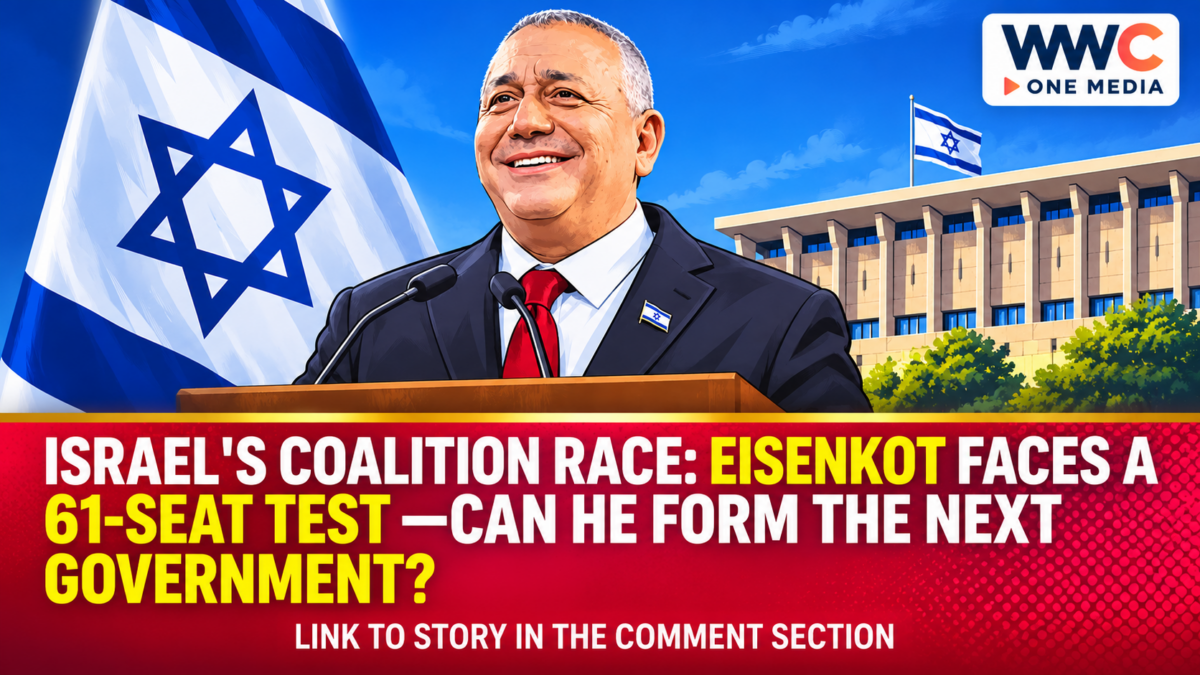
JERUSALEM, Israel — Israel’s coalition talks face a critical parliamentary test as Gadi Eisenkot works to assemble a government following the country’s Oct. 27, 2026, election, which left no individual political party with an outright majority.
President Isaac Herzog formally assigned Eisenkot the responsibility of forming a government on Nov. 8, despite Benjamin Netanyahu’s Likud emerging as the largest parliamentary faction.
The appointment placed Eisenkot at the centre of a political contest in which cooperation among parties could prove more decisive than their individual election performances.
The challenge now is to convert parliamentary recommendations into a workable governing arrangement capable of securing the confidence of the Knesset.
Israel Coalition Talks: Why 61 Seats Matter
Israel’s 120-member parliament requires 61 seats for an absolute majority.
The official election results gave Netanyahu’s Likud 27 seats, while Eisenkot’s Yashar secured 21. Neither party came close to winning enough seats to govern independently.
Naftali Bennett’s Be’Yahad secured 12 seats, followed by the Joint List with 11.
The Democrats, led by Yair Golan, and the United Arab List each obtained eight seats. Yisrael Beitenu, Otzma Yehudit and United Torah Judaism each secured seven, while Shas and Religious Zionism obtained six apiece.
The fragmented result makes negotiations among political parties particularly important.
Similar parliamentary arithmetic has become central to political developments elsewhere, including New Zealand’s 2026 election and the challenge of establishing a parliamentary majority.
Although the two countries operate under different electoral frameworks, their experiences illustrate how election results do not automatically determine the composition of the next government.
Why Eisenkot Received the Mandate Instead of Netanyahu
Herzog’s consultations with parliamentary factions produced a different picture from the individual election rankings.
Factions representing 67 members of parliament recommended Eisenkot to receive the mandate to form a government.
Factions representing 46 lawmakers recommended Netanyahu, while a faction representing seven members declined to recommend either candidate.
The president subsequently selected Eisenkot, explaining that the responsibility of forming a government does not necessarily have to be assigned to the leader of the largest parliamentary party.
Eisenkot’s selection reflected the parliamentary recommendations made during those consultations.
However, recommending a candidate to receive the mandate is not equivalent to entering a governing coalition or committing to every policy of a prospective administration.
That distinction remains important as negotiations continue.
How Smaller Parties Could Shape Israel’s Next Government
The distribution of parliamentary seats gives several smaller parties considerable negotiating importance.
Eisenkot’s Yashar and Golan’s Democrats hold a combined 29 seats. Adding Yisrael Beitenu’s seven seats would increase that numerical grouping to 36.
Even if all three factions supported the same government, they would remain 25 seats short of an absolute majority.
Be’Yahad’s 12 representatives could increase that hypothetical grouping to 48, leaving a further 13 seats needed.
The Joint List and United Arab List collectively hold 19 seats, making their parliamentary positions another potentially important factor in government formation.
Both factions recommended Eisenkot during the presidential consultations.
These calculations illustrate possible parliamentary combinations rather than confirmed coalition commitments. They also demonstrate why political agreement on government policies may be as important as the number of seats each faction controls.
The broader significance of parliamentary negotiations is also evident in India’s forthcoming parliamentary session and its legislative agenda.
Israel’s Government Formation Deadline
Under Israel’s Basic Law, the politician assigned the task of forming a government initially receives 28 days to complete the process.
The president may authorise an extension of up to 14 additional days.
With Eisenkot receiving his mandate on Nov. 8, the initial period points to a Dec. 6 deadline, unless an extension is granted.
The timetable increases the importance of resolving differences among prospective coalition partners.
Negotiations over government priorities, ministerial responsibilities and parliamentary cooperation must ultimately produce an arrangement that can secure legislative confidence.
The challenge resembles other complex political negotiations in which deadlines create pressure without guaranteeing agreement, such as the European Union’s budget negotiations in Brussels.
A New Government Must Address More Than Political Arithmetic
During the ceremony assigning Eisenkot the mandate, Herzog emphasised the importance of establishing a stable government capable of serving different sections of Israeli society.
The president also highlighted economic resilience, public security and social cohesion as important national priorities.
For prospective coalition partners, assembling enough parliamentary support is therefore only the beginning.
A government must also establish a policy programme and determine how its political partners will cooperate once an administration takes office.
A numerical majority may facilitate government formation, but it does not guarantee agreement on every legislative, economic or security issue.
For international observers, including those across the Asia-Pacific, Israel’s political transition remains relevant to future diplomatic and economic policy expectations.
Any specific changes in foreign policy, trade relations or regional security arrangements would require separate official confirmation.
What Happens Next?
The immediate focus is whether Eisenkot can convert the support expressed during presidential consultations into a governing arrangement.
The initial December deadline provides a defined period for negotiations, although the legal framework allows additional time if necessary.
The formation of a government would represent a separate institutional development from the election result and presidential appointment.
Until that process is completed, parliamentary seat calculations should not be confused with confirmed cabinet appointments or an established administration.
Israel’s election has determined the composition of its parliament. The remaining question is whether its political parties can agree on who will govern and under what conditions.
Frequently Asked Questions
Who is Gadi Eisenkot?
Gadi Eisenkot is the leader of Israel’s Yashar party and a former chief of the general staff of the Israel Defense Forces. He received the mandate to form a government on Nov. 8, 2026.
How many seats are needed for an absolute majority in Israel?
An absolute majority requires 61 seats in the 120-member Knesset.
Which party won the most seats in Israel’s October 2026 election?
Benjamin Netanyahu’s Likud won 27 seats, followed by Eisenkot’s Yashar with 21.
How many parliamentary recommendations did Eisenkot receive?
Factions representing 67 lawmakers recommended Eisenkot during presidential consultations. These recommendations do not automatically constitute a governing coalition.
When is Eisenkot’s initial government formation deadline?
The initial 28-day period points to Dec. 6, 2026. The president may grant an extension of up to 14 days.