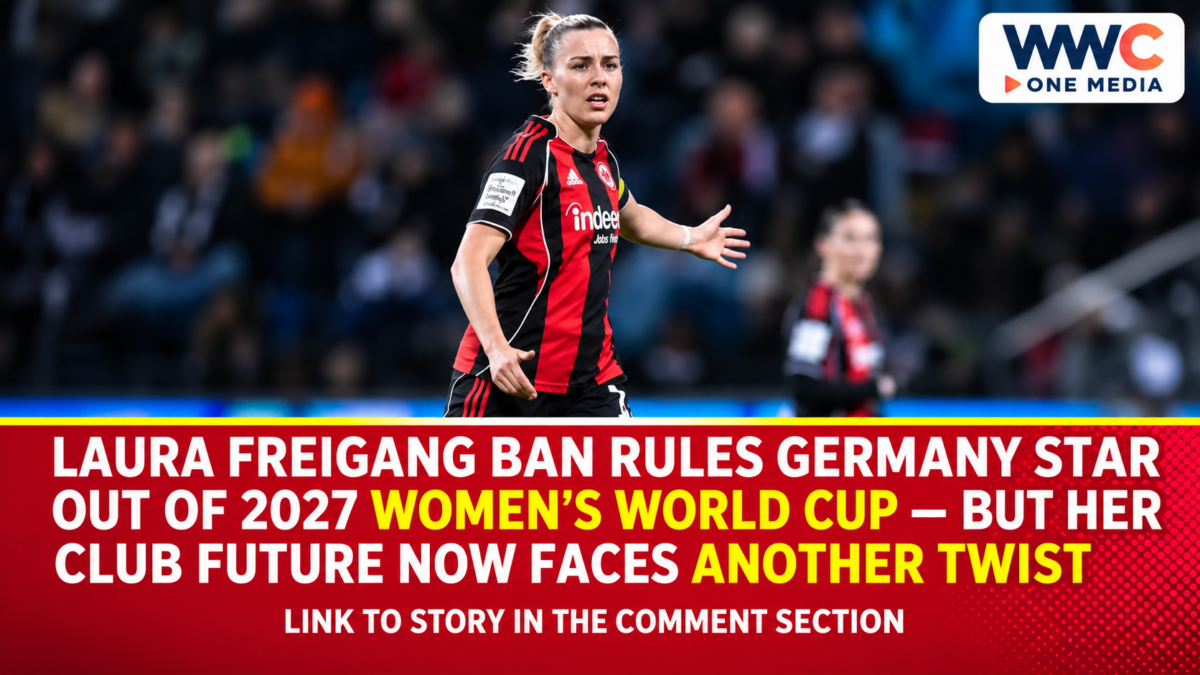
FRANKFURT, GERMANY — Germany international Laura Freigang will miss the 2027 FIFA Women’s World Cup in Brazil after receiving a 16-month suspension for three anti-doping whereabouts failures.
The sanction, announced on Nov. 26, 2026, prevents the 28-year-old Eintracht Frankfurt footballer from returning to competitive action until Oct. 8, 2027, more than two months after the World Cup final.
The decision also places her professional future in uncertainty, with her existing club contract scheduled to expire before she becomes eligible to compete again.
While the Laura Freigang ban represents a significant setback for her international career, the case concerns compliance with mandatory anti-doping reporting and testing obligations rather than a confirmed positive test for a prohibited substance.
Laura Freigang Ban Follows Three Whereabouts Failures
Freigang became part of Germany’s Registered Testing Pool in October 2024, placing her under mandatory anti-doping whereabouts requirements.
Three failures were recorded between March 11, 2025, and Feb. 23, 2026, resulting in a violation of Article 2.4 of the World Anti-Doping Code and corresponding German anti-doping regulations.
The case was resolved through an agreement involving Freigang, the World Anti-Doping Agency, Germany’s National Anti-Doping Agency and the German Football Association.
Although the sanction was publicly announced in November, its starting date was set retrospectively at June 8, 2026, when Freigang received notification from the German football governing body.
She can resume training with a team beginning Aug. 8, 2027. Her eligibility for competitive matches will return on Oct. 8, 2027.
The distinction between training and competition is important because permission to participate in team preparations does not automatically restore an athlete’s eligibility to play official matches.
Germany Will Head to Brazil Without Freigang
The FIFA Women’s World Cup 2027 will run from June 24 to July 25, with Brazil hosting the tournament across eight cities.
It will be the tenth edition of the competition and the first Women’s World Cup staged in South America.
Germany secured its qualification in June 2026, but Freigang’s suspension means she cannot participate in the tournament under the current decision.
National team preparations will therefore have to proceed without her availability as a potential attacking option.
Squad depth remains an important consideration for national teams preparing for major international competitions, as highlighted in the United States women’s national team preparations for World Cup qualification.
Germany’s circumstances are different, but the challenge of maintaining competitive options when individual players become unavailable is relevant across international football.
For Freigang, the timing of the suspension means there is no opportunity to return midway through the tournament, even if Germany advances to the final.
Eintracht Frankfurt Faces a Contract Decision
The suspension creates another significant issue for Freigang at club level.
Her current contract with Eintracht Frankfurt runs until June 30, 2027.
That expiration date comes before she is permitted to resume team training and before her eligibility for competitive football is restored.
Eintracht Frankfurt has confirmed that discussions with Freigang will take place concerning their future contractual relationship in light of the suspension.
However, no contract extension or departure was announced as part of the Nov. 26 statement.
The club must now consider how to manage its future squad arrangements while Freigang faces an extended absence from competition.
Her contractual circumstances also highlight the importance of planning beyond individual seasons in professional women’s football.
Across the sport, clubs face different operational and organisational challenges, including those examined in the debate over stadium availability for National Women’s Soccer League playoff matches.
Freigang’s situation is specifically a disciplinary and contractual matter. Its resolution will depend on the outcome of discussions between the footballer and Eintracht Frankfurt.
Individual Results Disqualified, but Team Results Stand
The sanction extends beyond Freigang’s temporary exclusion from competitive football.
Her individual competitive results dating from Feb. 23, 2026, have been disqualified.
The decision also requires the forfeiture of applicable individual awards and benefits associated with those results.
However, the teams for which she played will retain their results from the relevant matches.
This distinction means the disciplinary consequences imposed on Freigang do not automatically invalidate the collective performances of her club or national team.
The published decision does not provide a detailed match-by-match list of affected individual achievements or specify the financial value of any forfeited prizes.
What Are Anti-Doping Whereabouts Failures?
Athletes enrolled in designated testing pools must provide information about their location so that anti-doping authorities can conduct testing outside scheduled competitions.
These obligations allow testing programmes to operate without depending exclusively on matchdays or previously arranged appointments.
A whereabouts failure may involve inadequate reporting of required location information or failure to satisfy testing availability obligations.
Such violations are treated separately from cases involving the detection of prohibited substances.
In Freigang’s case, the official disciplinary announcement identifies Article 2.4 whereabouts violations as the basis of the suspension.
It does not identify a prohibited substance detected in a sample.
Maintaining that distinction is essential when discussing the case because an anti-doping rule violation does not necessarily establish the use of performance-enhancing substances.
What Happens Next for Freigang?
The immediate focus will be on Freigang’s contractual discussions with Eintracht Frankfurt and the conditions surrounding her eventual return to football.
Meanwhile, preparations for Brazil 2027 will continue as the international women’s game approaches another major milestone.
The tournament’s wider significance has already been examined in the growing commercial opportunities and challenges facing women’s football at Brazil 2027.
For football audiences across Asia-Pacific, Europe and the Americas, Freigang’s suspension also illustrates the importance of understanding athlete eligibility and the rules that govern international competition.
Her next opportunity to resume team training is scheduled for August 2027, followed by competitive eligibility in October.
Whether that return will take place in an Eintracht Frankfurt shirt remains unresolved.
Frequently Asked Questions
Why was Laura Freigang banned?
Freigang received a 16-month suspension after three anti-doping whereabouts failures recorded between March 2025 and February 2026.
Will Laura Freigang play in the 2027 Women’s World Cup?
No. Under the announced suspension, she will remain ineligible throughout the tournament in Brazil, which concludes on July 25, 2027.
Did Laura Freigang test positive for a prohibited substance?
The published disciplinary decision concerns whereabouts violations. It does not establish a positive test for a prohibited substance.
When can Laura Freigang return to football?
She can resume team training on Aug. 8, 2027, and competitive matches on Oct. 8, 2027.
When does Laura Freigang’s Eintracht Frankfurt contract expire?
Her existing contract expires on June 30, 2027. Discussions concerning her future relationship with the club have been announced, but no final outcome has been disclosed.