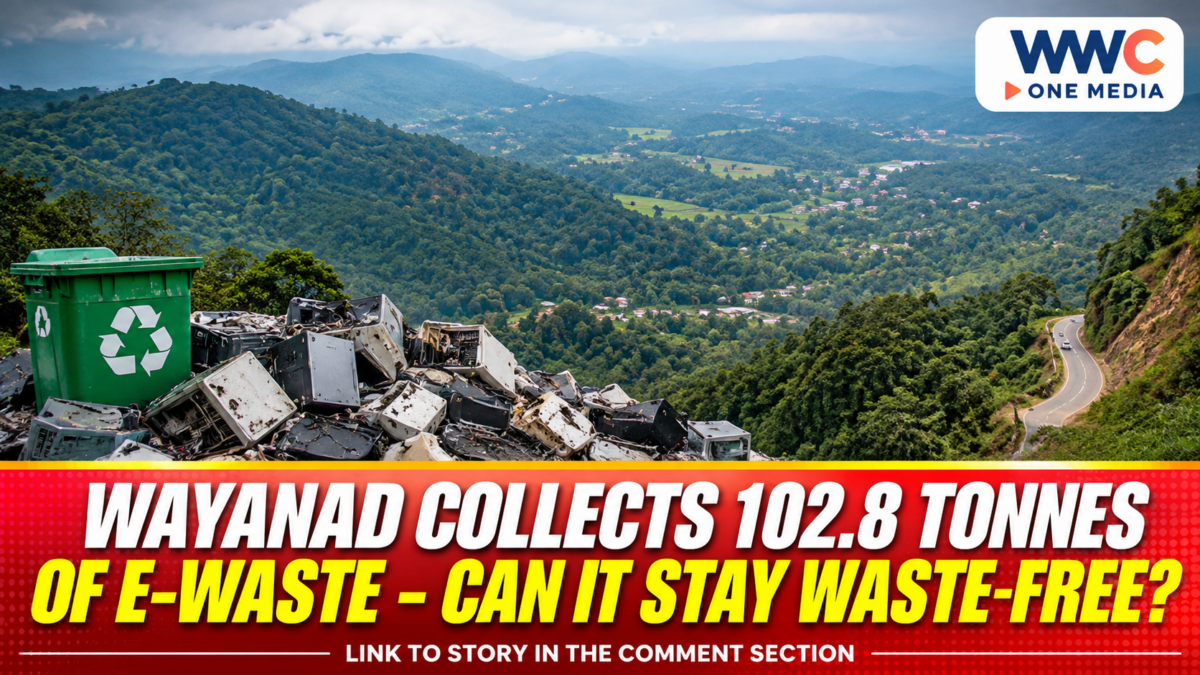
Wayanad in Kerala is preparing to make environmental history, but its biggest challenge may begin after the celebrations.
The district has collected 102.8 tonnes of electronic waste through a coordinated campaign covering government offices, households, schools, institutions and local government areas. The material has been handed over to Clean Kerala Company for scientific processing, according to the Kerala government’s official announcement.
Chief Minister V.D. Satheesan is scheduled to formally declare Wayanad India’s first completely e-waste-free district on November 27 at Chandragiri Auditorium in Kalpetta. The programme is also expected to launch a separate initiative to make tourist destinations across the district plastic-free.
The achievement is significant because discarded electronic equipment is not ordinary household rubbish. Computers, televisions, refrigerators, batteries, cables and circuit boards can contain substances that pose environmental and health risks when handled or disposed of improperly.
But collecting more than 100 tonnes is only one part of the task. Wayanad must now demonstrate that its collection network, authorised processing arrangements and public participation can prevent discarded electronics from accumulating again.
How Wayanad Collected More Than 102 Tonnes
The district’s campaign was carried out in four stages, with local self-government institutions coordinating collection across all 23 grama panchayats and three municipalities.
The first phase focused on government offices. Authorities removed approximately 32 tonnes of electronic waste from government institutions, clearing equipment that had accumulated in public buildings.
The second phase expanded the operation through collection points established under the local bodies. This allowed residents and institutions to hand over discarded electronics through designated locations rather than leaving them in ordinary waste streams.
The third phase brought the campaign directly to households. Members of Haritha Karma Sena, the sanitation workers’ network operating through local self-government institutions, visited homes across the district to collect electronic waste.
A fourth phase addressed households and institutions that had not participated in the earlier rounds. Special collection points were established in each local government area to gather the remaining material.
The four stages produced a reported total of 102.8 tonnes. Clean Kerala Company received the collected waste for scientific processing.
The campaign involved local governments, sanitation workers, government departments, schools, businesses and residents. Its reach across the district is important: an e-waste programme cannot succeed if collection is limited to government offices while unwanted appliances remain stored or discarded in private homes.
Why Electronic Waste Needs Special Treatment
Electronic waste can contain hazardous materials that require controlled handling.
India’s E-Waste (Management) Rules, 2022, which came into force on April 1, 2023, establish a national framework for managing discarded electrical and electronic equipment. The rules cover manufacturers, producers, refurbishers and recyclers involved in the relevant activities.
The framework also requires covered businesses to register through the Central Pollution Control Board’s system. Producers must meet extended producer responsibility obligations, while recycling activities are subject to registration and regulatory requirements.
This is important because collecting discarded electronics does not automatically mean they have been recycled safely.
Improper dismantling, open burning or uncontrolled disposal can release hazardous substances into the surrounding environment. The Kerala government’s own campaign guidance warns that materials such as lead and mercury can contaminate soil and water when electronic equipment is handled irresponsibly.
The difference between collection and recycling is therefore critical. Collection removes unwanted equipment from homes and institutions; authorised processing determines how the material is subsequently handled, recovered or disposed of.
Wayanad’s announcement identifies Clean Kerala Company as the organisation receiving the collected material for scientific processing. The public announcement does not provide a detailed breakdown of the final quantities recycled, refurbished or sent for other forms of treatment.
That information will matter when assessing the environmental results beyond the headline collection figure.
The Role of Kerala’s Waste Management System
Wayanad’s campaign forms part of a wider effort to strengthen waste management through local government participation.
The Kerala government has already approved a state policy on Extended Producer Responsibility. The policy recognises that manufacturers and producers should have responsibilities for the waste generated by the products they introduce into the market.
Under this approach, waste management is not simply a municipal collection problem. Producers, consumers, local governments and waste workers all have roles in ensuring that materials are recovered and processed responsibly.
The state’s policy also supports a circular-economy approach, in which materials are kept in use for as long as possible and waste generation is reduced.
That framework is relevant to electronic products because they contain materials that may be recovered and reused through appropriate processes. However, recovering valuable materials requires specialised facilities and compliant recycling operations rather than informal dismantling.
WWC previously examined the wider challenge of turning electronic waste and other discarded materials into usable resources. The central issue is similar: collection systems need to connect with reliable processing infrastructure if waste is to become a recoverable resource.
Wayanad’s Next Environmental Target Is Plastic-Free Tourism
The e-waste announcement is not the only environmental initiative planned for November 27.
The Kerala government says a broader programme to make tourist destinations within Wayanad’s local government areas completely plastic-free will also begin. A dedicated framework for the initiative is scheduled for official release.
The plan is intended to strengthen cleanliness and protection at tourism locations. The government announcement says strict controls on bringing and using plastic products at those destinations will form part of the system.
This is particularly relevant to Wayanad, where tourism depends heavily on the district’s landscapes and natural attractions.
However, the plastic-free tourism initiative should be treated as a separate programme, not as proof that plastic pollution has already been eliminated across the district.
Its effectiveness will depend on how restrictions are implemented, whether visitors and businesses comply, and whether local authorities provide practical alternatives and consistent monitoring.
WWC has reported on Davao’s coastal cleanup and the need to prevent waste at its source. The same principle applies to tourist destinations: removing litter after it appears is not enough if waste continues entering the environment.
The Real Test Begins After the Declaration
Wayanad’s collection drive offers a measurable achievement, but a declaration alone cannot guarantee that the district will remain free of accumulated electronic waste.
The next step is to maintain convenient collection arrangements so residents and businesses have a reliable way to hand over old appliances, computers, phones, batteries and other covered equipment.
Local authorities will also need to ensure that materials reach authorised handlers and that the processing chain can be documented. Regular collection rounds, public information and monitoring can help prevent discarded electronics from returning to open spaces, ordinary waste piles or informal disposal channels.
The challenge is not unique to Wayanad. Communities across India face the task of managing growing volumes of electronic products as households, businesses and public institutions replace equipment.
WWC has also examined how businesses and government can share responsibility for reducing waste. The wider lesson is that environmental programmes need cooperation between public authorities, producers, waste workers and consumers.
Wayanad’s 102.8-tonne collection demonstrates what coordinated local action can achieve. Whether the district can sustain that result will depend on what happens after the official announcement.
What Happens Next
The immediate milestone is the November 27 declaration by Chief Minister V.D. Satheesan in Kalpetta. The event is also scheduled to introduce the district’s plastic-free tourism initiative.
After the announcement, the more important work will involve maintaining collection points, ensuring scientific processing, monitoring local bodies and keeping residents involved.
Further public information on the quantities actually recycled, the authorised processing facilities involved and the frequency of future collection drives would help measure the programme’s long-term performance.
The distinction between a one-time clean-up and a lasting waste-management system is crucial. Wayanad has collected more than 100 tonnes of electronic waste. Its next achievement must be preventing that waste from building up again.
Frequently Asked Questions
1. Why is Wayanad making headlines in India?
Wayanad in Kerala is scheduled to be formally declared India’s first completely e-waste-free district on November 27, 2026, after a campaign collected 102.8 tonnes of electronic waste.
2. How much electronic waste did Wayanad collect?
The Kerala government’s official announcement gives the total as 102.8 tonnes. The material was collected in four phases and handed over to Clean Kerala Company for scientific processing.
3. Which areas were covered by the campaign?
The collection covered all 23 grama panchayats and three municipalities in Wayanad district.
4. What is Haritha Karma Sena?
Haritha Karma Sena is a sanitation workers’ network operating through local self-government institutions in Kerala. Its members participated in door-to-door electronic-waste collection during the Wayanad campaign.
5. Why is electronic waste dangerous?
Some discarded electronic equipment contains hazardous substances, including lead and mercury. Improper disposal, burning or handling can contaminate soil and water and create health risks.
6. What is Wayanad planning after the e-waste campaign?
The district is launching a separate initiative to make tourist destinations plastic-free. The longer-term challenge will be maintaining regular waste collection and responsible processing after the initial campaigns.