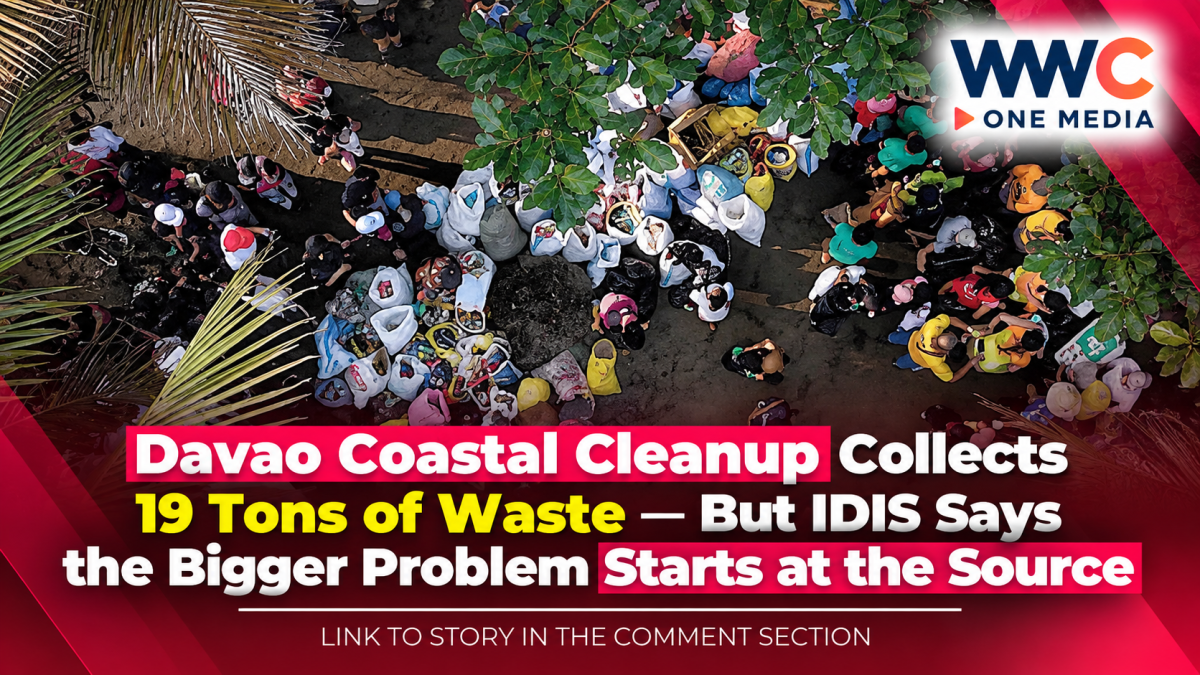
The massive volume of garbage recovered during Davao Region’s latest coastal cleanup has renewed calls for stronger action against plastic pollution—not only along shorelines, but at the point where waste is produced and enters the environment.
The 2026 International Coastal Cleanup in the region gathered 19,115.19 kilograms, or about 19.1 metric tons, of waste from roughly 32 kilometers of coastline on September 19. A total of 6,852 participants took part, filling 2,520 sacks with marine debris and other waste.
Environmental group Interfacing Development Interventions for Sustainability (IDIS) recognized the work of government agencies, local governments, communities, businesses and volunteers. But the organization said the amount and type of waste collected show that annual cleanup activities alone cannot solve the underlying problem.
IDIS said cleanup data should be used to identify which products and packaging repeatedly end up in waterways and coastal areas, trace where they originate, and guide policies aimed at preventing the waste from being generated in the first place.
Among the commonly collected items were beverage bottles and cans, glass and plastic containers, foam packaging, food wrappers and small plastic and foam fragments. Single-use plastics, including bottles, caps, sachets, bags and food packaging, made up a significant portion of the debris recovered during the regional activities.
The scale of this year’s collection was substantially higher than the previous year’s cleanup in Davao City. In 2025, a coastal cleanup in Barangay 76-A, Bucana recovered 692 sacks weighing about 4,674 kilograms.
IDIS is therefore urging national and local authorities to move beyond repeated cleanup campaigns and strengthen measures that reduce waste at its source.
The group called for stronger policies governing the production, distribution and consumption of single-use plastics and packaging, including restrictions or phaseouts where appropriate, while promoting reuse, refill and other systems that reduce dependence on disposable materials.
One issue specifically raised by IDIS is the long-awaited list of Non-Environmentally Acceptable Products and Packaging, or NEAPP. The group urged the Department of Environment and Natural Resources to release and implement the list, arguing that the continued presence of disposable materials in waterways and coastlines demonstrates the need for stronger regulatory action.
IDIS also called on the Davao City Government and other local government units to strictly enforce existing rules on single-use plastics. The organization said local ordinances need to be matched with consistent enforcement, business compliance and practical alternatives such as reusable and refill systems.
The cleanup effort itself demonstrated the scale of community participation. In Davao City, a separate activity at Seaside 2 in Barangay Matina Aplaya recovered 4,832 kilograms of waste from an 804-meter stretch, involving 852 volunteers from 92 partner organizations.
For IDIS, however, the recurring appearance of the same types of trash should prompt a deeper question: why does the waste continue reaching the coast in the first place?
The group is pushing for greater support for zero-waste programs, barangay-level waste reduction and segregation, materials recovery, composting, reuse and refill systems, as well as initiatives involving waste workers and local communities.
The message is increasingly shifting from simply asking how much garbage can be removed to asking how much can be prevented from becoming marine waste in the first place.
With more than 19 metric tons collected in a single regional cleanup, the next challenge for Davao may not be another cleanup drive—but whether the data gathered can translate into policies that stop the same waste from reaching its waterways and coastlines again.