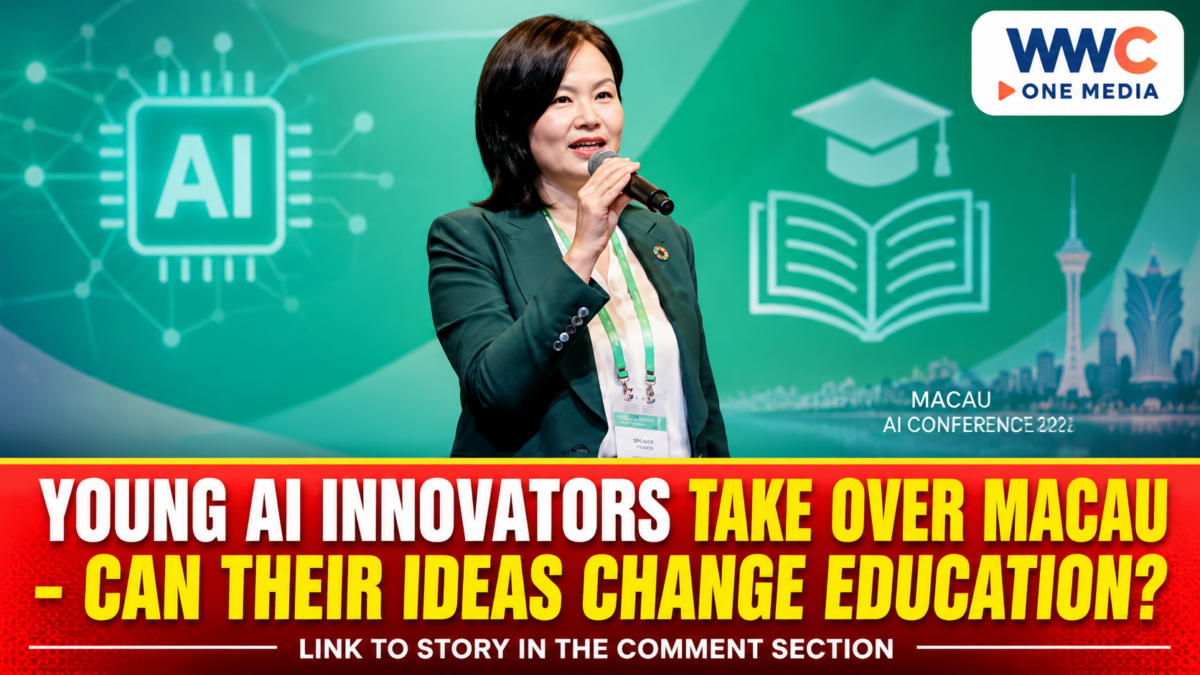
MACAU SAR, China — Young innovators from around the world brought artificial intelligence solutions for education, healthcare, accessibility and underserved communities to Macau, as the United Nations University-backed AI for SDGs – Global Youth AI Future Innovation Competition held its global final on Nov. 26, 2026.
The competition featured 15 finalist teams: 12 international teams selected from 314 applications across 128 countries and regions, alongside three teams from Macau’s secondary school division.
Their projects addressed problems that go beyond the technology itself. Some focused on helping teachers prepare lessons, others explored sign-language learning, maternal healthcare, accessible transport and education in places where internet connectivity and electricity remain unreliable.
The final formed part of the UNU Macau AI Conference 2026, held on Nov. 25–26 at MGM Macau under the theme “AI × Education: AI for Learning, Learning for AI”.
The central question was not simply how advanced young people could make artificial intelligence. It was whether they could apply it to practical challenges affecting communities with very different resources and needs.
314 Applications, 128 Countries and 15 Finalist Teams
The scale of the competition reflects growing international interest in youth-led artificial intelligence development.
The 12 international finalists came from 10 countries and regions and competed across three categories: AI for Education, AI for Social Innovation and AI for Less Developed Countries.
Three additional teams from Macau’s secondary school division joined the global final, creating a platform for local students to present alongside international participants.
The competition was initiated by the UNU Global AI Network, with Venture Cup China as co-organiser, UNU Macau as a co-organising institution and the Macao Computer Society as local partner.
The final was structured around project presentations, demonstrations and questions from the judging panel. Each team was scheduled to deliver a 10-minute presentation followed by a five-minute question-and-answer session.
The format placed emphasis on more than an impressive demonstration. Teams were expected to explain the problem they were addressing and show how their proposed technology could work in a real setting.
The competition’s three tracks also reflected an important distinction: AI innovation is not limited to commercial applications or advanced research laboratories. It can also involve improving access to education, supporting vulnerable communities and addressing infrastructure limitations.
AI for Education: From Teacher Support to Personalised Learning
Six international finalists competed in the AI for Education category.
Brazil’s DED IA developed an AI assistant grounded in official curriculum textbooks to help public-school teachers prepare lesson plans, examinations and exercises. The project also aims to help educators identify learning gaps and provide more targeted support.
In the United States, WriteRight focused on handwritten Chinese learning. Its system analyses photographs of handwriting to identify stroke-level errors and turn the feedback into personalised learning games.
South Africa’s BuddyAI uses WhatsApp to provide multilingual tutoring, combining explanations in learners’ home languages with access to human tutors.
Other projects explored collaborative learning, university assessment and personalised financial education.
Hong Kong SAR’s YoChatGPT! creates collaborative learning spaces in which multiple users interact with AI models to develop critical thinking and AI literacy. China’s SmarTAI focuses on university STEM assessment through teacher-controlled grading, evidence-based feedback and natural-language analytics.
Brazil’s Iara by Barkus uses WhatsApp to provide personalised financial learning based on users’ needs and goals.
Together, the projects illustrate how AI tools could support different parts of the education process, from classroom preparation to individual learning.
However, their appearance in a competition does not establish that they have already been adopted widely or independently proven to improve educational outcomes.
WWC previously examined the growing AI divide in Philippine classrooms, where working students risk being left behind without adequate institutional support. The Macau projects highlight another side of the same challenge: developing useful tools matters, but learners must also have the resources and support to use them.
Healthcare and Accessibility Become AI Innovation Priorities
The AI for Social Innovation category brought technology into areas where access, affordability and inclusion can have direct consequences for everyday life.
China’s Micro-Organ and AI project combines AI modelling with a micro-organ platform to examine drug responses and explore more evidence-informed approaches to cancer treatment selection.
Singapore’s E3A Healthcare focuses on maternal, newborn and women’s health. Its technologies include fetal monitoring and newborn jaundice measurement, with applications intended to extend beyond clinical settings.
Kenya’s Ishara AI is developing an AI-powered three-dimensional avatar to present digital content in Kenyan Sign Language. The project also includes courses designed to build practical AI skills among Deaf learners.
Malaysia’s Move My Way addresses mobility and accessibility. It aims to help people with disabilities and other accessibility needs identify suitable facilities and plan barrier-free journeys.
These projects demonstrate why AI development cannot be measured only by processing speed, model size or commercial potential.
A system that makes educational content accessible to Deaf learners or helps people identify barrier-free routes addresses a practical problem that conventional technology may not adequately solve.
Healthcare applications, however, require particular care. A prototype or competition presentation should not be confused with a clinically validated medical product. Medical safety, regulatory approval and independent testing remain essential before such systems can be relied upon in healthcare decisions.
Offline AI Could Reach Communities Left Behind
The third competition category, AI for Less Developed Countries, focused on a challenge that is often overlooked in discussions about artificial intelligence: what happens when communities lack reliable internet access, electricity or digital infrastructure?
The Democratic Republic of the Congo’s Genyss project proposes an offline “school in a box” that runs AI models locally. It is designed to provide interactive, multilingual STEM education in conflict-affected settings without depending on internet connectivity or grid electricity.
Pakistan’s Urdu AI project focuses on practical AI courses, responsible-use guidance and community-supported learning in Urdu.
Both projects address barriers that can prevent people from participating in the global technology economy.
Many AI education tools assume that learners have stable internet connections, suitable devices and access to English-language resources. That assumption does not hold everywhere.
Offline systems and locally relevant language support could help widen access, although their effectiveness will depend on the quality of educational content, available hardware, maintenance and the ability of local communities to use them sustainably.
WWC has also reported on Filipino students competing internationally in artificial intelligence. The Macau competition adds another example of young people applying technical skills to problems that affect communities beyond their own countries.
Macau’s Local Students Join the Global AI Stage
The competition also created a dedicated pathway for students from Macau.
Three Gold Award-winning teams from the Macao Secondary School Division joined the international finalists:
- WhisperGuard — Colégio Mateus Ricci
- Global Voice — Chan Sui Ki Perpetual Help College
- Pocket Lab — Premier School Affiliated to Hou Kong Middle School
Their participation placed local secondary school innovators alongside teams working on projects from different parts of the world.
The wider UNU Macau AI Conference also brought together more than 400 policymakers, education leaders, researchers, technologists and young innovators from more than 200 organisations.
Its programme included 16 thematic sessions and 12 practical workshops. Discussions covered generative and agentic AI, education and employability, AI governance, institutional integration and the challenges facing education systems in low-resource settings.
The conference also examined how countries and institutions can use AI without compromising human agency, trust and equitable access.
What Happens After the Competition?
The next challenge for the finalists is turning promising ideas into solutions that can operate beyond a competition environment.
Projects involving education will need to demonstrate that teachers and learners can use them effectively. Healthcare technologies will require appropriate validation and regulatory scrutiny. Accessibility applications will need reliable information and practical testing with the communities they are designed to serve.
Offline AI tools face their own questions involving hardware costs, power requirements, content updates and long-term maintenance.
The competition therefore offers a snapshot of emerging youth-led innovation, not proof that all 15 projects are ready for widespread deployment.
The conference organisers said selected panellists would contribute to proceedings in the UNU–Springer book series on AI and Sustainable Development, extending the event’s discussions into research, policy and practice.
WWC’s coverage of Davao students advancing their CubeSat research into a university laboratory also illustrates the importance of moving student innovation beyond presentations and into testing and research environments.
Macau’s AI competition brought together young people trying to solve problems in classrooms, hospitals, communities and regions with limited infrastructure.
The bigger test begins after the presentations: whether their ideas can be tested, improved and made accessible to the people they are intended to help.
The next generation is already building AI solutions. The question is whether the world can help turn those ideas into lasting public benefits.