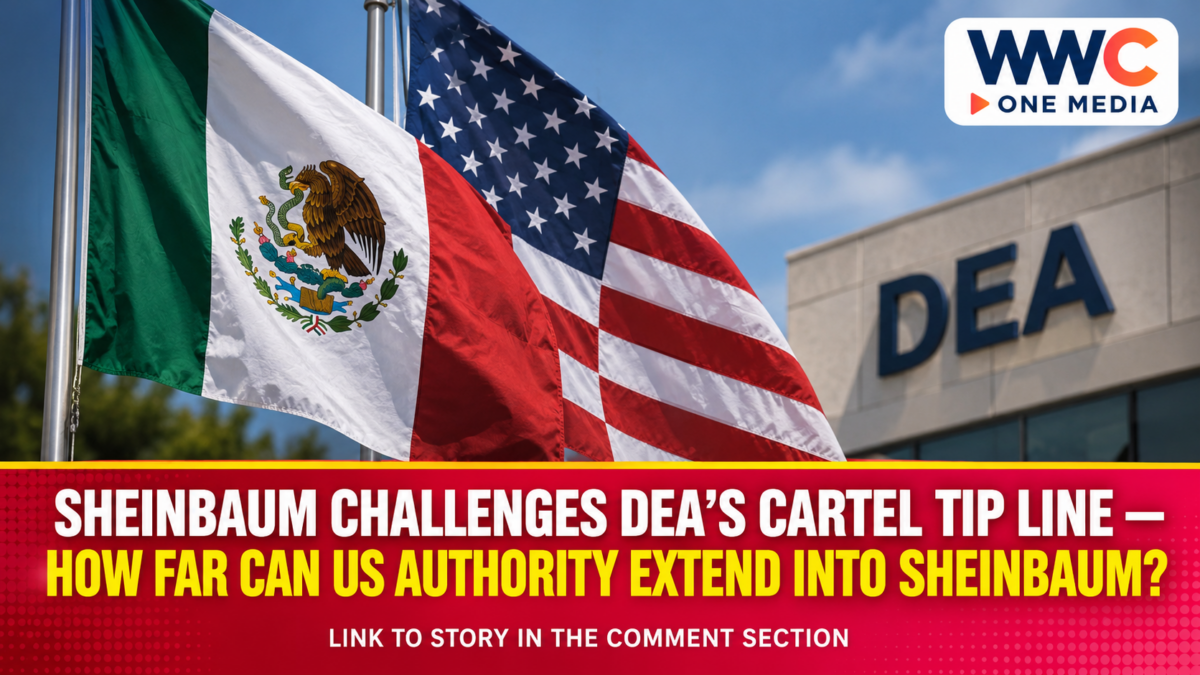
MEXICO CITY — Mexican President Claudia Sheinbaum challenged the United States Drug Enforcement Administration’s (DEA) cartel tip line on Nov. 26, 2026, describing the initiative as interference in Mexico’s domestic affairs and questioning Washington’s efforts to combat drug trafficking within its own borders.
The controversy has brought national sovereignty and the limits of international law enforcement cooperation back into focus, raising questions about how the neighbouring countries can combat organised crime without undermining each other’s legal authority.
Why Sheinbaum Opposes the DEA Cartel Tip Line
During her Thursday morning press conference, Sheinbaum questioned why an American law enforcement agency was encouraging Mexican citizens to report criminal activities occurring within Mexico.
The president argued that Mexico has its own institutions responsible for receiving criminal complaints, investigating offences and pursuing organised crime.
She illustrated her objection by asking how Washington would respond if Mexican security authorities established a reporting channel for corruption occurring inside the United States.
Her remarks distinguished between bilateral security cooperation and independent initiatives by foreign government agencies.
The controversy also comes amid broader questions surrounding the boundaries of American enforcement authority, including concerns over US border enforcement technology and public safety.
Mexico Calls for Greater US Action Against Domestic Drug Networks
Sheinbaum used the press conference to draw attention to the American side of the illegal drug market.
She questioned who distributes fentanyl within the United States and where the financial proceeds from those transactions ultimately go.
The Mexican president also defended her administration’s efforts to dismantle illegal drug laboratories, confiscate narcotics and apprehend individuals suspected of involvement in organised crime.
Her position places emphasis on responsibilities on both sides of the border rather than concentrating enforcement efforts exclusively on Mexican criminal organisations.
The distinction is important because combating international drug trafficking involves multiple areas of enforcement, including criminal investigations, financial surveillance, public health and the prosecution of individuals involved in illicit distribution.
US-Mexico Security Cooperation Faces a Sovereignty Question
The dispute comes against the backdrop of an existing bilateral security framework.
On Sept. 3, 2025, Mexico and the United States reaffirmed their commitment to security cooperation founded on mutual trust, reciprocity, respect for sovereignty and territorial integrity, and shared responsibilities.
The framework establishes an important distinction between working together against common security threats and allowing one government to exercise authority independently within another country.
The current disagreement concerns how those principles should apply to a foreign agency directly soliciting information about suspected criminal activity.
International cooperation can facilitate the exchange of intelligence and evidence. However, receiving information, conducting criminal investigations and exercising enforcement powers are distinct activities that may raise different legal questions.
Sheinbaum’s criticism does not, by itself, establish that the DEA initiative violates a particular Mexican law.
Why the Dispute Matters Across APEC Economies
Mexico and the United States are important participants in the Asia-Pacific Economic Cooperation (APEC) forum.
For governments and businesses operating across the Pacific, international security cooperation forms part of a broader environment in which trade, investment, institutional stability and cross-border regulatory relationships intersect.
WWC ONE MEDIA’s coverage of Mexico’s 2027 tax and business reforms highlights another dimension of the country’s evolving regulatory landscape.
Meanwhile, wider developments in ASEAN, CPTPP and European Union trade cooperation underscore the importance of international coordination among economies with different domestic legal frameworks.
The DEA controversy is primarily a security and diplomatic matter. It should not be interpreted as evidence of an immediate change to trade agreements, investment regulations or commercial relations.
Its wider significance lies in the challenge of maintaining cooperation between sovereign governments when their respective approaches to enforcement differ.
What Happens Next?
The central issue is whether the two governments can reconcile the DEA’s information-gathering initiative with Mexico’s expectations concerning national jurisdiction and bilateral coordination.
Questions surrounding the handling of criminal complaints, the protection of confidential information and the involvement of domestic authorities could become relevant to any subsequent discussions.
Mexico and the United States have an existing framework through which security concerns can be addressed.
Whether that framework will be used to resolve the disagreement over the tip line remains an open question.