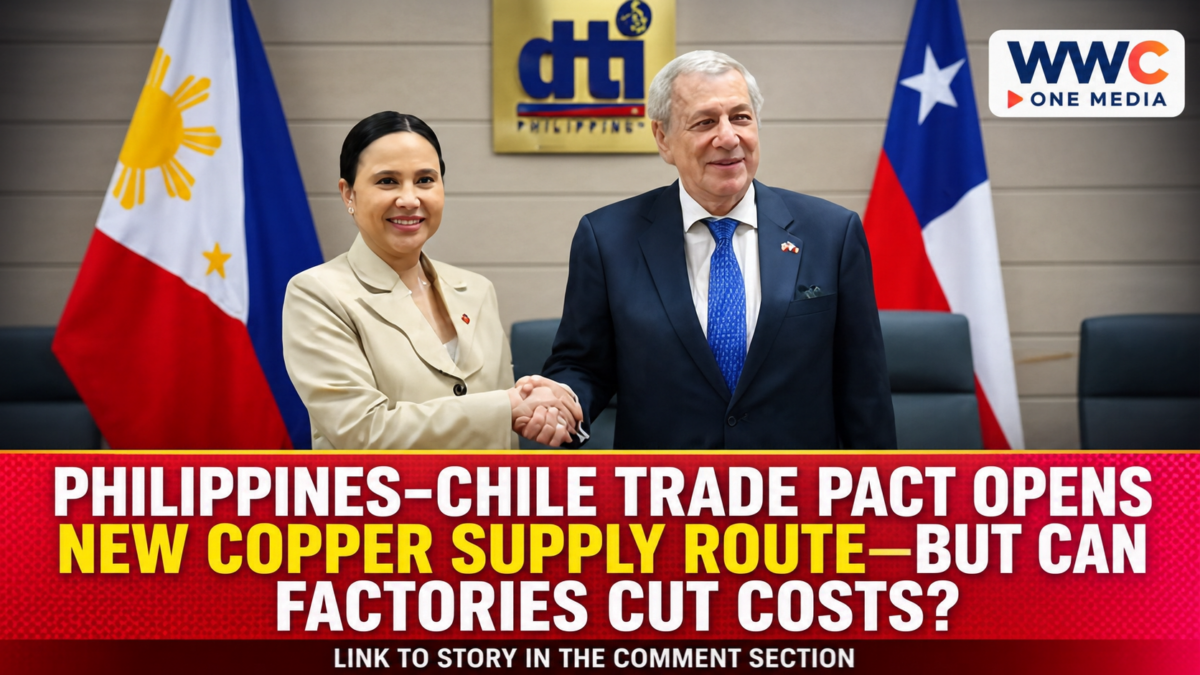
MANILA, Philippines — Philippine manufacturers could gain additional options for sourcing copper, industrial materials and other production supplies following the signing of the Philippines–Chile Comprehensive Economic Partnership Agreement (CEPA) on Nov. 19, 2026, in Shenzhen, China.
The Philippines–Chile trade pact establishes the country’s first bilateral free trade agreement with a Latin American nation, creating opportunities to diversify industrial supply chains and expand commercial relationships across the Pacific.
For factories seeking to manage production expenses, however, the agreement’s commercial value will ultimately depend on applicable tariff reductions, implementation arrangements and the total cost of imported materials.
Philippines–Chile trade pact puts industrial supplies in focus
The agreement was signed by Philippine Trade Secretary Ma. Cristina Roque and Chilean Foreign Affairs Minister Francisco Pérez Mackenna, with Philippine President Ferdinand Marcos Jr. and Chilean President José Antonio Kast witnessing the signing during the Asia-Pacific Economic Cooperation (APEC) meetings.
The two countries concluded negotiations in July 2026, following discussions that covered merchandise trade, services, investment and other areas of economic cooperation.
Among the industrial products identified for preferential market access are copper cathodes, copper wire, copper minerals and lithium compounds.
These materials present potential sourcing opportunities for businesses involved in electronics, energy infrastructure and industrial production.
The agreement complements the wider regional discussions surrounding APEC free trade and economic integration, where commercial connectivity remains an important concern for businesses operating across international markets.
Copper access could reshape manufacturing procurement
Copper has emerged as a particularly relevant component of the bilateral economic relationship because of its importance to electronics, semiconductor manufacturing, renewable energy and advanced industrial applications.
Chilean exports to the Philippines increased from US$103.4 million in 2023 to US$290.8 million in 2024, with demand for strategic industrial materials contributing to that expansion.
The trade agreement presents an opportunity for purchasing managers to evaluate Chilean suppliers alongside their existing procurement networks.
Having additional suppliers could improve purchasing flexibility, particularly when businesses encounter disruptions or unfavourable commercial terms in established markets.
Preferential tariffs, where applicable, may also improve the competitiveness of imported materials.
Nevertheless, preferential market access should not be confused with guaranteed savings. Companies must assess whether alternative supplies meet their technical specifications, delivery requirements and commercial expectations.
The agreement also intersects with broader Asia-Pacific efforts to secure critical minerals and energy supplies, highlighting the importance of reliable industrial resources to regional economic development.
Why lower tariffs may not immediately reduce factory costs
A trade agreement can influence the cost of importing goods, but customs duties represent only one component of industrial procurement expenses.
Manufacturers must consider international freight, insurance, exchange-rate movements, handling charges, inventory requirements and supplier pricing when calculating the actual cost of production materials.
Even where preferential tariffs become available, a manufacturer may find that shipping arrangements or other commercial expenses offset part of the potential benefit.
Product eligibility is another important consideration.
Businesses will need to determine whether imported materials satisfy the agreement’s rules of origin and applicable customs procedures before claiming preferential treatment.
Purchasing decisions should therefore be based on the complete delivered cost of materials rather than tariff reductions alone.
The available information does not establish a specific percentage by which Philippine factories could reduce their manufacturing expenses through the agreement.
Chile expands its commercial footprint in Southeast Asia
The Philippines agreement forms part of Chile’s wider commercial engagement with Southeast Asia.
Chile already maintains trade agreements with Thailand, Singapore, Vietnam, Brunei, Malaysia and Indonesia.
Trade between Chile and ASEAN reached US$5.186 billion in 2025, compared with US$2.710 billion in 2016, representing average annual growth of 7.5%.
The new bilateral partnership adds another commercial connection between Latin American suppliers and Southeast Asian businesses.
It also arrives alongside other cross-Pacific economic initiatives, including the Peru–Thailand free trade agreement.
For companies operating across APEC economies, these arrangements create opportunities to evaluate new suppliers, customers and investment partnerships.
Individual bilateral agreements, however, retain their own conditions. Preferential treatment under one agreement does not automatically extend to every regional trading partner.
What the agreement means beyond manufacturing
The economic partnership extends beyond the movement of physical goods.
Its negotiated scope includes services, investment, digital commerce, intellectual property, environmental matters, labour issues, small and medium enterprises and global value chains.
This broader framework could support commercial relationships involving logistics providers, technology companies, professional services firms and businesses seeking international expansion.
Improved access to industrial materials could also complement investment decisions involving manufacturing facilities and energy infrastructure.
However, additional investment, increased production and employment opportunities remain prospective economic outcomes rather than guaranteed consequences of the signing.
The practical benefits will depend on whether businesses can use the agreement to establish commercially viable relationships.
What happens next?
Manufacturers and importers will need clarity on when preferential tariffs become available, which products qualify and what documentation is required.
Companies considering Chilean supplies can assess potential vendors, compare delivered prices and evaluate shipping schedules before committing to long-term purchasing arrangements.
The agreement creates an opportunity to broaden industrial procurement networks, but the ultimate measure of success will be whether businesses achieve more competitive sourcing costs and dependable supplies.
For Philippine manufacturers and their Asia-Pacific trading partners, the next important development is not another diplomatic announcement. It is the conversion of negotiated trade preferences into measurable commercial results.