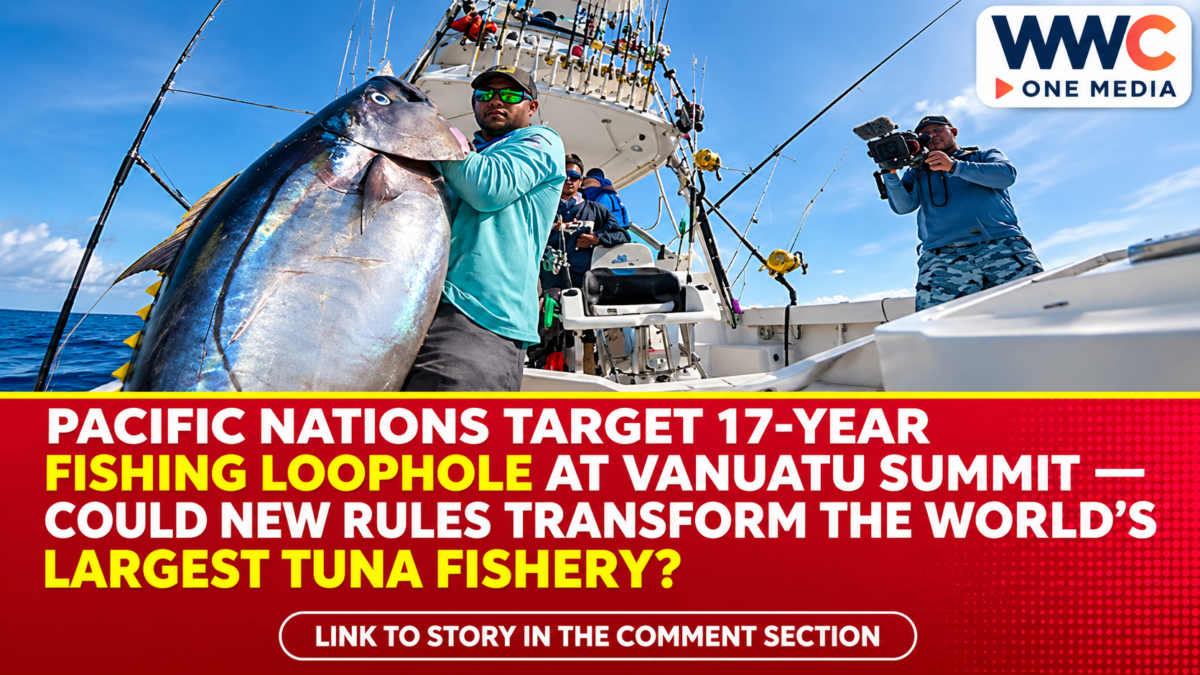
PORT VILA, VANUATU — Pacific fisheries authorities are intensifying efforts to reform offshore fish transfers as new research challenges the commercial justification for a controversial exemption that has existed under regional fishing regulations since 2009.
The Western and Central Pacific Fisheries Commission (WCPFC) will hold its 23rd regular session in Port Vila, Vanuatu, from Nov. 30 to Dec. 5, 2026, bringing international fisheries governance into the spotlight.
Research conducted by the Marshall Islands Marine Resources Authority (MIMRA) and Starboard Maritime Intelligence indicates that fishing vessels frequently transfer catches to cargo ships despite having suitable ports within comparable distances.
The findings raise important questions about seafood traceability, fisheries enforcement, crew welfare and the economic opportunities available to Pacific Island communities.
The upcoming negotiations could influence how tuna is transported from fishing grounds to international seafood markets.
Pacific Fishing Loophole Faces Renewed Scrutiny
At the centre of the negotiations is a practice known as transshipment, in which fishing vessels transfer their catches to another vessel rather than unloading them at a port.
Refrigerated cargo ships can collect fish from multiple fishing vessels before transporting the products to processing facilities or distribution centres.
The WCPFC’s Conservation and Management Measure 2009-06 generally prohibits transshipment on the high seas, subject to exceptions for qualifying vessels where operating without offshore transfers is determined to be impracticable.
The measure also establishes reporting, authorisation and observer requirements.
Separate provisions prohibit purse seine vessels from conducting high-seas transshipment within the convention area.
The central policy dispute concerns whether existing exemptions remain sufficiently justified and whether stronger common standards are necessary.
Permitting offshore transfers under an exemption does not automatically mean a vessel is operating illegally. The debate concerns the adequacy of the regulatory framework and its implementation.
New Research Examines 1,644 Offshore Fish Transfers
The Marshall Islands Marine Resources Authority and Starboard Maritime Intelligence examined satellite tracking information covering May 2020 to March 2026.
Their analysis included 1,644 offshore transfers involving 486 fishing vessels and six cargo ships.
Among the 1,277 transfers for which researchers could compare distances, 41% involved circumstances where a suitable port was at least as close as the cargo vessel.
In another significant finding, approximately 19% of comparable cases involved fishing vessels travelling more than three times farther to reach a cargo ship than to reach an appropriate port.
Researchers also found no measurable relationship between fuel prices and transfer locations during the study period.
The findings challenge the argument that geographical distance and fuel expenditure consistently make port-based transfers impractical.
However, the study does not establish that every offshore transfer was unlawful or that all vessels could operate profitably under different arrangements.
Its findings instead provide evidence for fisheries authorities to reconsider how exemptions should be evaluated.
Why Offshore Tuna Transfers Create Oversight Challenges
A fishing vessel that regularly enters port provides authorities with opportunities to examine its documentation, inspect its catch and assess conditions aboard the vessel.
When fish are transferred offshore, some of these opportunities may be reduced.
Combining catches from several fishing vessels aboard a refrigerated cargo ship can also complicate the process of identifying the original source of seafood products.
For seafood buyers, reliable documentation is particularly important when verifying whether imported products comply with fishing regulations and sustainability requirements.
These challenges form part of a wider fisheries enforcement issue, including efforts to combat illegal and destructive fishing activities in coastal communities.
Nevertheless, offshore transshipment should not be treated as proof of illegal fishing. Enforcement decisions require evidence concerning individual vessels and their activities.
Pacific Island Ports Could Gain Greater Economic Opportunities
The reform debate also concerns where the economic benefits associated with commercial fishing are generated.
The Marshall Islands fisheries authority has advocated moving more transshipment activities into ports and national waters, where fisheries authorities can exercise greater oversight.
From an economic perspective, additional port activity could create opportunities for local businesses providing vessel maintenance, refrigeration, fuel, supplies, transport and seafood handling.
However, the scale of those opportunities would depend on port infrastructure, commercial demand and the operating costs associated with alternative arrangements.
The importance of preserving fish quality and maintaining reliable distribution networks is also illustrated by WWC ONE MEDIA’s coverage of traditional tuna processing and fisherfolk livelihoods.
For Pacific Island economies, improving participation in seafood supply chains could provide opportunities beyond the initial harvesting of marine resources.
Fishing Crew Welfare Becomes Part of the Reform Debate
Extended periods at sea can reduce opportunities for fishing crews to access independent assistance.
The Marshall Islands research initiative and its conservation partners have highlighted the potential benefits of regular port visits, independent fisheries observers and more clearly documented exemptions.
Such safeguards could improve opportunities to examine working conditions and identify possible violations.
Importantly, the vessel-tracking study did not independently establish labour violations aboard every fishing vessel included in its analysis.
The policy challenge is developing oversight mechanisms that protect legitimate fishing operations while reducing opportunities for unlawful activities.
Tuna Conservation Remains Critical to Asia-Pacific Food Security
The Western and Central Pacific fisheries network connects Pacific Island communities with seafood processors, exporters and consumers across international markets.
Protecting the long-term productivity of these fisheries requires effective monitoring alongside broader marine conservation measures.
Fishing activity is also affected by changing environmental conditions, including variations in ocean temperatures and marine ecosystems.
WWC ONE MEDIA has examined these additional challenges in its coverage of El Niño-related risks to marine biodiversity and fisheries.
For seafood companies operating across APEC economies, more transparent supply chains could support efforts to demonstrate regulatory compliance and responsible procurement.
Any changes to transshipment regulations, however, could also require adjustments to existing transportation arrangements and commercial contracts.
What Happens Next at the Vanuatu Fisheries Summit?
The Port Vila meeting will provide fisheries authorities with an opportunity to consider changes to regional monitoring and transshipment arrangements.
Potential reforms include tighter restrictions on offshore transfers, stronger documentary requirements for exemptions and additional independent oversight.
The research released ahead of the meeting provides evidence for reconsidering the existing system, but it does not determine the Commission’s final decision.
Any newly adopted restrictions must be distinguished from proposals submitted before the negotiations.
For Pacific Island communities, fishing companies and international seafood buyers, the outcome could influence how catches are monitored, transported and introduced into global markets.
After nearly 17 years of operating under the existing exemption framework, the Vanuatu summit presents another opportunity to establish clearer rules for offshore fish transfers.
Frequently Asked Questions
What is the Pacific fishing loophole?
It refers to an exemption under WCPFC regulations allowing qualifying vessels to conduct high-seas transshipment when operating without such transfers is deemed impracticable.
When is the Vanuatu fisheries summit?
The 23rd regular session of the Western and Central Pacific Fisheries Commission is scheduled for Nov. 30 to Dec. 5, 2026, in Port Vila.
What did the latest Pacific fisheries research discover?
Researchers found that in 41% of 1,277 comparable offshore transfer cases, a suitable port was at least as close as the cargo vessel.
Is high-seas transshipment automatically illegal?
No. Existing regulations permit qualifying exemptions, subject to applicable authorisation, monitoring and reporting requirements.
Has the Pacific fishing loophole already been closed?
No final decision from the upcoming Vanuatu meeting has been established as of Nov. 26, 2026.