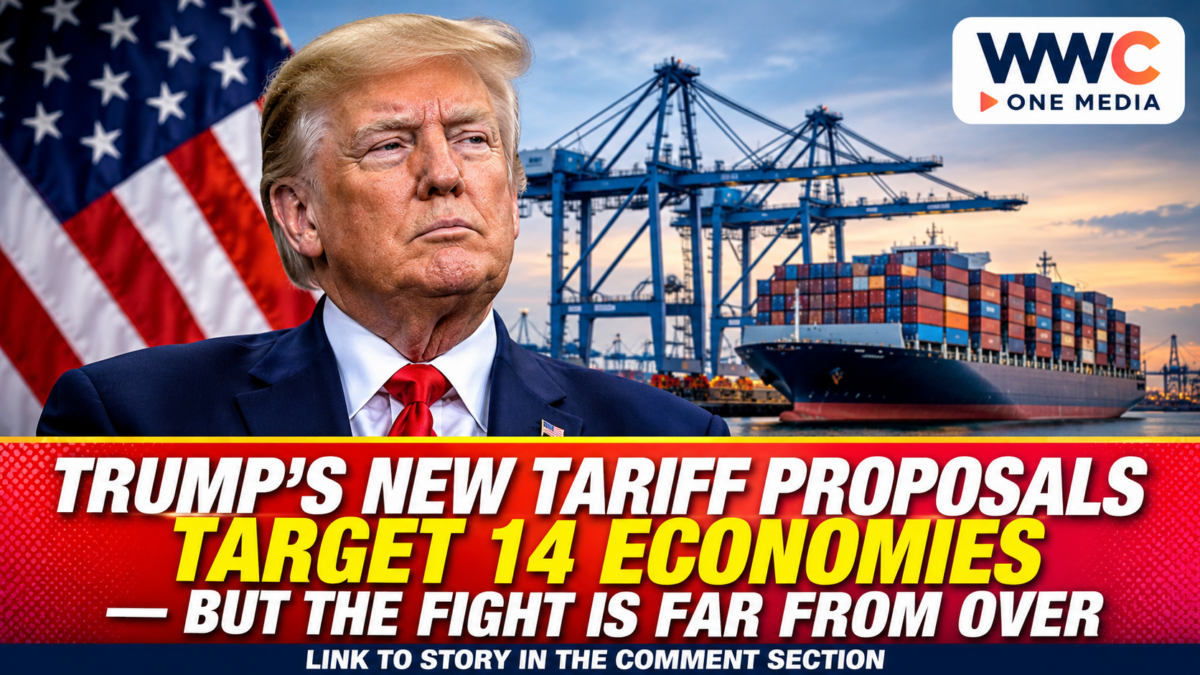
The United States has proposed new trade duties covering 14 economies, adding another layer of uncertainty for international businesses as President Donald Trump continues to pursue a tougher trade policy. The proposals, announced on November 25, come as American consumer prices continue to increase and Congress faces a December deadline to keep federal agencies funded.
The latest action is significant because it moves beyond political statements: the Office of the United States Trade Representative (USTR) has issued formal determinations under Section 301 of the Trade Act of 1974 and outlined possible tariff responses. But the proposed duties are not yet final, and the next stage will involve public comments, hearings and further decisions.
For companies that depend on international supply chains, the distinction matters. A proposed tariff can influence sourcing and investment decisions before it takes effect, but businesses still need the final product coverage, rates and implementation dates before calculating the actual cost.
US tariff proposals cover 14 economies
The USTR determined that certain policies and practices linked to structural excess manufacturing capacity in 14 economies are unreasonable and burden or restrict US commerce. The economies are China, the European Union, Singapore, Switzerland, Indonesia, Malaysia, Cambodia, Thailand, South Korea, Vietnam, Taiwan, Bangladesh, Japan and India.
The agency’s action followed investigations launched on March 11, 2026, covering 16 economies. Mexico and Norway were included in the original investigations, but the USTR said it had not made determinations on them at this time.
The proposed rates differ by economy. The USTR is considering duties of up to 20% on certain Chinese goods, subject to product exclusions and adjustments. For the European Union, it proposed a 15% tariff rate, while Japan and South Korea face proposed rates of up to 15%.
Other examples include proposed rates of up to 18% for Bangladesh, Cambodia, Indonesia, Malaysia and Thailand. India faces a proposal of up to 25%, with the USTR also identifying a possible 17% rate if a qualifying trade agreement is reached. Vietnam’s proposal reaches up to 35%, with a possible adjustment to 20% under specified trade-agreement conditions.
These figures should not be read as a single across-the-board increase. The USTR’s proposals contain exemptions, account for certain existing duties and refer to trade commitments with individual economies.
Why Washington is using Section 301
Section 301 gives the US Trade Representative authority to investigate foreign government practices considered unjustifiable, unreasonable or discriminatory when they burden or restrict US commerce.
In this case, the USTR’s determinations focus on what it describes as structural excess capacity and production in manufacturing sectors. The agency’s position is that certain government policies, industrial support and production practices can distort competition and weaken opportunities for American producers.
That is the administration’s official trade rationale. The determinations are government findings under US trade law; they should not be treated as independent proof that every company in the named economies benefits from unfair practices.
The legal route also matters. Section 301 is a trade-law mechanism with an investigation and public process. The latest action is therefore distinct from a tariff announcement that immediately changes customs charges.
For businesses, the practical questions are which products will be covered, how the rates interact with existing duties, and whether negotiations lead to changes before implementation.
Inflation figures require a closer reading
The tariff proposals arrive while consumer prices remain a major concern in the United States. The Bureau of Labor Statistics reported that the Consumer Price Index for All Urban Consumers rose 0.4% on a seasonally adjusted basis in October 2026, following a 0.6% increase in September.
Food prices rose 0.5% in October, while the energy index increased 0.7%. The index for all items excluding food and energy rose 0.3%.
There is an important limitation in the latest release. Because the Bureau of Labor Statistics did not collect survey data for October 2025 during the previous lapse in federal appropriations, it could not publish most 12-month inflation comparisons for October 2026. It would therefore be inaccurate to attach a new October year-on-year inflation rate to the latest monthly increase.
Tariffs can affect the cost of imported goods, but their eventual effect on consumer prices depends on several factors. Importers may absorb some additional costs, suppliers may adjust prices, businesses may change sourcing arrangements, and retailers may pass some costs to customers.
US Customs and Border Protection guidance identifies the importer of record as the party responsible for applicable duties and taxes. That does not mean every tariff increase is automatically passed directly to consumers at the same rate.
For Philippine exporters and manufacturers, this is a reminder that access to the US market involves more than the headline tariff rate. WWC’s review of what official US–Philippines trade records establish explains why product coverage and the wording of government instruments matter.
The Philippines is not on the new 14-economy list
The Philippines is not among the 14 economies covered by the November 25 determinations. That is an important distinction for local businesses assessing whether the latest announcement directly names Philippine exports.
However, exclusion from this particular investigation does not mean Philippine products are automatically exempt from every other US trade measure. Different investigations and tariff authorities can apply to different products and circumstances.
The issue is already relevant to Philippine companies. WWC has previously examined the return of lower US tariffs to the Philippine trade agenda, including the need to distinguish one tariff measure from another.
The latest US action also comes while Manila and Washington continue to discuss commercial relations. Businesses should avoid treating a diplomatic discussion, a proposed tariff adjustment and an implemented customs rule as interchangeable developments. WWC’s report on ongoing Philippines–US trade talks and the separate tariff question provides further context.
Shutdown deadline adds another policy pressure point
Trade policy is not the only issue facing Washington. Federal agencies are operating under a continuing resolution that funds government operations through December 11, 2026.
The Congressional Research Service says Congress must enact the regular fiscal 2027 appropriations bills or another continuing resolution before the current measure expires. Without new funding authority, a funding gap could begin on December 12 and result in a shutdown affecting covered government activities.
That deadline is a risk, not a confirmation that another shutdown will happen. Congress still has the option of passing appropriations legislation or extending temporary funding.
A funding lapse could disrupt some government services and delay administrative work. For businesses, the concern is that uncertainty around government operations may complicate regulatory processes, public services and economic planning.
The previous lapse also has a direct connection to the latest inflation data: the BLS says it could not collect October 2025 survey data because of the earlier appropriations lapse. That missing information is why the October 2026 CPI release lacks most year-on-year comparisons.
What happens next
The next formal stage for the proposed tariffs is already scheduled. Interested parties must submit written comments by January 5, 2027. Requests to appear at hearings, together with summaries of testimony, are also due by that date. USTR hearings are scheduled to begin on January 25.
Those proceedings could affect the final product lists, exemptions and tariff rates. The agency may also take account of negotiations and commitments made with individual trading partners.
Separately, Congress must address the December 11 funding deadline to avoid a lapse in appropriations. The next inflation release, covering November 2026, is scheduled for December 10.
The administration’s direction is clear: it is continuing to use trade measures to pressure foreign governments over manufacturing and industrial policies. What remains unresolved is how much of the proposed tariff package will survive the consultation process and how businesses will respond if the duties are implemented.
Frequently asked questions
Has Trump imposed new tariffs on 14 economies?
The USTR announced determinations and proposed tariff actions on November 25, 2026. The proposed duties are still subject to public comments and hearings, so they should not be described as fully implemented.
Which economies are covered by the new US tariff proposals?
The 14 are China, the European Union, Singapore, Switzerland, Indonesia, Malaysia, Cambodia, Thailand, South Korea, Vietnam, Taiwan, Bangladesh, Japan and India.
What tariff rate is proposed for China?
The USTR is considering tariffs of up to 20% on certain Chinese goods, with different treatment for specified products and exemptions.
Is the Philippines included in the new tariff investigation?
No. The Philippines is not among the 14 economies for which the USTR made determinations in this November 25 action. Other US trade measures may still apply separately.
When could the proposed tariffs take effect?
The USTR has scheduled written comments by January 5, 2027, and hearings beginning January 25. The November 25 announcement does not establish a final implementation date for the proposed duties.