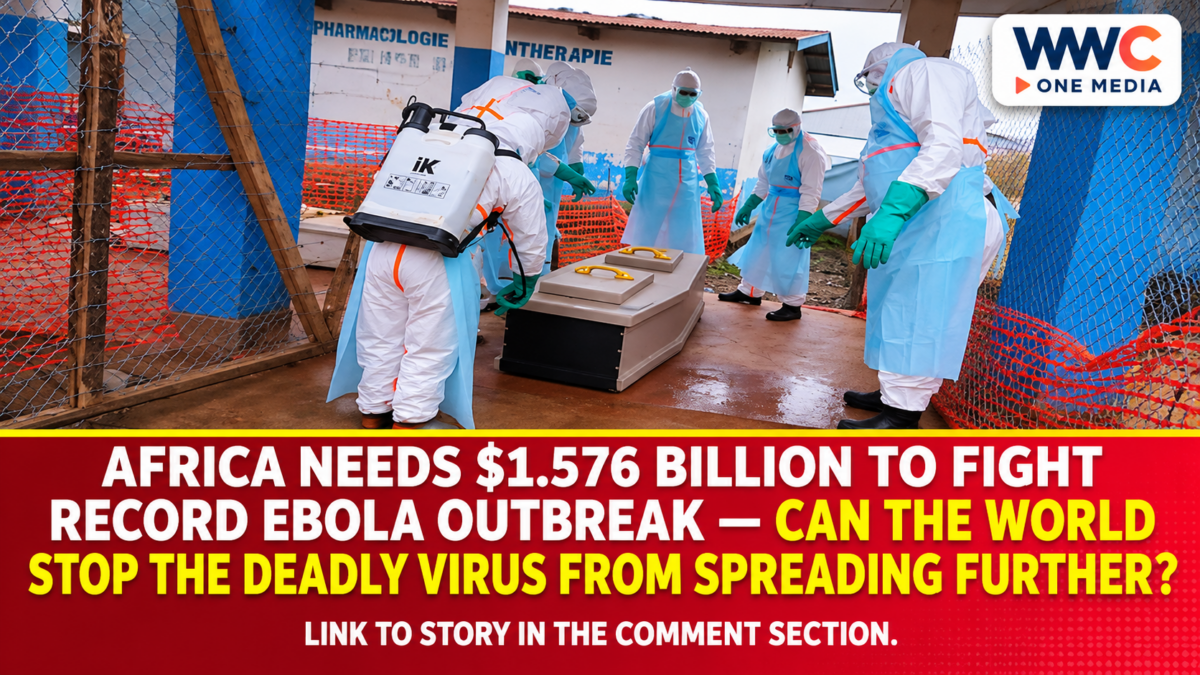
ADDIS ABABA, ETHIOPIA — Africa faces an estimated US$1.576 billion funding requirement to combat the ongoing Ebola outbreak and strengthen regional disease preparedness through May 2027, as the Democratic Republic of the Congo continues to confront its largest recorded Ebola epidemic.
The revised continental preparedness and response plan, published on November 25, 2026, by the Africa Centres for Disease Control and Prevention (Africa CDC) and the World Health Organization (WHO), establishes the financial resources needed to expand emergency operations.
The outbreak, caused by the Bundibugyo virus, has placed considerable pressure on healthcare systems already confronting insecurity, population displacement and humanitarian emergencies.
With infections also reported outside Congo, international cooperation remains essential to limiting further transmission while maintaining essential healthcare services.
Africa Ebola outbreak requires unprecedented Bundibugyo response
The updated response plan covers November 2026 through May 2027, with an estimated resource requirement of US$1.576 billion.
The financial estimate includes an interquartile range of US$1.509 billion to US$1.648 billion, reflecting uncertainty surrounding the resources needed across participating countries and implementing organisations.
The new plan follows an earlier US$518 million continental initiative covering June through November 2026.
The revised requirements reflect the scale of the continuing emergency and the need for sustained operations across affected and vulnerable communities.
However, the estimated US$1.576 billion should not be interpreted as confirmed donor contributions or money already available to health authorities.
The effectiveness of the programme will depend on funding mobilisation, operational coordination and the ability of response teams to reach communities requiring assistance.
Congo remains at the centre of the Ebola emergency
The Democratic Republic of the Congo continues to carry the largest share of the outbreak’s documented burden.
As of November 17, 2026, the country had recorded:
- 11,613 confirmed infections
- 5,678 confirmed deaths
- 3,148 recoveries
- A crude case fatality ratio of 48.9%
- Cases across 68 health zones in eight provinces
Ituri remains the most severely affected province in terms of cumulative infections, followed by North Kivu.
The outbreak represents the largest recorded epidemic involving the Bundibugyo virus and the largest Ebola outbreak documented within the Democratic Republic of the Congo, regardless of virus species.
The figures extend developments previously examined in WWC ONE MEDIA’s coverage of Congo’s Ebola outbreak and difficulties reaching remote communities.
Confirmed infections and deaths reflect cases identified through official surveillance systems. They should not be assumed to represent every infection that has occurred.
What will the $1.576 billion Ebola response support?
The continental plan combines outbreak containment with efforts to reinforce healthcare systems and humanitarian assistance.
Its operational priorities include strengthening disease surveillance, improving access to diagnostic services, supporting healthcare personnel and maintaining essential medical services.
Community participation is also a central component of the response.
Effective disease surveillance depends partly on whether people experiencing symptoms can access medical assessment and whether communities are willing and able to cooperate with health teams.
Funding must therefore support not only clinical facilities but also the wider infrastructure necessary to identify infections, communicate risks and deliver assistance.
The financial requirement highlights the importance of coordination among governments, humanitarian organisations and international development partners.
An announced budget, however, does not automatically translate into operational capacity. Access to affected communities and timely delivery of resources remain critical considerations.
Armed conflict continues to complicate outbreak containment
Insecurity and population displacement remain significant obstacles to Ebola response operations in eastern Congo.
Healthcare teams must operate in areas where humanitarian access can be restricted and where communities may face multiple emergencies simultaneously.
Delayed payments to frontline personnel have also disrupted response activities.
The November 25 international risk assessment identified persistent weaknesses in disease surveillance, healthcare capacity and the availability of infection-control supplies.
More than 80% of newly reported infections were being identified among people outside established contact-tracing lists.
This makes it more difficult for response teams to establish transmission links and identify potentially exposed individuals before additional infections occur.
Earlier developments involving these challenges were documented in Congo’s expanding Ebola infection hotspots and response difficulties.
Improving security, protecting healthcare personnel and maintaining community trust are therefore central to the broader containment effort.
Why the Bundibugyo virus presents additional challenges
The availability of vaccines and medical treatments differs depending on the Ebola virus species responsible for an outbreak.
The current emergency involves Bundibugyo virus, rather than the species targeted by existing licensed Ebola vaccines.
As of the November 17 international emergency committee briefing, clinical research involving potential treatments had enrolled more than 900 participants.
A vaccine trial involving Ervebo began in October, although that vaccine is not specifically approved for Bundibugyo virus.
Two additional vaccine candidates developed specifically for Bundibugyo were expected to enter the research programme.
These developments represent ongoing scientific investigations rather than proof that an effective, approved Bundibugyo vaccine is already available.
Until appropriate vaccines and targeted treatments are established, early medical care, infection prevention, contact tracing and other established public-health measures remain fundamental.
Why the Ebola emergency matters to Asia-Pacific economies
On November 18, 2026, WHO reaffirmed that the outbreak constitutes a Public Health Emergency of International Concern.
The November 25 risk assessment classified the public-health risk as very high in the Democratic Republic of the Congo and high in Kenya and Nigeria, where cases had been reported without documented community transmission.
Risk classifications for other countries depend on factors including their connections to affected areas and their capacity to detect and respond to infections.
Countries with strong response capabilities may face substantially different risks from those with limited healthcare resources.
For Asia-Pacific economies, maintaining effective disease surveillance and emergency coordination remains relevant to preparedness.
Japan’s recent national Ebola emergency response simulation illustrates how countries outside the affected region can test institutional readiness without implying that domestic transmission is occurring.
Broader regional preparedness is also examined in Pacific disease alerts and the importance of effective surveillance.
The international emergency designation should not be confused with evidence of widespread Ebola transmission across the Asia-Pacific region.
What happens next?
The response programme’s next phase will focus on expanding access to healthcare, securing sustainable financing and improving coordination across affected countries.
Progress will depend on the ability of healthcare workers to identify infections earlier and provide appropriate care while protecting essential medical services.
Vaccine and therapeutic research will remain important, but experimental products must undergo appropriate scientific and regulatory assessment.
For international donors, the immediate challenge is ensuring that financial commitments translate into practical assistance.
For affected communities, the priority remains timely access to medical services and protection from further infection.
The proposed US$1.576 billion programme establishes the scale of the required response. Whether it can bring the epidemic under control will depend on its implementation over the coming months.
Frequently asked questions
How much money is needed to fight Africa’s Ebola outbreak?
Africa CDC and WHO estimate that US$1.576 billion will be required for the continental response from November 2026 through May 2027.
Which Ebola virus is causing the current outbreak?
The outbreak is caused by Bundibugyo virus, a species of Ebola virus.
How many Ebola deaths have been confirmed in Congo?
As of November 17, 2026, Congo had recorded 5,678 confirmed deaths among 11,613 confirmed infections.
Is there an approved vaccine specifically for Bundibugyo Ebola?
The reviewed official November 2026 records describe ongoing vaccine research rather than an established licensed vaccine specifically approved for Bundibugyo virus disease.
Does the Ebola international emergency mean a global pandemic has begun?
No. The emergency designation establishes the need for coordinated international public-health action. It does not establish widespread transmission throughout the world.