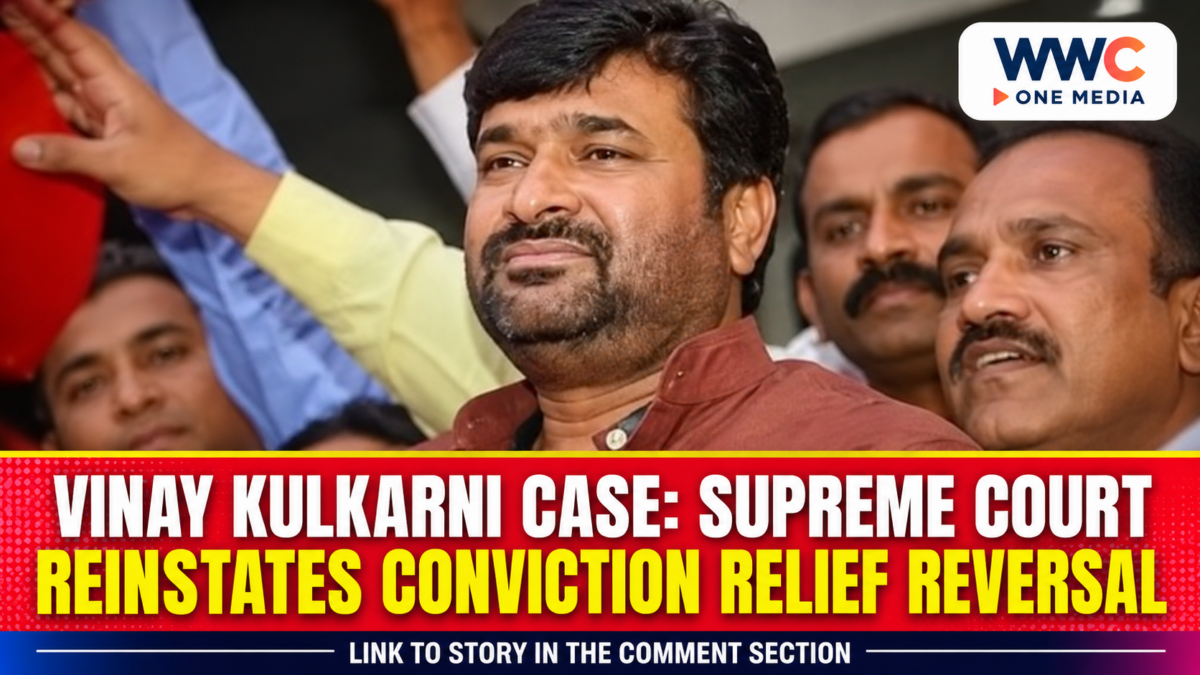
NEW DELHI — November 26, 2026 — India’s Supreme Court has overturned Karnataka High Court orders that had suspended the conviction and prison sentences of former legislator Vinay Rajashekharappa Kulkarni and other convicted respondents in the 2016 murder of Yogesh Goudar. The November 25 ruling directs the affected convicts to surrender before the appropriate court within two weeks.
The decision puts the trial court’s conviction and sentence back into operation while the criminal appeals remain pending. It also clarifies the demanding legal standard courts must apply when considering whether to suspend a conviction, particularly when the person seeking relief is an elected legislator.
Why the Vinay Kulkarni case returned to the Supreme Court
The proceedings concern the killing of Yogesh Goudar, a Zilla Panchayat member from Dharwad, Karnataka. The Supreme Court judgment records that Goudar was attacked near Uday Gym and Fitness Centre in Saptapura on June 15, 2016. The local police initially registered a case against unknown assailants.
The investigation later expanded. Following a Karnataka government order dated September 6, 2019, the Central Bureau of Investigation took up further investigation. The case eventually proceeded before the Special Court in Bengaluru as Special Case No. 565 of 2021.
Kulkarni was named as accused No. 15 in the later proceedings. The prosecution alleged that he was involved in a criminal conspiracy connected to Goudar’s killing. Those allegations were tested during the trial, which resulted in convictions and life sentences for several accused.
The Supreme Court’s November ruling concerns the interim relief granted after those convictions. It does not amount to a final decision on the separate appeals challenging the trial court’s findings.
The High Court’s July decision and the challenge that followed
On July 31, 2026, the Karnataka High Court granted relief to several convicted respondents by suspending their sentences and allowing them to remain on bail while their appeals were pending. In a separate order on the same date, it stayed Kulkarni’s conviction.
The High Court considered issues raised by the defense, including questions about the evidence, the investigation and the potential consequences of the conviction for Kulkarni’s legislative position.
The State of Karnataka and Gurunatha Gouda, the deceased’s brother, challenged the stay of conviction. The CBI and the deceased’s brother also brought connected challenges to the suspension of sentences granted to other convicted respondents.
The Supreme Court considered the connected appeals together. Its review focused on whether the High Court had applied the proper legal tests before granting the relief.
The procedural distinction is important. A court may suspend a sentence while an appeal is pending, but staying the conviction itself is a separate and more exceptional remedy. The two forms of relief do not carry identical legal requirements.
The Supreme Court’s standard for staying a conviction
In its judgment, the Supreme Court said that staying a conviction requires more than establishing an ordinary prima facie case. The applicant must demonstrate a clear and serious error in the conviction judgment—one apparent from the record and significant enough to make the conviction legally unsustainable.
The Court found that the High Court’s order did not identify the kind of fundamental error required to justify staying Kulkarni’s conviction. It also rejected the idea that the possibility of disqualification from the legislature could, by itself, provide the main reason for suspending a conviction.
The judgment discussed Section 8(3) of India’s Representation of the People Act, 1951, which provides for disqualification consequences following conviction and sentence for specified offences. The Court said that the possibility of disqualification may be considered, but cannot replace the demanding legal test for staying a conviction.
This reasoning has implications beyond the immediate case. It signals that the political consequences of a criminal conviction do not automatically justify exceptional judicial relief.
WWC ONE MEDIA has also examined how courts distinguish procedural relief from a final finding of guilt in its coverage of the Sandiganbayan’s ruling in the Bong Revilla flood-control case. The cases involve different legal systems and allegations, but both demonstrate why an interim court order should not be confused with a final resolution of criminal liability.
Why the Court also rejected the sentence suspensions
The Supreme Court separately reviewed the High Court’s decision to suspend the sentences of other convicted respondents.
It said that the expected delay in hearing a criminal appeal does not automatically entitle a person sentenced to life imprisonment for a grave offence to release on bail. An appellate court must examine whether the conviction record discloses a good and legally supportable basis for believing that the appeal has a fair chance of success.
The judgment also addressed arguments concerning the testimony of an accused who became an approver, or a prosecution witness after receiving legal pardon. The Court explained that such testimony is admissible under Indian law, while corroboration remains an important safeguard for assessing its reliability.
The justices referred to material that the trial court had considered, including witness testimony and documentary, medical and forensic evidence. These observations were made while assessing the interim orders; the Supreme Court did not conduct the final hearing of the pending criminal appeals.
The ruling therefore does not eliminate the convicted respondents’ right to challenge the trial court’s decision. It determines that the High Court’s reasons were insufficient to justify the particular suspension and stay orders under review.
The broader issue of judicial oversight is also visible in other cases. WWC’s report on a Telangana High Court ruling over a police encounter investigation examined how courts assess the records and procedures supporting official explanations. In another jurisdiction, its coverage of the South Korean Supreme Court’s decision in the Han Duck-soo case showed how a higher court can alter parts of a lower-court outcome without necessarily ending the underlying proceedings.
What the decision means for the appeals
The Supreme Court’s order restores the legal effect of the challenged conviction and sentence orders for the affected respondents. Their bail bonds stand cancelled, and the Court directed them to surrender before the concerned court within two weeks.
That direction is not the same as dismissing their appeals. The underlying criminal appeals remain to be decided by the appropriate appellate court. The respondents may continue to challenge the convictions through those proceedings, subject to the applicable law and court directions.
The ruling also leaves a clear legal distinction for future cases: suspension of a sentence and a stay of conviction are different forms of relief, and the latter requires a particularly strong justification.
For public officials and elected representatives, the decision reinforces that the consequences of conviction cannot be set aside merely because they affect political office. For the justice system, it places renewed attention on how appellate courts explain decisions that temporarily prevent a criminal conviction or sentence from taking effect.
What happens next
The immediate next step is compliance with the Supreme Court’s surrender direction. The affected respondents must report to the court concerned within the two-week period specified in the judgment.
The appeals against the trial court convictions remain pending. Their eventual outcome will depend on the appellate court’s examination of the record and the legal arguments raised by the parties.
The November 25 decision resolves the challenge to the High Court’s interim orders. It does not close the wider criminal appeal process.
Frequently asked questions
1. Why did India’s Supreme Court cancel Vinay Kulkarni’s bail relief?
The Court set aside the Karnataka High Court’s orders after finding that the legal requirements for staying the conviction and suspending the sentences had not been properly met.
2. How long does Vinay Kulkarni have to surrender?
The Supreme Court directed the affected convicted respondents to surrender before the concerned court within two weeks of its November 25, 2026 judgment.
3. Has Vinay Kulkarni’s conviction become final?
No. The trial court’s conviction is again operative after the Supreme Court set aside the interim stay, but the criminal appeal challenging the conviction remains pending.
4. What was the case about?
The case concerns the June 15, 2016 killing of Yogesh Goudar, a Zilla Panchayat member from Dharwad, Karnataka. The prosecution alleged a criminal conspiracy involving multiple accused.
5. Can the convicted respondents still appeal?
Yes. The Supreme Court’s ruling addressed the High Court’s interim orders. It did not dispose of the underlying appeals against the convictions.