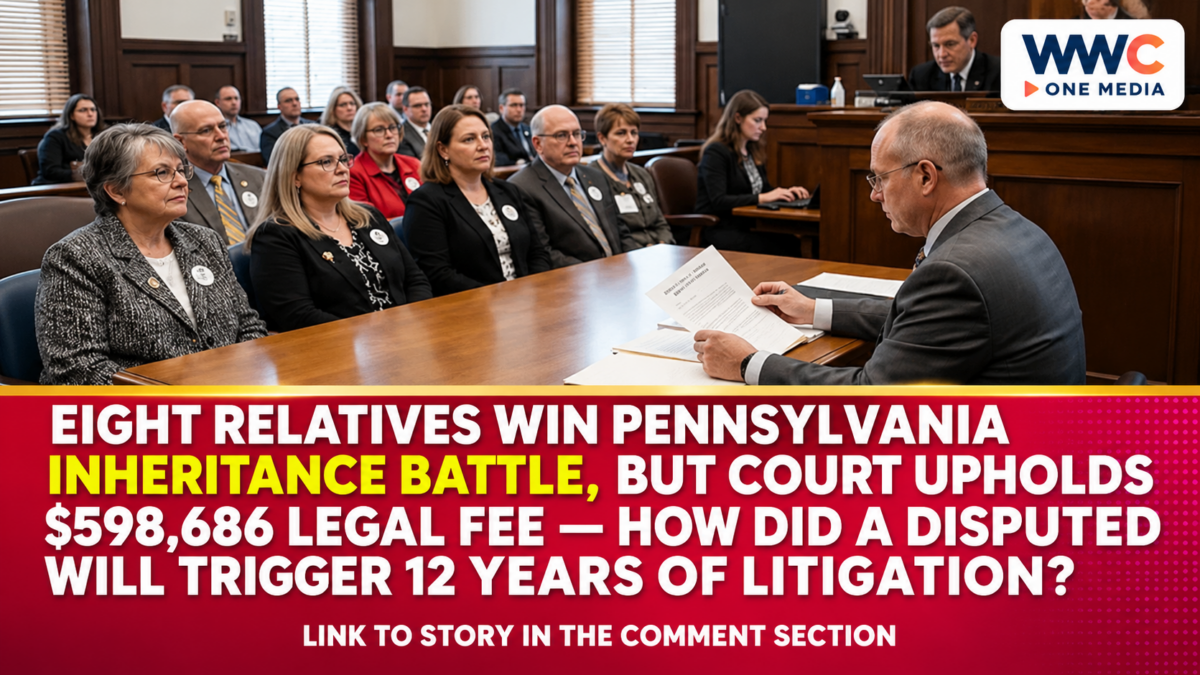
PENNSYLVANIA, UNITED STATES | November 26, 2026 — A Pennsylvania inheritance dispute that began with a man’s death in 2014 has reached another major legal milestone after the Pennsylvania Superior Court upheld an award of US$598,686.34 in attorney’s fees and costs to the lawyer who successfully represented eight relatives in challenging a disputed will.
The November 24, 2026 decision rejected attorney Richard P. Joseph’s appeal against an October 30, 2025 order issued by the Beaver County Orphans’ Court.
Joseph had successfully helped the eight nieces and nephews of John J. Thomas establish their inheritance rights. However, determining how much the lawyer should receive for his services became a separate legal battle.
More than 12 years after Thomas died, the proceedings illustrate how inheritance litigation can develop into disputes over legal contracts, professional compensation and the financial consequences of pursuing an estate claim.
Pennsylvania Inheritance Dispute Began With a Contested Will
John J. Thomas died on October 12, 2014, leaving eight surviving nieces and nephews.
Following his death, Timothy Ungarean, his second cousin, submitted a document dated July 7, 2014, purporting to be Thomas’s last will and testament.
The document designated Ungarean as the estate’s only beneficiary.
Thomas’s nieces and nephews challenged the document’s validity and retained Joseph to represent their interests.
The dispute eventually reached the Beaver County Orphans’ Court, where Judge Paul F. Lutty determined that the purported will and other documents allegedly executed by Thomas on the same date were invalid.
The ruling established that Thomas had died intestate, meaning that his estate would pass to his legally recognised heirs under the applicable succession laws rather than under the disputed document.
Ungarean subsequently appealed, but the Pennsylvania Superior Court affirmed the ruling on March 6, 2020.
The inheritance dispute demonstrates why the validity of estate documents can be as consequential as the assets themselves.
Similar questions concerning beneficiaries and estate administration have emerged in other jurisdictions, including a Singapore inheritance dispute involving the legal validity of a marriage.
Although the legal circumstances differ, both cases illustrate how an underlying judicial determination can affect who is entitled to inherit property.
Winning the Estate Battle Was Only the Beginning
The successful challenge to the will did not resolve every financial issue facing Thomas’s estate.
In December 2014, the heirs and Joseph entered into a written agreement outlining the terms of his legal representation.
The arrangement established a contingency-based payment structure.
Under this type of agreement, a lawyer’s compensation depends on the outcome of the legal matter and the contractual conditions governing the fee.
Joseph’s agreement provided for a 33⅓% fee on a settlement, increasing to 40% under specified conditions involving the progression of the litigation.
It also required the clients to provide advance funding for litigation expenses.
The agreement, however, became the subject of competing interpretations after the inheritance litigation succeeded.
Joseph maintained that his compensation should encompass 40% of the entire estate, including assets that might subsequently be recovered.
The estate’s representatives disputed that interpretation.
The central question was no longer whether the relatives were entitled to inherit. It was how the lawyer’s compensation should be calculated.
As broader research into estate planning and disputes between beneficiaries has illustrated, legal disagreements can continue even after fundamental inheritance questions have been resolved.
Why an Earlier $851,505 Fee Award Was Overturned
In 2023, the Orphans’ Court issued orders awarding Joseph US$851,505 while also recognising an entitlement to 40% of estate assets.
The estate’s representatives questioned the financial implications of those orders.
At the time, the estate reported that US$1,543,711.67 was held in escrow as of June 30, 2023.
The representatives raised concerns that the wording of the orders could result in compensation exceeding what they understood the original fee agreement to permit.
The dispute returned to the Pennsylvania Superior Court.
On October 24, 2024, the appellate court concluded that Joseph was contractually entitled to a 40% contingency fee. However, the agreement did not adequately define the financial base on which that percentage should be calculated.
The court determined that the percentage should apply to the net escrow balance available for distribution to the heirs.
It also concluded that the agreement did not provide additional compensation for Joseph’s work defending the successful will-contest ruling against Ungarean’s appeal.
Furthermore, expenses previously advanced by the heirs had to be credited in determining the amount payable.
The earlier orders were vacated, and the matter was returned to the lower court for further proceedings.
The ruling highlights an important distinction in financial litigation: agreeing on a percentage does not necessarily eliminate disagreements over the amount to which that percentage applies.
How the $598,686 Legal Fee Became the Latest Dispute
Following further proceedings, the Beaver County Orphans’ Court issued a revised award on October 30, 2025.
The court determined that Joseph was entitled to US$598,686.34 in attorney’s fees and costs.
Joseph challenged the revised award and also contested Judge Michael F. Marmo’s refusal to withdraw from the proceedings.
The November 2026 appeal therefore addressed both the financial award and whether the judge should have recused himself.
However, a significant procedural issue affected the appellate court’s ability to examine the compensation dispute.
The certified record did not contain the transcript of an August 15, 2025 evidentiary hearing.
The Superior Court concluded that the responsibility for ensuring the availability of the necessary appellate record rested with Joseph.
Without the transcript, the judges could not adequately examine the evidentiary basis of his challenge to the fee calculation.
Consequently, the compensation issue was deemed waived.
The court also rejected his challenge concerning judicial recusal, leaving the October 2025 award intact.
The distinction between appellate review and a new determination of financial entitlement is important. Other cases, including the appellate ruling upholding a ₱240.6-million monetary award for GMA employees, similarly demonstrate the financial significance of appellate decisions, although the underlying legal issues are different.
What the Case Reveals About the Financial Risks of Estate Litigation
The Thomas estate proceedings raise broader questions about the financial arrangements families enter into when challenging inheritance documents.
Contingency-fee agreements can provide a mechanism for pursuing legal claims without requiring the entire professional fee upfront.
Nevertheless, the precise wording of such agreements can become critical when substantial assets are involved.
The definition of recoverable assets, the treatment of litigation expenses and the compensation arrangements for subsequent appeals may all influence how much money ultimately remains available for beneficiaries.
The Pennsylvania case also illustrates the importance of maintaining complete documentation throughout litigation.
An appellate challenge may depend not only on the substance of a party’s arguments but also on whether the court has the necessary record to evaluate them.
These considerations are particularly relevant to families managing substantial estates or navigating inheritance arrangements across different legal jurisdictions.
What Happens Next?
The immediate legal position is that the Pennsylvania Superior Court has affirmed the US$598,686.34 award.
The November 24 ruling is designated as non-precedential, meaning it should not be interpreted as establishing a universally binding contingency-fee formula for other inheritance disputes.
It also does not establish that Joseph has already received the full amount or that every remaining administrative matter involving the estate has been completed.
Whether additional proceedings will follow remains unconfirmed.
For now, the Thomas estate dispute stands as a striking example of how winning an inheritance case can leave another consequential question unresolved for years: how much of the recovered wealth must be allocated to the legal process that secured it?
Frequently Asked Questions
What was the Pennsylvania inheritance dispute about?
Eight nieces and nephews of John J. Thomas challenged a purported will naming his second cousin as the estate’s sole beneficiary. The document was declared invalid, and the estate was ordered to pass under intestate succession.
How much did the Pennsylvania court award the lawyer?
The Beaver County Orphans’ Court awarded Richard P. Joseph US$598,686.34 in attorney’s fees and costs. The Pennsylvania Superior Court affirmed the award on November 24, 2026.
Why did the lawyer claim a 40% contingency fee?
His December 2014 agreement with the heirs provided for a 40% contingency fee once specified litigation conditions were satisfied. The subsequent dispute concerned how that percentage should be calculated.
Why was the lawyer’s latest appeal unsuccessful?
The necessary transcript of an evidentiary hearing was absent from the certified record, resulting in waiver of his challenge to the fee amount. The court also rejected his judicial-recusal argument.
Does the ruling mean every inheritance lawyer can charge 40%?
No. The percentage arose from the specific contractual agreement in this case. The November 2026 decision was designated non-precedential.