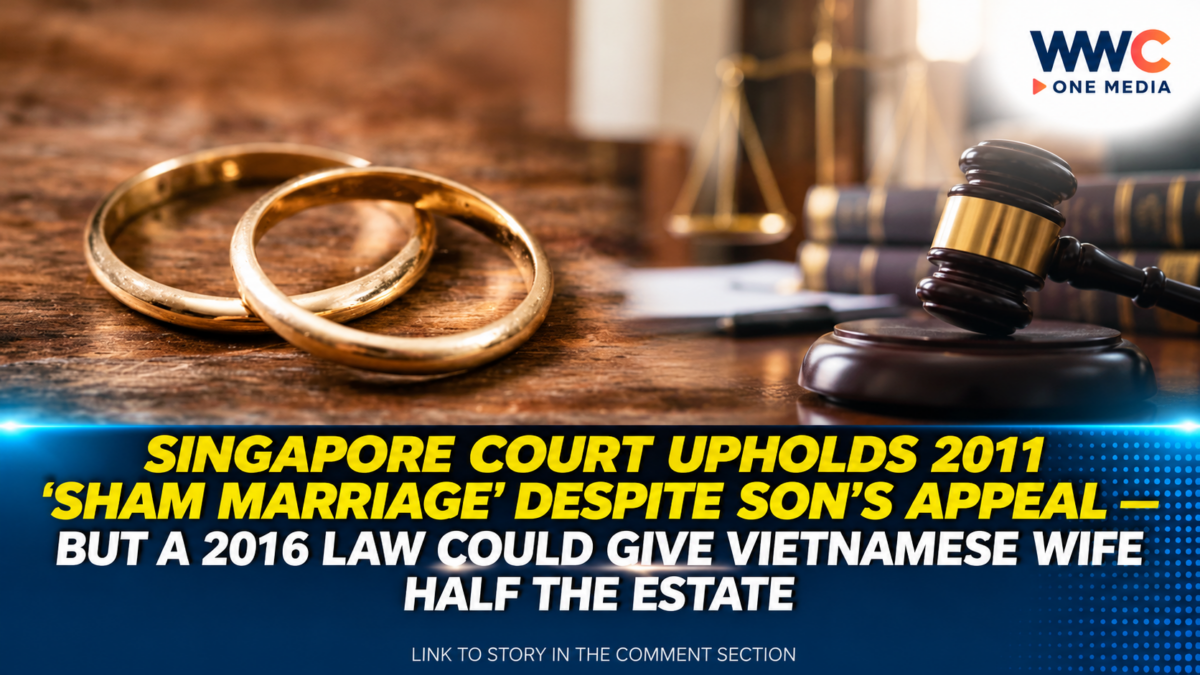
SINGAPORE — A Vietnamese woman whose marriage to a Singaporean man lasted less than a year could inherit half of his estate despite the union being regarded as a marriage of convenience, following a closely divided ruling by Singapore’s highest court.
In a decision delivered on Wednesday, October 21, 2026, the Court of Appeal ruled that a marriage registered in 2011 could not be declared void solely because it was entered into for improper immigration-related purposes.
The reason lies in a crucial difference between the law when the couple married and amendments that took effect five years later.
Since October 1, 2016, Singapore’s Women’s Charter has expressly provided that certain marriages of convenience are void. But the court’s majority determined that the provision does not apply retrospectively to marriages solemnised before that date.
The ruling means the woman remains legally recognised as the deceased man’s wife, potentially entitling her to half his estate under Singapore’s intestate succession rules.
However, the court did not order the immediate payment of any inheritance or determine how the estate should be distributed.
The case has attracted attention because it places family inheritance rights, immigration offences and the limits of marriage law at the centre of an unusual legal dispute.
A Marriage That the Husband’s Family Never Knew Existed
The dispute began with the marriage of Singaporean Cheng Meng Koon and Vietnamese national Dang Lan Anh on January 26, 2011.
It was Cheng’s second marriage, following his divorce from his first wife.
According to court documents, he never informed his family about the new marriage, even though he remained close to his relatives.
He also never moved in with Dang. Instead, he continued living with his sister.
At the time, Cheng had been experiencing serious financial problems. He had relapsed into drug addiction and was reportedly facing harassment from loan sharks.
The harassment stopped around the period of his marriage, although his family did not know how his debts had been resolved.
The evidence was considered in proceedings examining whether the marriage had been entered into primarily for immigration-related purposes.
The High Court had been prepared to accept that it was a marriage of convenience, but the critical legal question was whether that made it void under the law applicable in 2011.
Husband Dies of Cancer Less Than a Year Later
The marriage ended in tragedy when Cheng developed terminal cancer and died in January 2012.
Court documents stated that Dang was absent during his hospitalisation and did not provide support or communicate with his family.
Cheng also did not mention her during his final days.
Most importantly for the inheritance dispute, he died without leaving a valid will.
In legal terminology, this is known as dying intestate.
His reported assets included a 14% ownership interest in a Housing and Development Board (HDB) flat and money in his Central Provident Fund (CPF) account.
His son, Cheng Tze Tzuen, subsequently became involved in a legal effort to challenge the marriage’s validity.
The dispute was not simply about whether the relationship was genuine. It was about whether the woman could legally be recognised as a surviving spouse for inheritance purposes.
Family Discovers Secret Marriage Through CPF Notification
The family learned about the marriage only after Cheng’s death.
In March 2012, the Insolvency and Public Trustee’s Office sent a letter informing the family that Dang was entitled to a portion of Cheng’s CPF savings as his surviving wife.
Until then, the family had reportedly been unaware that Cheng had remarried.
They did not know how to locate Dang, prompting the authorities to place a notice in The Straits Times seeking information about her whereabouts.
Years later, in July 2024, the family learned through the Immigration and Checkpoints Authority that Dang had been deported in 2011 for immigration offences.
That discovery added another dimension to the family’s suspicions about the nature of the marriage.
However, a past immigration offence did not automatically establish a legal basis for invalidating the marriage under the legislation that applied when it took place.
Son Goes to Court to Stop Woman From Inheriting
In October 2024, Cheng’s only son applied to the High Court for a declaration that his father’s marriage to Dang was void.
If successful, the application would have removed the marriage as a basis for Dang’s claim to inheritance.
The High Court declined to make the requested declaration.
In its July 2025 written grounds, the court examined the Women’s Charter and previous judicial decisions involving marriages of convenience.
The court accepted that some such marriages could be legally questionable while finding that the 2016 amendment did not apply to unions solemnised before its commencement.
The son subsequently appealed.
The case eventually reached Singapore’s Court of Appeal, where three judges considered the legal consequences of a marriage entered into before the law was changed.
The majority held that courts cannot declare a marriage void on grounds outside those provided for by the Women’s Charter.
Justices Debbie Ong and Ang Cheng Hock concluded that the statutory grounds applicable to the 2011 marriage did not permit the court to invalidate it solely because the parties entered into it for a marriage-of-convenience arrangement.
They also drew a distinction between criminal offences associated with such arrangements and the separate legal question of whether a marriage remains valid.
The judges found no basis to apply the October 2016 amendment to a marriage entered into more than five years earlier.
The son therefore lost his appeal.
Why Singapore’s 2016 Marriage Law Was Decisive
The central legal issue was Section 11A of the Women’s Charter.
Introduced in 2016, the provision makes certain marriages of convenience void when solemnised on or after October 1 of that year.
The rule targets marriages entered into for specified immigration-related purposes involving gratification.
However, the law includes a clear commencement date.
| Date | Legal significance |
|---|---|
| January 26, 2011 | Cheng and Dang marry |
| January 2012 | Cheng dies without a will |
| October 1, 2016 | New provision invalidating specified marriages of convenience takes effect |
| October 2024 | Son begins proceedings challenging the marriage |
| July 2025 | High Court explains why the requested declaration cannot be granted |
| October 21, 2026 | Court of Appeal dismisses the son’s appeal by a 2–1 majority |
This means the outcome should not be interpreted as a general declaration that marriages of convenience are lawful or protected from scrutiny today.
The ruling turned on the law applicable to this particular marriage at the time it was solemnised.
Chief Justice Disagrees: Why He Would Have Voided the Marriage
Chief Justice Sundaresh Menon took a different position.
In his dissenting judgment, he concluded that the marriage should be declared void because it was not solemnised on the authority of a valid marriage licence under the relevant provisions of the Women’s Charter.
His analysis offered a different legal route to invalidity rather than simply applying the 2016 amendment retrospectively.
However, his view was in the minority.
The positions of Justices Ong and Ang therefore determined the outcome, leaving the marriage legally valid for the purposes of the appeal.
Illustration of the general statutory rule, not a final distribution ordered in this case. CPF savings may require separate analysis under applicable CPF rules.
Because Cheng left a son and a legally valid surviving spouse, Dang potentially qualifies for half of his distributable estate under the general rule.
However, the Court of Appeal explicitly did not decide estate administration or distribution.
No verified final payment amount has been announced, and the size of the estate has not been established in the available reporting.
That is an important distinction: the court upheld the marriage’s legal validity, but did not order that half of all assets be transferred to Dang immediately.
Additional Context: Earlier Singapore Courts Faced Similar Disputes
This case is not the first time Singapore’s courts have addressed the relationship between marriages of convenience and inheritance rights.
A 2009 case involving the estate of Tan Kiam Poh considered whether a marriage could be declared void under the Women’s Charter.
A separate 2016 case, Soon Ah See v Diao Yanmei, examined a disputed marriage and the consequences for CPF savings following the husband’s death.
These earlier decisions illustrate an important legal distinction: the validity of a marriage and entitlement to particular assets may involve different statutory rules.
Singapore’s Ministry of Law also discussed the Cheng case in its 2025 probate case digest, noting conflicting earlier judicial approaches to marriages of convenience entered into before October 2016.
Why This Case Matters Beyond Singapore
The ruling offers a cautionary example for families dealing with inheritance disputes.
A marriage that relatives consider suspicious or morally questionable is not automatically invalid in law.
For cross-border marriages, the timing of the marriage, applicable legislation and legal documentation can become decisive.
This is relevant to other countries, including the Philippines, where marriage validity and inheritance rights are also governed by specific legal requirements.
However, Singapore’s ruling does not establish how an equivalent Philippine case would be decided. Philippine marriage and succession laws differ.
The Bigger Question: Who Ultimately Receives the Inheritance?
The immediate legal dispute over the marriage’s validity has ended with the son’s appeal being dismissed.
What remains unresolved is the actual administration and distribution of Cheng’s assets.
The court did not establish a final inheritance amount, order immediate payment or resolve every question concerning CPF monies.
The bottom line: A Vietnamese woman remains legally recognised as the wife of a Singaporean man she married in 2011, despite the union being treated as a marriage of convenience. Because a later law cannot be applied retrospectively, she remains potentially entitled to inherit from his estate. But the final distribution was not determined in this appeal.