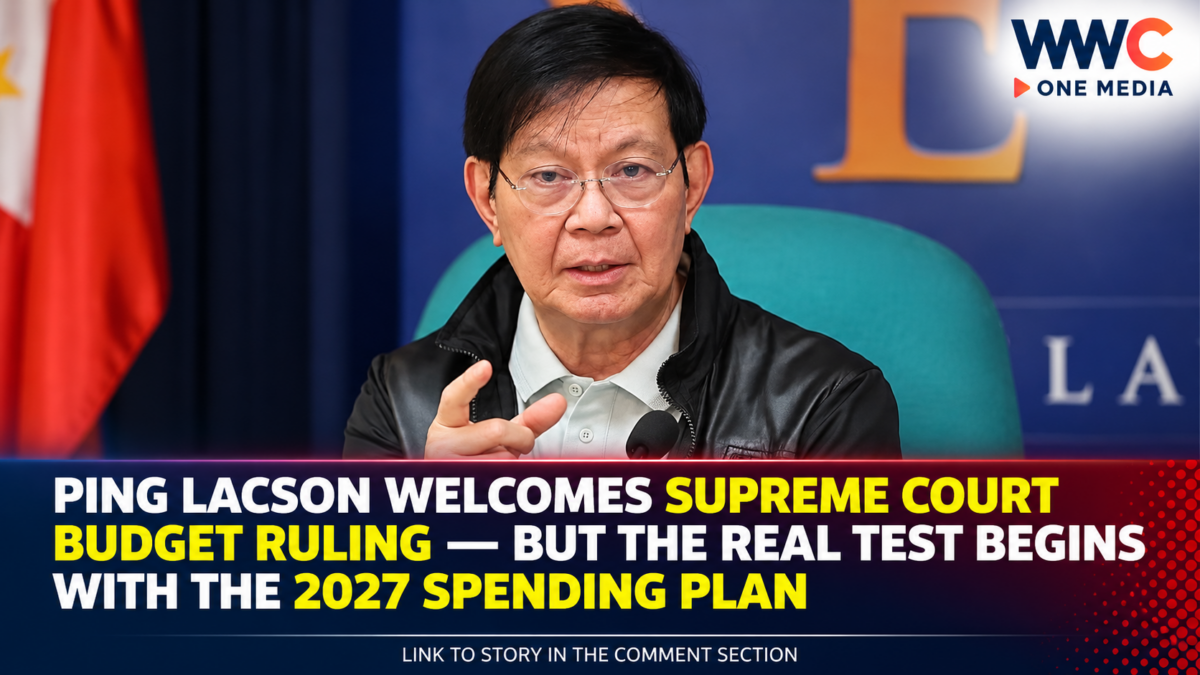
MANILA, Philippines — Senator Panfilo “Ping” Lacson has welcomed the Supreme Court’s ruling against unconstitutional provisions in the country’s recent national budgets, saying the decision sends a timely warning as lawmakers begin scrutinizing the proposed 2027 spending plan.
In a statement released on October 21, 2026, Lacson said the ruling reinforces the constitutional limits on Congress’ authority to revise the National Expenditure Program (NEP), the proposed budget prepared by the executive branch.
He emphasized that the timing matters because the Senate is reviewing the House of Representatives’ version of the proposed 2027 General Appropriations Bill (GAB), where lawmakers must carefully examine spending adjustments and funding priorities.
Lacson also clarified that he was not a senator when the 2024 and 2025 General Appropriations Acts (GAAs) were passed.
Supreme Court flags billions in budget increases
The controversy intensified after the Supreme Court declared unconstitutional several provisions in the 2024, 2025 and 2026 national budgets.
According to reports by Philstar.com and the Daily Tribune, the Court found that certain congressional amendments exceeded constitutional limits on budget appropriations and weakened safeguards over public spending.
One of the most significant findings involved the 2024 national budget. Congress increased unprogrammed appropriations from the executive branch’s proposed ₱281.9 billion to ₱731.4 billion—a difference of ₱449.5 billion.
Unprogrammed appropriations are standby funds that may be released only when specified funding conditions are met. While these appropriations are not inherently unconstitutional, the Supreme Court stressed that their approval and release must comply with constitutional and fiscal safeguards.
The Court ruled that Congress cannot increase the President’s total recommended appropriations by manipulating the division between programmed and unprogrammed spending.
The ruling also struck down a ₱17.99-billion increase in the Department of Public Works and Highways’ Special Road Fund under the 2025 budget, along with other challenged budget provisions.
Sources: Philstar.com and Daily Tribune.
Why the ruling matters for the 2027 budget
Lacson said the Supreme Court’s decision provides an important reference point as senators review changes introduced in the House version of the proposed 2027 budget.
He previously warned that the Senate could revisit hundreds of billions of pesos in proposed cuts and realignments, including funding for foreign-assisted projects and flood-control initiatives.
The challenge for lawmakers is to ensure that any adjustments comply with constitutional requirements while addressing the country’s development priorities.
The ruling also places greater emphasis on transparency, proper documentation and accountability in the bicameral conference committee, which reconciles differences between the House and Senate versions of the budget.
For taxpayers, the broader issue is how public money is allocated, what safeguards govern its release, and whether spending decisions remain within the limits established by the Constitution.
What happens to money from the questioned budgets?
The Supreme Court’s ruling does not automatically mean that every project funded under the affected budgets must be reversed.
Lacson said he understood that funds remaining unspent might no longer be disbursed under the invalidated provisions, while expenditures already made might not necessarily be invalidated.
The legal consequences, however, depend on the specific provisions involved and the Court’s directives.
Reports by the Daily Tribune and Philstar.com explain that the Court applied the doctrine of operative fact to protect certain completed or irreversible actions and good-faith beneficiaries under the 2024 and 2025 budgets. This does not make the unconstitutional provisions valid; rather, it recognizes that some consequences of actions taken under them may remain legally effective.
The Court also invalidated specified provisions of the 2026 budget concerning the release of unprogrammed appropriations and imposed a permanent injunction against their implementation.
These distinctions are important because the ruling addresses both constitutional compliance and the practical consequences of government spending that has already occurred.
Lacson invokes the lessons of the DAP controversy
Lacson compared the significance of the latest decision to the controversy surrounding the Disbursement Acceleration Program (DAP), portions of which the Supreme Court declared unconstitutional in 2014.
The DAP controversy centered on the executive branch’s use of funds and the constitutional limits on budget transfers. It became a major national issue because of questions over the separation of powers and the proper use of public money.
For Lacson, the latest ruling underscores the need to prevent questionable budget practices from recurring.
His warning comes as the Senate examines the proposed 2027 national budget, making scrutiny of funding insertions, realignments and spending conditions particularly significant.
The bigger question: Will the 2027 budget withstand scrutiny?
The Supreme Court ruling has reinforced a central principle of public finance: Congress has the authority to deliberate on and enact the national budget, but that authority is subject to constitutional limits.
As the Senate reviews the proposed 2027 spending plan, lawmakers face pressure to scrutinize funding changes, demand clearer justifications for allocations and ensure that public funds are released under lawful conditions.
The coming budget deliberations will test whether the lessons of the 2024–2026 budget controversies translate into stronger safeguards and greater transparency.
For taxpayers, the stakes extend beyond political disagreements. They concern whether billions of pesos in public funds are allocated responsibly, supported by clear priorities and protected by meaningful accountability mechanisms.
The key question now is whether the Senate’s scrutiny of the 2027 budget will prevent the same constitutional problems from resurfacing.