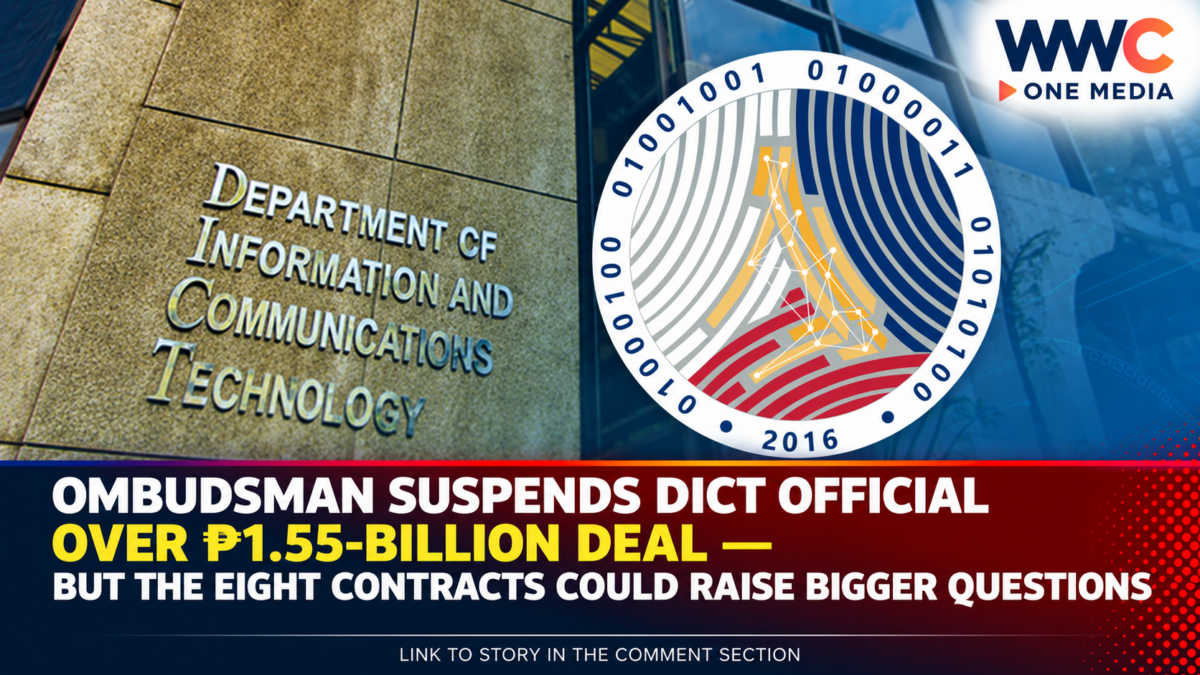
MANILA, Philippines — A senior official of the Department of Information and Communications Technology (DICT) has been ordered suspended for six months without pay as the Office of the Ombudsman investigates alleged conflicts of interest involving approximately ₱1.55 billion in government technology contracts.
David Almirol Jr., DICT undersecretary for e-government, is facing administrative complaints involving alleged grave misconduct, conduct prejudicial to the best interest of the service, and possible violations of Republic Act No. 6713, the Code of Conduct and Ethical Standards for Public Officials and Employees.
The preventive suspension is intended to protect the integrity of the investigation. It does not constitute a final ruling that Almirol committed wrongdoing.
Eight government technology contracts under scrutiny
According to reports published by The Manila Times and other Philippine news outlets on October 21, 2026, the Ombudsman identified at least eight e-government-related contracts awarded between November 2023 and May 2025 to companies with financial connections to Multisys Technologies Corp.
The contracts reportedly covered information and communications technology consultancy, e-government application deployment, web-based messaging services, cloud infrastructure, data-center colocation and software subscriptions.
The combined value was reported at approximately ₱1.55 billion, placing the transactions under heightened scrutiny over procurement transparency and the management of public funds.
The complaints reportedly stemmed from a DICT Internal Audit Unit report issued in June 2025, which flagged potential conflict-of-interest concerns involving the hiring of former Multisys personnel and the awarding of contracts to related companies.
Why Almirol’s former business ties matter
Before entering government service, Almirol founded Multisys and served as its president and chief executive officer for more than a decade. He was appointed DICT undersecretary for e-government in August 2022.
The Ombudsman’s order reportedly noted that Almirol continued to appear as a Multisys stockholder after assuming public office. A corporate filing received by the Securities and Exchange Commission in November 2022 reportedly removed his name from the company’s stockholder list.
The timing is central to the allegations because Republic Act No. 6713 requires public officials to avoid conflicts between their private interests and official responsibilities. Its implementing rules generally require an official facing a conflict of interest to resign from the private enterprise or divest the relevant holdings within the prescribed period, including a 60-day period for divestment.
Investigators are examining whether the circumstances surrounding Almirol’s business interests and the subsequent government contracts complied with applicable ethical requirements.
The existence of a former business relationship, however, does not by itself establish that a contract was improperly awarded or that an official personally benefited from it.
What the controversy means for the eGovPH program
Almirol has been associated with the development and rollout of the eGovPH Super App, a government initiative designed to bring public services together on a digital platform.
The platform is part of the Philippines’ broader push to make government transactions more accessible online. Such programs rely on technology contractors and supporting systems, making transparent procurement, reliable infrastructure and proper oversight essential to public confidence.
In a separate report published in September 2026, Newsbytes.ph reported that the DICT had pledged to cooperate with an Ombudsman fact-finding investigation into alleged “ghost Internet projects.” That inquiry concerns separate allegations involving connectivity services, software and project delivery. It should not be treated as proof that the contracts in Almirol’s administrative case involved the same alleged irregularities.
Taken together, the investigations underscore the importance of verifying whether publicly funded digital projects deliver the services specified in their contracts.
Why the Ombudsman ordered preventive suspension
The Ombudsman reportedly determined that Almirol’s continued presence in office could prejudice the investigation because of his access to documents and other relevant evidence.
Under Section 24 of Republic Act No. 6770, the Ombudsman Act of 1989, preventive suspension may be imposed under specified circumstances while an investigation is pending, including when an official’s continued stay in office could affect the case.
The measure is temporary and intended to safeguard the proceedings. It is distinct from dismissal from government service or a final administrative penalty.
DICT Secretary Robert Joseph de Claro was reportedly directed to implement the suspension order and submit proof of compliance.
What happens next?
The next steps will depend on the Ombudsman’s evaluation of the administrative complaints, the supporting documents and the responses of the parties concerned.
Key questions include whether the relevant business interests were properly disclosed and divested, whether the procurement process complied with applicable rules, and whether the contracts were awarded and implemented in accordance with government requirements.
The outcome could have implications for public accountability and confidence in the government’s digitalization program. For now, the allegations remain subject to investigation, and any determination of liability must follow the applicable administrative process.
The bottom line: The six-month suspension puts a spotlight on the relationship between private business interests and public procurement. The central issue is not simply the size of the contracts, but whether the evidence establishes a violation of the rules governing public officials and government transactions.