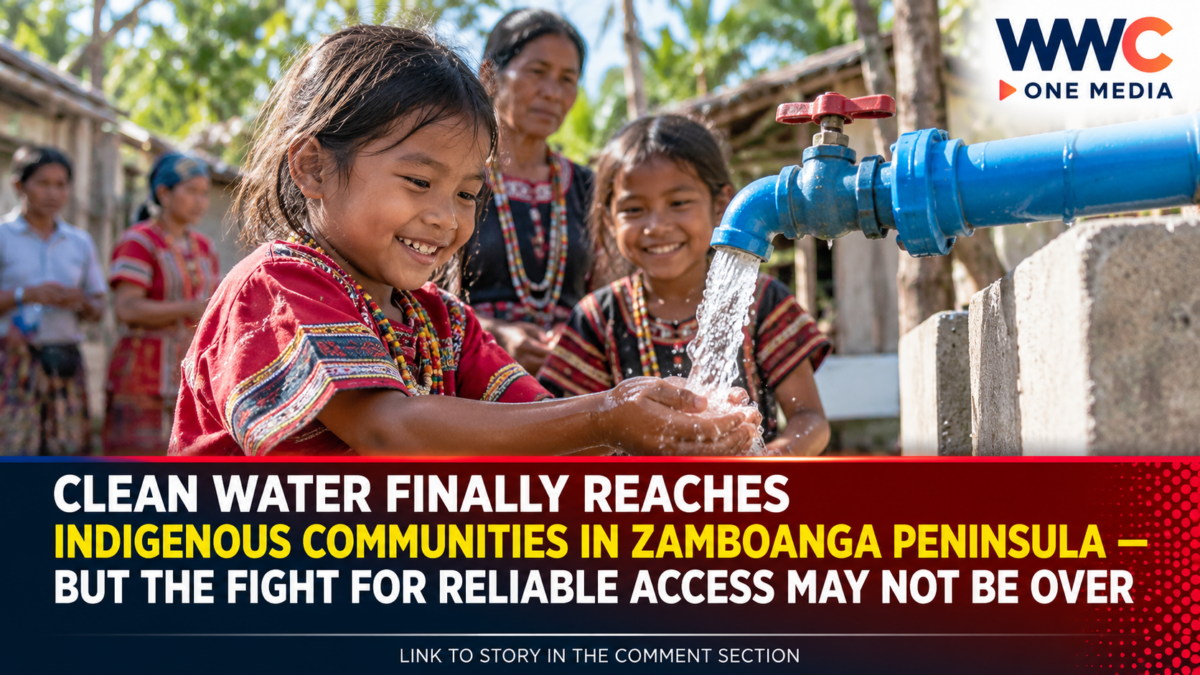
For Indigenous communities in the Zamboanga Peninsula, access to clean water represents more than a basic convenience. It means safer drinking water, better hygiene, less time spent collecting water, and a greater opportunity for families to focus on education, livelihoods, and daily life.
A report by the Philippine Daily Inquirer highlights the arrival of clean water for Indigenous people in the Zamboanga Peninsula, bringing renewed attention to the long-standing challenges faced by underserved communities in accessing essential services.
For families in remote and geographically isolated areas, the distance between a household and a dependable water source can make an ordinary daily task physically demanding and costly. Water shortages can also complicate cooking, washing, sanitation, and other basic household activities.
The development marks an important step toward addressing those difficulties. However, the long-term impact will depend on whether communities can maintain reliable access to safe and affordable water beyond the initial rollout.
Why access to clean water matters
Reliable drinking water is fundamental to public health. When households depend on questionable water sources, they may face increased exposure to waterborne illnesses. Limited access can also make it more difficult for families to maintain proper hygiene and sanitation.
The burden can be particularly challenging in remote communities, where difficult terrain, limited infrastructure, and the cost of transporting supplies can complicate the delivery of essential services.
For Indigenous peoples, access to basic infrastructure is also closely connected to inclusive development. Projects must respond to the actual needs of communities while respecting their rights, local circumstances, and participation in decisions that affect their ancestral domains.
Other water projects show the scale of the challenge
Recent reports from government agencies and Philippine news organizations illustrate how water access remains a significant concern in different parts of the Zamboanga Peninsula.
In a report published on April 1, 2026, the Philippine News Agency documented the introduction of a water filtration system on Tumalutab Island in Zamboanga City. Residents had previously relied on deep wells that could pose safety concerns or purchased water transported from the mainland at higher costs. The new system was intended to make drinking water more accessible and affordable.
The report also described the Department of Environment and Natural Resources’ wider water-security initiative, which seeks to extend water services to underserved communities. Although the Tumalutab project concerns an island community rather than the Indigenous communities featured in the Inquirer report, it demonstrates the practical challenges of providing safe water in geographically isolated areas.
Meanwhile, the Philippine Information Agency reported on February 12, 2026, that a potable water project in Josefina, Zamboanga del Sur, had eased the burden on residents who previously faced long walks and difficult climbs to collect water.
More recently, the agency reported on September 28, 2026, that a ₱105-million potable water project in Josefina had brought water closer to 1,874 households.
These projects are separate initiatives and should not be confused with the specific development involving Indigenous communities. Together, however, they highlight the importance of investing in water infrastructure across the region.
What must happen next?
Bringing clean water to a community is a major milestone, but the benefits must be sustained.
Long-term success requires dependable operations, regular maintenance, water-quality monitoring, and a fair system for managing costs. Communities also need clear arrangements for repairs and continued access if equipment breaks down or water sources become unreliable.
For Indigenous communities, meaningful participation is equally important. Local leaders and residents should have a voice in how water systems are managed, maintained, and adapted to changing needs.
The broader challenge is to ensure that essential services reach people who have historically faced barriers because of their location or limited infrastructure.
Beyond the water supply
The arrival of clean water is a reminder that development is measured not only by completed infrastructure but also by the difference it makes in people’s daily lives.
For families who have struggled to obtain safe water, dependable access can reduce daily hardship and create more time for work, education, and family responsibilities.
The key question now is whether this progress can be sustained — and whether more underserved Indigenous communities across the Zamboanga Peninsula will receive the same opportunity.
Because clean water should not be a privilege determined by where a family lives. It should be a basic service every community can depend on.