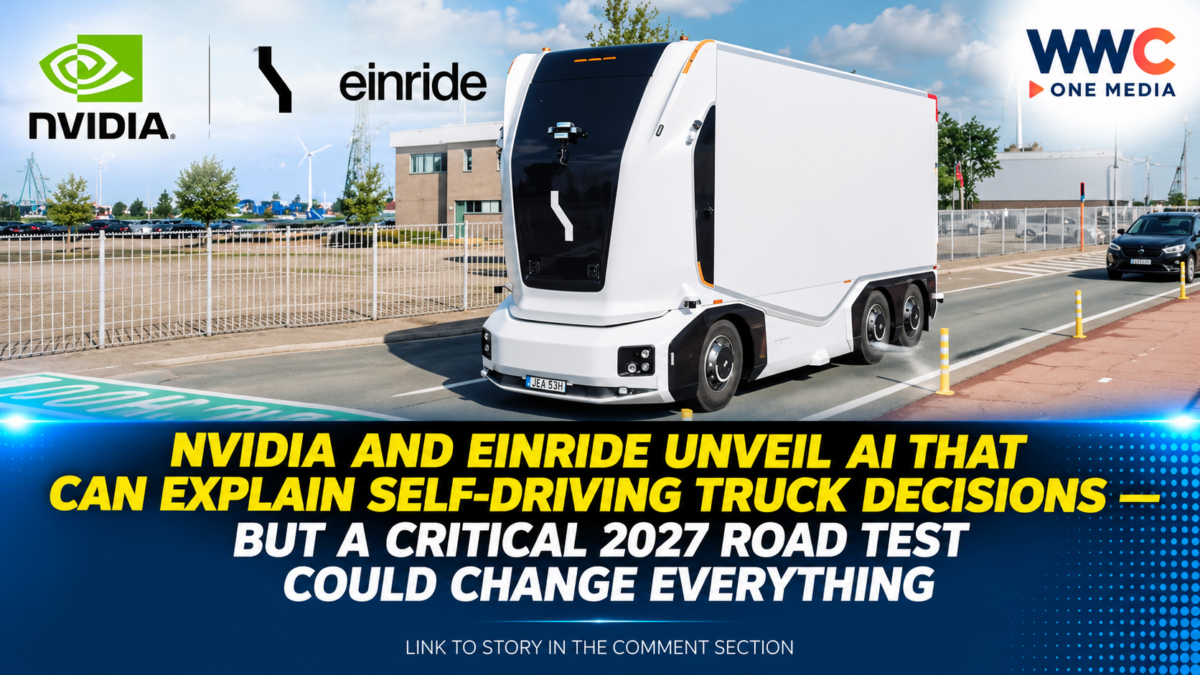
STOCKHOLM, SWEDEN — The race to bring artificial intelligence-powered trucks onto public roads is accelerating as Swedish autonomous freight company Einride expands its partnership with U.S. chipmaking giant Nvidia to develop self-driving trucks capable of interpreting complex road conditions and explaining their decisions.
Announced on Wednesday, October 21, 2026, the expanded collaboration will introduce Nvidia’s Alpamayo AI reasoning technology into Einride’s autonomous trucking development program.
The system is designed to analyze road environments, recommend driving actions and provide explanations for its decisions.
Unlike conventional driving systems that primarily process sensor information and predict the next maneuver, reasoning-based AI aims to help developers assess why a particular action was selected.
Einride hopes the technology will accelerate autonomous freight deployment, reduce development costs and make it easier to adapt self-driving systems to different vehicles and transportation routes.
However, the most significant test is still ahead: Einride is planning a live road evaluation of the technology in the second half of 2027.
For now, the company’s initial experiments will use a testing arrangement in which the new AI observes driving conditions without taking control of the truck.
What Is Nvidia Alpamayo — and Why Does It Matter?
The technology at the center of the partnership is Nvidia’s Alpamayo family of artificial intelligence models and development tools.
Alpamayo includes vision-language-action capabilities, allowing an AI system to process visual information, interpret road situations and generate recommended driving actions.
For autonomous vehicles, that could be particularly useful in complicated situations involving unusual road layouts, uncertain traffic behavior and other conditions that may not be adequately represented in training data.
Nvidia introduced the Alpamayo family in January 2026 as part of a broader effort to develop reasoning-based autonomous driving.
Its tools also include simulation systems and datasets intended to help engineers train and evaluate vehicle behavior.
One important distinction: Alpamayo is a family of models and development tools, not a guarantee that a truck can immediately operate safely without human intervention.
Einride’s First Step: Let the AI Observe Before It Drives
Einride plans to begin by testing Alpamayo in what engineers call shadow mode.
How shadow-mode testing works
1. Observe road conditions
AI processes driving data from the vehicle’s environment
2. Generate a driving recommendation
Alpamayo proposes maneuvers and supporting reasoning
3. Compare the decisions
Engineers compare its output with existing vehicle software and human driving behavior
During initial shadow-mode testing, Alpamayo does not control the vehicle.
This approach allows developers to measure the new model’s behavior without handing it responsibility for operating the truck.
By comparing driving decisions, Einride can identify situations where Alpamayo performs well and where more training or testing is required.
The company expects to adapt the model using data from its commercial freight activities.
Such testing could help shorten software development cycles, although actual cost reductions have not yet been quantified publicly.
The Critical Timeline: What Happens in 2027?
Einride’s latest announcement establishes an important development milestone.
September 21, 2026 — Initial partnership announced
Einride announced plans to build the next generation of its autonomous driving system using Nvidia’s Hyperion platform.
October 21, 2026 — AI reasoning expansion
The companies announced the planned use of Alpamayo, starting with testing that does not control the truck.
Second half of 2027 — Planned road evaluation
Einride aims to assess the technology in live road conditions. The announcement does not establish that unrestricted commercial deployment will begin at that time.
The distinction between evaluation and deployment is important.
Testing a technology on public roads does not automatically demonstrate that it meets all the requirements for widespread driverless operation.
Regulatory approval, reliable performance, safety validation and the ability to handle difficult driving situations remain essential.
Einride Already Has Driverless Trucks Operating in Europe
The company is not beginning its autonomous trucking journey from scratch.
Einride has been developing electric and autonomous freight technology for commercial customers for several years.
In September 2026, it announced what it described as the first cabless autonomous truck to enter regular freight service on public roads in Germany, transporting goods for supermarket chain Lidl.
The achievement demonstrated a commercial application of its existing autonomous technology.
But the October Nvidia announcement represents a separate development effort.
Einride’s already operating vehicles should not be confused with trucks running Alpamayo as their active driving system.
The new reasoning model is still undergoing integration and evaluation.
Nvidia Is Building a Larger Autonomous Vehicle Ecosystem
The Einride announcement was part of a broader set of developments unveiled by Nvidia at GTC Berlin.
The company highlighted partnerships and demonstrations involving major European automotive manufacturers and mobility providers.
| Company | Announced Nvidia collaboration |
|---|---|
| Einride | Autonomous freight trucks using Hyperion, Halos, Alpamayo and Cosmos technologies |
| Volvo Cars | Automated driving development using Hyperion and Alpamayo Stack |
| Mercedes-Benz | Expansion of advanced automated driving capabilities |
| Volkswagen Commercial Vehicles | Autonomous ID. Buzz vehicle platform using Hyperion |
| Bolt and Lucid | Planned European robotaxi deployment using Nvidia autonomous driving technologies |
Nvidia also introduced Halos SAFE, a framework combining physical testing and simulation to help developers produce measurable safety evidence.
Additional announcements included Alpamayo 2 Edge, Alpamayo Agentic Factory and updated Cosmos simulation models.
These technologies are intended to support vehicle development and testing at scale.
However, the companies are pursuing different timelines and use cases. Participation in Nvidia’s ecosystem does not mean every manufacturer has commercially launched fully autonomous vehicles.
Why Autonomous Freight Is Attracting Major Investment
The trucking industry faces significant operational challenges, including driver shortages in some markets, increasing transport costs and pressure to improve delivery efficiency.
Autonomous trucking companies believe AI-powered vehicles could eventually improve fleet utilization by operating along suitable freight routes with less dependence on a conventional driver.
Electric freight vehicles could also help reduce tailpipe emissions where they replace diesel trucks, although the broader environmental benefits depend on electricity generation, vehicle manufacturing and logistics operations.
For logistics businesses, the potential advantages include more predictable deliveries, improved route planning and reduced downtime.
But these outcomes are not guaranteed.
Autonomous trucks require expensive computing equipment, sensors, maintenance systems, remote operational support and comprehensive safety testing.
The technology must also demonstrate reliable performance in bad weather, road construction zones and unexpected traffic situations.
The Biggest Challenge: Can AI Reasoning Make Driverless Trucks Safer?
A model that can explain its recommended decisions may help engineers understand and assess autonomous vehicle behavior.
For example, developers may be able to examine why the system suggested slowing down, changing lanes or stopping for a hazard.
That could make software testing and error analysis more effective.
But an explanation does not prove that a decision is correct.
AI-generated reasoning can still be incomplete or inaccurate, and a vehicle must respond safely even when sensor information is unclear.
Einride and Nvidia will therefore need to demonstrate that their new technology performs reliably across a wide range of real-world situations.
The planned 2027 evaluation is one step in that process.
What This Means for Southeast Asia and the Philippines
Autonomous trucking developments could eventually influence freight transportation in Southeast Asia.
Logistics companies across the region are already investing in digital fleet management, route optimization and electric vehicles.
Self-driving technology could become relevant to ports, industrial parks and dedicated freight corridors, where operating conditions may be easier to control than in heavily congested city centers.
In the Philippines, however, large-scale driverless truck operations would raise questions involving road conditions, traffic laws, insurance, worker training and public safety.
Einride has not announced a Philippine rollout of Alpamayo-powered trucks in the reviewed reports.
Any discussion of local adoption therefore remains an assessment of possible future applications rather than a confirmed expansion plan.
The Bigger Question: Can Nvidia Help Make Driverless Freight Commercially Viable?
Einride’s expanded partnership is significant because it combines existing autonomous freight experience with Nvidia’s growing AI development platform.
The companies aim to improve the speed and efficiency of developing self-driving capabilities.
But the technology still needs to prove its reliability and economic value.
The 2027 road evaluation could provide evidence about whether reasoning-based models can enhance existing autonomous truck systems.
The bottom line: Einride and Nvidia are expanding their partnership to test AI technology capable of explaining driving decisions. The announcement is a meaningful development for autonomous freight, but Alpamayo has not yet been confirmed as an active driver of Einride’s commercial fleet, and widespread deployment remains subject to testing and safety requirements.