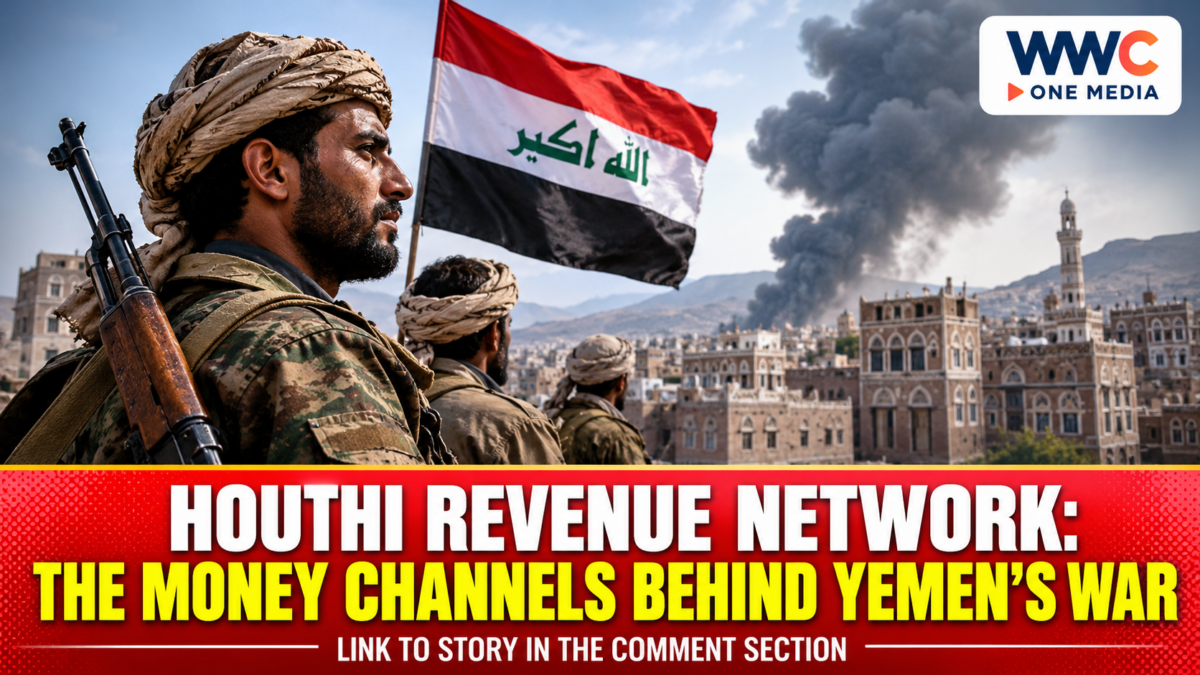
The financial networks sustaining Yemen’s Houthi movement extend beyond oil sales, involving commercial intermediaries, cross-border payments and revenue collected in territories under its control. Records published by the United States and the United Nations describe how these income streams have become a target of international sanctions and financial scrutiny.
The issue matters because cutting off money is different from stopping the movement’s ability to collect revenue locally, trade through intermediaries or adapt its payment channels. The public record shows a complex system—and why disrupting it is likely to require more than announcing sanctions.
Houthi revenue comes from more than oil
Oil trading is one of the most prominent revenue channels identified in US government records. In January 2026, the US Treasury Department said the Houthis continued to generate more than US$2 billion annually through what it described as illicit oil sales.
That figure is a US government estimate, not an independently audited financial statement. It should not be treated as a verified total of all Houthi income or as money necessarily available for military spending.
The same Treasury announcement described a network of companies and intermediaries operating across Yemen, Oman and the United Arab Emirates. It identified businesses involved in oil transactions, financial services, shipping and logistics, including companies it said facilitated transactions for Houthi-linked oil importers.
The significance is that oil revenue does not necessarily move directly from a seller to a political or military authority. Commercial entities, exchange houses, shipping agents and other intermediaries can form part of the transaction chain.
For a wider look at the strategic importance of Yemen’s coastline and the shipping corridor nearby, readers can revisit WWC’s report on the Houthis’ position near the Bab el-Mandeb shipping route.
The United Nations documented local collections and fees
Oil is only one part of the financial picture. A United Nations Panel of Experts report on Yemen, issued in October 2024, documented several forms of revenue collection in areas controlled by the Houthis.
The report said information received by the panel indicated that approximately YR3.392 trillion was collected and controlled by the group during 2023. It also estimated that collections from land crossing points between government-controlled and Houthi-controlled areas reached approximately YR300 billion that year.
The panel described customs-related charges and other fees imposed on traders moving goods between the two areas. It said sources reported that these collections went to senior Houthi leaders and were used to pay combatants and support other military purposes.
The report also examined fees connected with civil aviation. It estimated annual overflight-fee collections at approximately US$32.85 million, based on an estimated 150 aircraft crossing Yemeni airspace daily and an average payment of about US$600 per aircraft.
These figures describe different revenue categories and reporting periods. They should not be added together as if they were a single audited annual budget. The United Nations report also distinguishes between information received by the panel, estimates based on its investigation and allegations that remained under examination.
The findings nevertheless illustrate an important feature of the conflict: control over territory can create opportunities to collect money through trade, transport and administrative systems, even when a group faces international financial restrictions.
How international sanctions target the financial chain
The US response has focused on people and entities that Washington says help move money, petroleum products, equipment and other supplies.
On January 16, 2026, the US Treasury’s Office of Foreign Assets Control announced designations involving 21 individuals and entities and identified one vessel. The department said the targets had been involved in transferring oil products, procuring weapons and dual-use equipment, or providing financial services for Ansarallah, the name used by the Houthi movement.
The action relied on Executive Order 13224, as amended, a US counterterrorism sanctions authority. The department said the measures built on earlier actions against Houthi leaders, financiers, smugglers, procurement operatives and suppliers.
The US government had also designated Ansarallah as a Specially Designated Global Terrorist entity effective February 16, 2024. It subsequently designated the group as a Foreign Terrorist Organization on March 5, 2025.
In practical terms, sanctions can restrict designated parties’ access to property or financial transactions subject to US jurisdiction. They can also make banks, shipping companies and commercial partners more cautious about dealings that could expose them to sanctions risk.
But sanctions are not the same as a physical blockade of every transaction. Their effectiveness depends on identifying the people and companies involved, tracing payment routes, sharing information across jurisdictions and ensuring that businesses comply with restrictions.
Why intermediaries matter
The Treasury’s January 2026 announcement described financial links involving companies based in the UAE and exchange businesses connected to transactions in Yemen. It also identified logistics and shipping firms that it said supported oil shipments or procurement activities.
This points to a challenge for enforcement: a transaction may involve several companies in different countries before goods or money reach their intended destination.
A company that appears to provide ordinary commercial services may become relevant to sanctions enforcement if authorities establish that it is knowingly facilitating transactions for a designated party. That is why sanctions announcements often identify not only senior figures but also companies, owners, vessels and financial intermediaries.
The allegations in a sanctions designation should still be understood as the government’s stated basis for taking action. A designation is an administrative measure; it is not, by itself, a criminal conviction against every person or company named.
The wider conflict also has implications for the safety of shipping and regional commerce. WWC has previously examined the latest escalation in Yemen’s military campaign, as well as the difference between a security incident and a confirmed disruption to Saudi oil infrastructure.
Why cutting revenue is difficult
The central difficulty is that the sources of income are not limited to international transfers that can be targeted by foreign governments.
Oil imports, local collections, commercial fees and payments through intermediaries operate in different environments. A measure that restricts one international company may not automatically stop locally collected taxes or fees. Likewise, a financial restriction can make transactions harder without necessarily eliminating the underlying demand for fuel, goods or transport.
There is also a civilian dimension. Yemen depends on commercial imports and humanitarian assistance, while ordinary households and businesses operate in an economy shaped by years of conflict. Measures intended to restrict armed-group financing must be implemented carefully to avoid unnecessarily obstructing legitimate trade, remittances and aid.
The United Nations Security Council’s sanctions framework for Yemen has included provisions recognising the importance of humanitarian assistance and commercial imports. This distinction matters: financial pressure on armed actors should not be confused with a blanket restriction on ordinary economic activity.
For the Philippines and other economies connected to international shipping, the issue is relevant beyond Yemen’s domestic politics. Continued instability around the Red Sea can raise concerns about maritime security, route planning and the cost of moving goods. However, the revenue figures alone do not prove that a new shipping disruption or increase in oil prices has occurred.
What happens next
The next indicators to watch are additional sanctions designations, evidence of enforcement against identified intermediaries, and independently documented changes in oil trading and revenue collection.
It will also matter whether authorities can coordinate across the countries where companies, exchange houses, shipping operators and other facilitators are based. Sanctions are more likely to constrain a network when enforcement reaches multiple parts of its financial and logistical chain.
The public records reviewed establish that international authorities have identified several sources of Houthi-linked revenue and have taken action against entities they say facilitate them. They do not establish that those income streams have been eliminated.
The broader question is therefore not simply how much money the movement collects. It is whether governments can make the financial and commercial channels supporting its operations harder to use without further damaging Yemen’s civilian economy.
Frequently asked questions
How do the Houthis generate revenue?
US and United Nations records identify oil-related transactions, customs and other collections, commercial fees, and payments involving financial intermediaries as sources of revenue associated with Houthi-controlled areas.
How much revenue do the Houthis receive from oil?
The US Treasury said in January 2026 that illicit oil sales generated more than US$2 billion annually. This is a US government estimate, not an independently audited total.
What did the United Nations report about Houthi revenue?
A 2024 UN Panel of Experts report said information received by the panel indicated that approximately YR3.392 trillion was collected and controlled by the Houthis during 2023. It also described specific customs-related and aviation-fee collections.
What are US sanctions intended to do?
The sanctions target people, companies, vessels and financial channels that the US government says support Houthi oil trading, procurement, smuggling or financial activity. They can restrict access to property and transactions subject to US jurisdiction.
Have sanctions stopped Houthi revenue?
The records reviewed do not establish that sanctions have eliminated the movement’s revenue sources. Treasury’s January 2026 statement itself described continuing oil-related income despite earlier sanctions.