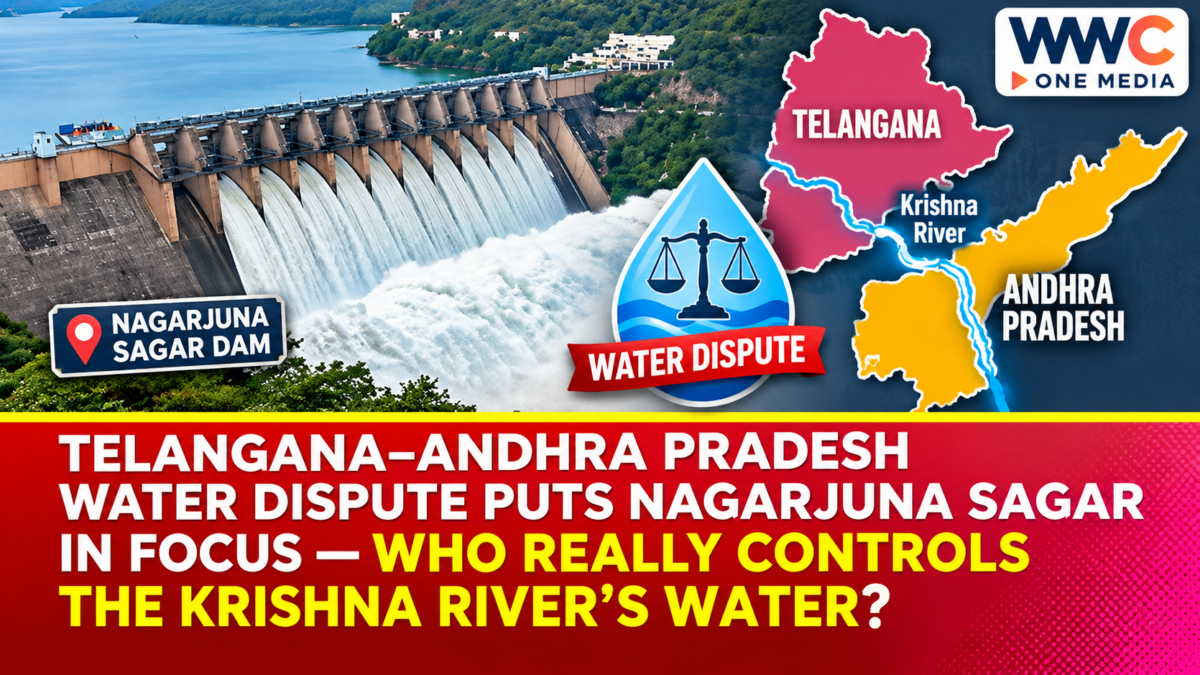
HYDERABAD, INDIA — The Krishna River water dispute raises fundamental questions about how Telangana and Andhra Pradesh manage shared water resources, approve infrastructure projects and protect drinking water supplies.
At the centre of the broader water security challenge is the Nagarjuna Sagar reservoir, a major infrastructure asset serving agricultural and electricity generation requirements across the two states.
The legal framework established under the Andhra Pradesh Reorganisation Act of 2014 provides mechanisms for regulating interstate water supplies, examining new infrastructure proposals and resolving disagreements.
However, the effectiveness of these mechanisms depends on transparent project assessments, reliable reservoir data and cooperation between government authorities.
The stakes extend beyond political disagreements. Water availability can influence agricultural productivity, household welfare, industrial development and regional economic stability.
Krishna River water dispute: Why Nagarjuna Sagar matters
Inaugurated on Dec. 10, 1955, by India’s then Prime Minister Jawaharlal Nehru, Nagarjuna Sagar is a major water infrastructure project situated between Telangana and Andhra Pradesh.
Its official engineering specifications reveal the scale of the reservoir and its importance to regional water management.
The project has a catchment area of approximately 215,185 square kilometres and a full reservoir level of 590 feet.
Its minimum drawdown level is listed at 510 feet, with live storage above that elevation amounting to 181 thousand million cubic feet, commonly expressed as TMC.
These specifications are particularly important when assessing proposals involving additional water extraction.
The minimum drawdown level represents a reference point for reservoir operations. It should not be confused with the physical bottom of the reservoir.
Similarly, the project’s designed storage capacity does not establish how much water is currently available.
Determining actual water availability requires recent measurements, expected inflows, existing commitments and applicable operating restrictions.
The economic importance of reservoir management is also examined in WWC ONE MEDIA’s coverage of declining water levels at Lake Lanao and Pulangi Dam, where water availability has implications for electricity generation.
Who has the authority to approve new Krishna River projects?
India established a specific regulatory framework for managing shared river infrastructure following the creation of Telangana as a separate state in June 2014.
Under Section 85 of the Andhra Pradesh Reorganisation Act, the Krishna River Management Board operates as an autonomous institution under the administrative oversight of the central government.
Its responsibilities include managing water deliveries to the successor states in line with applicable tribunal awards and interstate arrangements.
The board is also responsible for technical assessments of proposed new Krishna River projects, including examining their potential effects on water available to qualifying existing projects.
Section 84 establishes a separate Apex Council involving the central government’s water resources minister and the chief ministers of Andhra Pradesh and Telangana.
The council provides an additional mechanism for supervising river management and considering new infrastructure proposals after the required technical assessments.
This framework establishes an important distinction between a state’s decision to develop infrastructure and the regulatory approvals that may be necessary when shared water resources are involved.
Whether a particular tunnel or water grid requires additional approval must be determined through its actual engineering specifications, legal classification and applicable administrative records.
Why underground water extraction requires careful examination
A water extraction tunnel can provide an alternative means of transporting water from a reservoir to treatment facilities, distribution networks or agricultural areas.
However, its potential consequences depend on several technical considerations.
These include the elevation of the intake, the volume of water that can be transported, operating restrictions and the availability of water during periods of reduced rainfall.
A tunnel’s maximum engineering capacity may differ substantially from its authorised annual water allocation.
That distinction matters because physical extraction capability does not necessarily create a legal entitlement to withdraw an equivalent volume.
Technical assessments should therefore examine both the proposed infrastructure and the rules governing its future operation.
For any shared reservoir, additional extraction capacity could introduce competing demands during periods of limited availability.
However, proving that a particular project would damage another state’s water security requires more than political assertions. It requires engineering evidence and verified operating data.
Telangana seeks central assistance for irrigation development
On Nov. 15, 2026, Telangana Chief Minister A. Revanth Reddy met Indian Prime Minister Narendra Modi and requested assistance with pending infrastructure approvals and interstate issues.
The chief minister sought statutory and environmental clearances for several irrigation developments, including:
- Dr. S. Jaipal Reddy Palamuru-Rangareddy Lift Irrigation Scheme.
- Sitamma Sagar Multipurpose Project.
- Dindi Lift Irrigation Scheme.
Telangana also requested an additional ₹5,000 crore under the Scheme for Special Assistance to States for Capital Investment.
The requested financing is intended to support the completion of projects that are reportedly between 70% and 90% finished.
The proposed investment reflects the state government’s broader objective of expanding irrigation access, supporting agricultural incomes and improving rural employment opportunities.
However, the ₹5,000-crore figure represents a funding request, not confirmation that the central government has approved or released the money.
These projects and financing requests should also be distinguished from Andhra Pradesh’s disputed Palnadu Water Grid proposal.
Drinking water security must remain central to infrastructure planning
Reliable water supplies are fundamental to the operation of cities, agricultural communities and industrial facilities.
When several jurisdictions depend on a common reservoir, their individual infrastructure plans must be assessed alongside the requirements of other users.
Urban population growth can increase household demand, while agricultural development may require dependable seasonal irrigation.
During periods of reduced rainfall, these competing requirements can become more difficult to accommodate.
The challenge of maintaining reliable household water services is also explored in Thailand’s efforts to protect northern communities through clean-water infrastructure.
Although the environmental circumstances differ, both cases demonstrate why water security requires more than constructing additional distribution facilities.
Authorities must also consider the reliability and quality of water sources.
For Telangana and Andhra Pradesh, transparent operating arrangements could help reduce uncertainty surrounding future water availability.
India’s legal framework provides a path towards dispute resolution
The Andhra Pradesh Reorganisation Act also recognises the possibility that disagreements may arise over water allocations and reservoir operations.
Section 89 provides for project-specific allocations where these have not already been determined by an appropriate tribunal, alongside operating protocols for water releases during periods of insufficient river flows.
These provisions are especially relevant when both states seek to protect existing requirements while developing additional infrastructure.
Reservoir management must also account for changing environmental conditions. Insufficient water can restrict supply, while excessive inflows can create separate flood management challenges.
The importance of coordinated reservoir monitoring is illustrated by Thailand’s preparations after 22 reservoirs exceeded their storage capacity.
Effective water governance requires the ability to respond to both extremes without compromising long-term infrastructure safety and public welfare.
What happens next for the Nagarjuna Sagar water dispute?
The most consequential documents for assessing the Palnadu Water Grid controversy are its detailed project report, applicable government approvals, technical assessments and the Krishna River Management Board’s relevant decisions.
These records would help establish whether additional regulatory permissions are required, how much water the infrastructure is authorised to withdraw and what safeguards apply to existing users.
Without those documents, conclusions about unauthorised extraction, government misconduct or imminent drinking water shortages would be premature.
The broader challenge facing Telangana and Andhra Pradesh is establishing confidence that shared water resources will be managed transparently and consistently.
The future of Nagarjuna Sagar should ultimately be determined by verified engineering evidence, lawful water allocations and the needs of communities that depend on the Krishna River.
Political disagreements may draw attention to the issue, but durable solutions require cooperation supported by credible technical and legal records.
Frequently asked questions
What is the Krishna River water dispute?
It concerns the allocation, regulation and use of shared Krishna River water resources, including infrastructure serving Telangana and Andhra Pradesh.
What is Nagarjuna Sagar’s minimum drawdown level?
The project’s official engineering specifications list a minimum drawdown level of 510 feet and live storage of 181 TMC above that elevation.
Who regulates Krishna River water sharing?
The Krishna River Management Board performs regulatory and technical functions under the Andhra Pradesh Reorganisation Act of 2014, with additional oversight provided by the Apex Council.
How much additional infrastructure funding has Telangana requested?
On Nov. 15, 2026, Telangana requested ₹5,000 crore under the Scheme for Special Assistance to States for Capital Investment to support the completion of infrastructure projects.
Has Andhra Pradesh’s disputed tunnel been officially declared illegal?
The primary records examined for this article do not establish a final regulatory or judicial determination declaring the project illegal. Its precise approval status requires further documentary verification.