
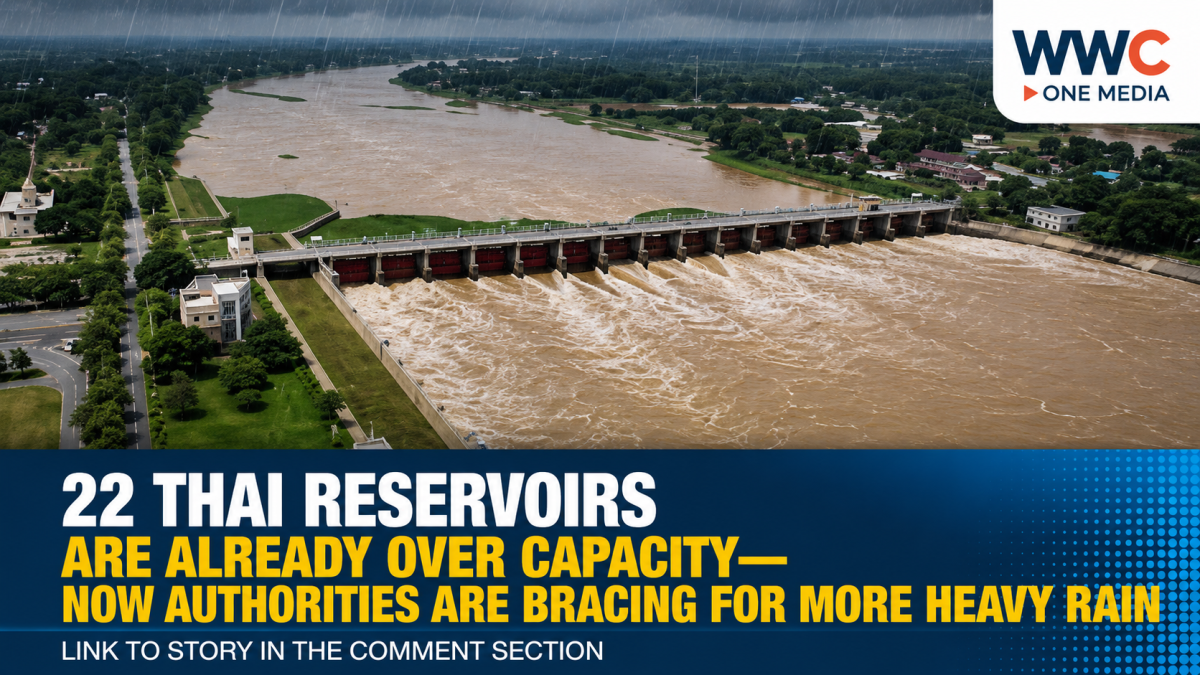
BANGKOK — Thailand is stepping up flood preparations after 22 medium and small reservoirs were reported to have water levels exceeding their storage capacity, while meteorological authorities warn that more heavy to very heavy rain could hit several parts of the country.
The warning comes as Thailand remains under a heightened flood risk through September 2, with authorities monitoring reservoirs, rivers and low-lying communities as rainfall continues across the country.
The situation does not mean the country’s major dams are about to fail. Rather, the concern is that reservoirs already holding unusually high volumes of water could face additional inflows from another round of heavy rain, increasing pressure on local water-management systems and downstream areas.
22 reservoirs under close watch
Thailand’s Office of the National Water Resources (ONWR) has ordered closer monitoring of 22 medium and small reservoirs in the North, Northeast and East after their water volumes exceeded their designed storage capacity.
Authorities have been instructed to adjust water-management and discharge operations to accommodate additional rainfall while continuing to monitor the structural safety of the reservoirs.
The goal is to prevent rapidly accumulating water from creating larger problems downstream.
Officials are also preparing waterways and drainage routes to handle additional runoff.
More rain is on the way
The timing is particularly concerning.
Thailand’s Meteorological Department said on September 1 that the monsoon trough is affecting the North and upper Northeast, while a relatively strong southwest monsoon continues over the Andaman Sea, Thailand and the Gulf.
The weather agency warned of more rain and isolated heavy to very heavy rainfall, particularly in western parts of the North, the Central region, parts of the Northeast and the East.
Authorities are warning residents in vulnerable areas to watch for:
- Flash floods
- River overflows
- Forest runoff
- Landslides
- Rapidly rising water levels
The risk is especially high around waterways, foothills and low-lying areas.
23 provinces currently facing disaster risks
Thailand’s disaster-management monitoring system showed 23 provinces under flash-flood, forest-runoff or short-term inundation watch on September 1, while 22 provinces were being monitored for overflowing rivers and waterlogging.
This follows a period of particularly wet weather across several parts of the country.
The National Water Resources Office had already identified 18 provinces as areas requiring heightened attention during the August 29–September 2 period, including provinces across the North, Northeast, West and East.
The Chao Phraya basin still has some breathing room
Despite the alarming situation involving smaller reservoirs, Thailand’s four major reservoirs serving the Chao Phraya River basin still have significant available storage.
The Royal Irrigation Department said the four major dams—Bhumibol, Sirikit, Khwae Noi Bamrung Dan and Pasak Jolasid—were collectively at about 61% of capacity, with more than 9.6 billion cubic metres of additional storage available as of late August.
That provides some buffer against incoming rainfall.
However, officials are continuing to adjust water releases according to rainfall and inflow conditions rather than simply maximizing storage.
The strategy is designed to balance two competing needs: retaining enough water for the dry season while keeping sufficient space for incoming rain.
Why smaller reservoirs are becoming a concern
The 22 reservoirs under scrutiny are different from Thailand’s largest dams.
Many medium and small reservoirs serve local communities, agriculture and regional water-management needs. When these facilities exceed their normal storage levels, heavy additional rainfall can quickly increase the amount of water flowing into surrounding drainage systems and rivers.
That can become particularly dangerous when several factors occur at the same time:
Heavy rain + saturated ground + full reservoirs + swollen rivers = greater flood risk.
Authorities are therefore focusing on early water management rather than waiting for widespread flooding to occur.
Thailand’s flood risk remains dynamic
The latest warnings come after flooding in parts of northern Thailand, including Nan province, where authorities have been working on recovery while continuing to monitor river levels.
Officials are paying particular attention to waterways including the Yom, Nan, Kok and Yuwam rivers, where rising levels could result in water spilling over riverbanks.
The disaster-management challenge is complicated by the fact that rainfall is not evenly distributed.
Some areas can receive intense rainfall and face flooding while other regions still have substantial water-storage capacity available.
That makes real-time monitoring essential.
Tropical weather is adding another layer of uncertainty
The Thai Meteorological Department also reported that a tropical depression south of China had developed into Tropical Storm Saudel over the upper South China Sea.
The agency said the storm was forecast to move near Taiwan around September 3–4 and was not expected to move into Thailand.
However, the broader atmospheric pattern is contributing to continued rainfall and rough seas around Thailand.
The department warned that waves in parts of the upper Andaman Sea and upper Gulf could reach 2–3 metres, with higher waves possible during thunderstorms.
Authorities are preparing before the next downpour
Thailand’s water agencies are now operating on the assumption that the situation could change quickly.
Reservoir levels are being monitored, discharge rates adjusted and vulnerable areas placed under closer observation.
The key concern is not simply how much water is currently in Thailand’s reservoirs.
It is how much more water could arrive before the current period of heavy rainfall ends.
With the country’s weather agency warning of additional heavy to very heavy rain and dozens of provinces already under flood-related monitoring, authorities are urging communities in vulnerable areas to remain alert.
The bottom line
Thailand currently has significant storage capacity in its four major Chao Phraya dams, but the fact that 22 medium and small reservoirs have exceeded capacity highlights the pressure being created by intense rainfall in some regions.
And with more rain forecast through the current weather period, the situation could change rapidly.
For residents in flood-prone areas, the biggest concern now isn’t just the water already on the ground—it is the next round of rain.
WWC ONE MEDIA J.M.D




Leave a Reply