
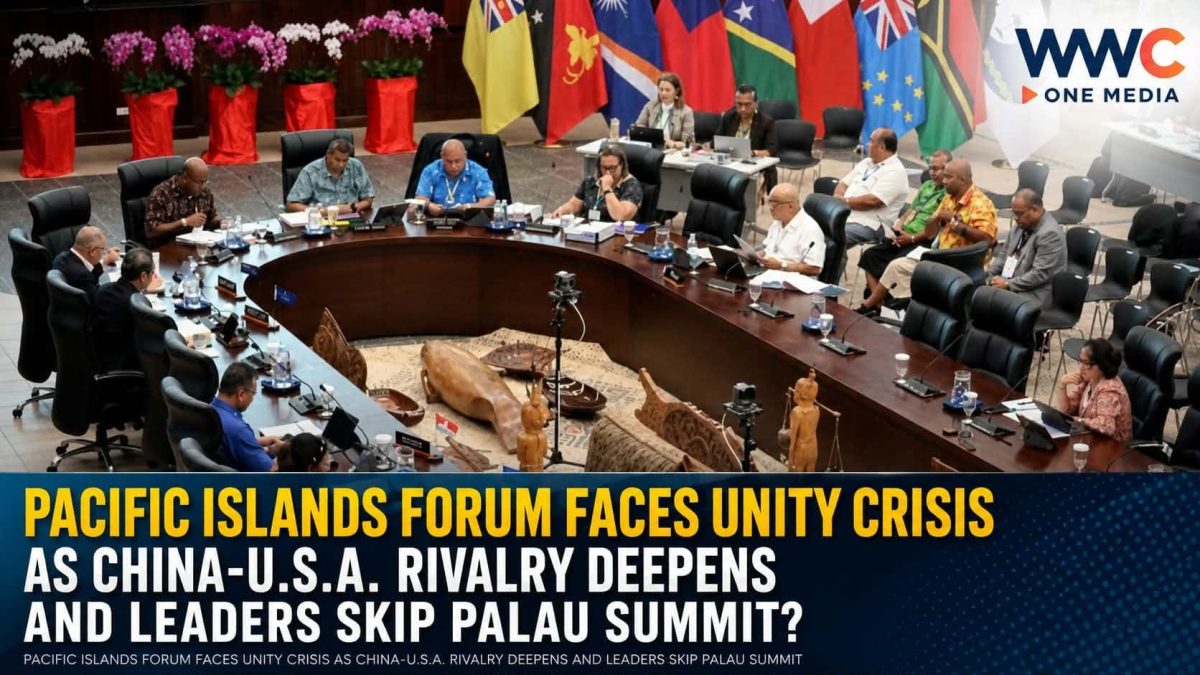
Pacific Islands Forum Faces Unity Crisis as China-U.S. Rivalry Deepens and Leaders Skip Palau Summit
Several Pacific leaders are absent from the 2026 Pacific Islands Forum in Palau as China-Taiwan tensions and growing great-power competition test regional unity.
Suggested slug: pacific-islands-forum-china-us-rivalry-leaders-absent-palau-2026
KOROR, Palau — The Pacific Islands Forum was supposed to project a message of regional unity this week. Instead, the gathering has been overshadowed by empty seats, diplomatic tensions and a growing struggle over the Pacific’s strategic direction.
The 55th Pacific Islands Forum Leaders’ Meeting opened in Palau on August 31 under the theme B.E.L.A.U. — Building Economies, Life, Action and Unity. But the absence of several national leaders has raised fresh questions about how effectively the region can maintain a united position as competition between China, the United States and their partners intensifies.
At least five Pacific leaders have been absent from the summit. The leaders of Kiribati, Samoa and Vanuatu sent representatives, while Fiji Prime Minister Sitiveni Rabuka remained away. Solomon Islands Prime Minister Matthew Wale arrived in Palau but returned home after a no-confidence motion was filed against him.
The departures do not, by themselves, prove that the absences were orchestrated by an outside power. Domestic political developments and other commitments are also important factors. But the timing has intensified concerns about the resilience of the Pacific Islands Forum at a moment when geopolitical competition is becoming increasingly difficult for island governments to avoid.
China-Taiwan tensions move to the center of the summit
One of the most sensitive issues surrounding this year’s meeting is Taiwan’s participation.
Palau, which maintains diplomatic relations with Taipei, hosted Taiwan’s Foreign Minister Lin Chia-lung and a delegation focused on development cooperation. Taiwan is not a formal member of the Pacific Islands Forum, but it participates in regional development activities.
China, meanwhile, strongly objected to Taiwan’s presence.
Chinese envoy Qian Bo said Beijing had “serious concerns” about Taiwan’s participation and warned of unspecified “consequences.” Taiwan’s foreign minister defended Taipei’s engagement with Pacific countries, while Australia and New Zealand rejected the idea that Beijing should determine who participates in the forum.
The confrontation illustrates the increasingly complicated diplomatic environment facing Pacific island states.
Only three Pacific Island countries — Palau, Tuvalu and the Marshall Islands — maintain formal diplomatic relations with Taiwan, while most of the region recognizes Beijing. Yet Taiwan continues to maintain development partnerships across the Pacific, making its role much larger than the number of its formal diplomatic allies might suggest.
The Pacific does not want to become a battlefield for big powers
The diplomatic competition is not new.
China has expanded its economic, diplomatic and security engagement across the Pacific over the past decade, while Australia, New Zealand and the United States have strengthened their own partnerships with island governments.
That competition has placed Pacific countries in an increasingly influential position.
For island governments, the priority is often less about choosing between Beijing and Washington than securing financing, infrastructure, climate assistance, economic opportunities and security cooperation while preserving national sovereignty.
The Pacific Islands Forum has traditionally provided a mechanism for governments to coordinate their positions collectively. But that consensus becomes harder to maintain when member states have different diplomatic relationships and competing strategic interests.
The problem was already visible last year.
At the 2025 Forum meeting in Solomon Islands, external partners — including China, the United States and Taiwan — were excluded from the gathering while the organization reviewed its partnership arrangements. Analysts subsequently highlighted the episode as another indication of how great-power competition was complicating Pacific regional diplomacy.
Solomon Islands adds another layer of uncertainty
The situation involving Solomon Islands has made this year’s meeting even more politically sensitive.
Prime Minister Matthew Wale had been expected to play a central role as outgoing Forum chair, but he left Palau after a no-confidence motion was lodged against him in Honiara.
His absence has added an unexpected domestic political dimension to an already geopolitically charged summit. Regional observers are watching closely because Solomon Islands has become one of the Pacific’s most closely followed countries in the competition between China and Western partners.
New Zealand Foreign Minister Winston Peters has also expressed skepticism about some of the explanations surrounding the absences,particularly kiribati’ decision not to send a senior political representative.However,There has been no estbalished public evidence proving that china directed the decisions of absent leader.
That distinction matters.
Pacific governments have their own domestic political calculations,economic interests and foreign-policy priorities. Treating every disaggreement or absence as evidence of Chinese or American manipulation risks overlooking the agency of the island states themselves.
Climate change remains the Pacific’s bigger priority
Despite the geopolitical tensions, the Forum’s core agenda extends well beyond China and Taiwan.
Pacific governments continue to face some of the world’s most severe climate-related risks, alongside challenges involving food security, economic development, maritime security, transnational crime, energy and access to finance.
That creates a difficult balancing act.
The region needs external partners — including Australia, New Zealand, the United States, China, Japan and Taiwan — but Pacific governments also want to ensure that those relationships do not dictate the region’s priorities.
Palau President Surangel Whipps Jr. has even proposed establishing a fixed annual date for the Forum Leaders’ Meeting, arguing that more predictable scheduling could improve attendance and help Pacific governments speak with a stronger collective voice.
Why the empty chairs matter
The significance of this year’s absences goes beyond the number of leaders missing from a photograph.
The Pacific Islands Forum operates on consensus, meaning that regional unity depends heavily on governments being willing and able to coordinate their positions.
When leaders are absent, representatives may still participate, but the political authority to negotiate sensitive language and make major commitments.
WWC ONE MEDIA G.A




Leave a Reply