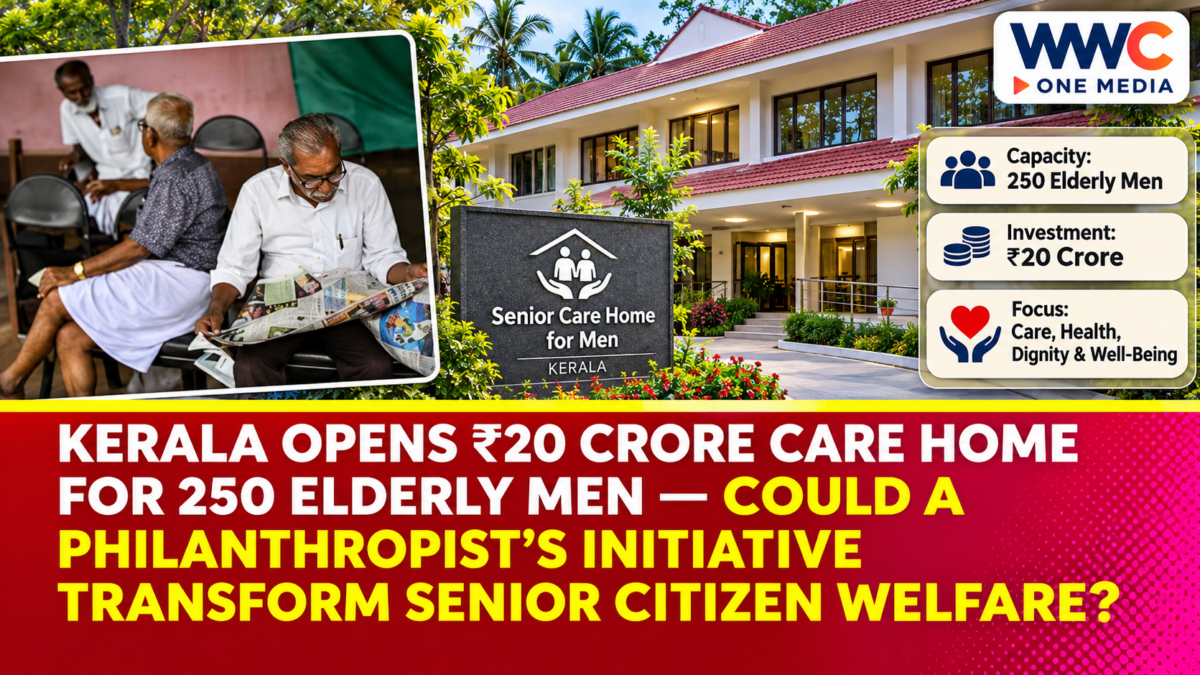
KOLLAM, INDIA — Kerala has strengthened its residential care infrastructure for vulnerable senior citizens with the inauguration of a ₹20 crore facility designed to accommodate 250 elderly men who have been abandoned by their families or are without adequate support.
Kerala Chief Minister V.D. Satheesan inaugurated the facility, named Pithrubhavanam, on November 23, 2026, at Gandhi Bhavan in Pathanapuram, Kollam district.
The project was funded by LuLu Group Chairman Yusuffali M.A., whose longstanding involvement with the institution previously resulted in the construction of a residential facility for elderly women.
The initiative brings renewed attention to a growing social challenge: ensuring that longer lives are accompanied by adequate healthcare, personal dignity, financial security and meaningful social connections.
As populations age across Asia and other parts of the world, the demand for accessible and sustainable elderly care is becoming an increasingly important consideration for governments, businesses and charitable organisations.
Kerala Elderly Care Home Provides Accommodation for 250 Men
Pithrubhavanam is a four-storey residential building covering approximately 40,000 square feet.
The facility combines accommodation with nursing support, accessible infrastructure and communal spaces intended to meet the needs of elderly residents.
Its residential capacity is complemented by provisions for individuals requiring additional physical assistance and specialised care.
The project includes adjustable beds, wheelchair facilities, nursing and palliative care services, a pharmacy and a laboratory.
Residents will also have access to spaces for reading, dining, prayer and communal activities.
The development represents a significant investment in residential care infrastructure, particularly for individuals who lack reliable family support.
However, the announced capacity of 250 residents should not be interpreted as confirmation that every available bed has already been occupied.
The importance of creating supportive environments for older people has also been examined in WWC ONE MEDIA’s coverage of Singapore’s transformation of neighbourhood spaces into places where senior citizens can remain socially connected.
Residential facilities can address accommodation needs, but opportunities for participation, companionship and meaningful daily activities are equally important considerations.
Yusuffali’s Philanthropic Commitment Extends Beyond a Single Building
The November inauguration represents another stage in Yusuffali’s relationship with Gandhi Bhavan, which began with a visit to the institution in 2016.
His earlier residential project, Mathrubhavanam, was handed over in November 2022 after construction costing ₹18 crore.
That facility was established for elderly women.
With the completion of Pithrubhavanam, the announced combined construction expenditure for the two residential buildings amounts to ₹38 crore, equivalent to ₹380 million.
Gandhi Bhavan founder and managing trustee Punalur Somarajan also disclosed that Yusuffali had provided an additional ₹11.75 crore in financial assistance supporting the institution’s residents, separate from the construction projects.
The distinction between infrastructure funding and continuing welfare assistance is important.
A residential building requires ongoing operational resources, including personnel, maintenance, food, healthcare supplies and administrative support.
The long-term effectiveness of philanthropic investment therefore depends not only on the quality of the infrastructure but also on whether sufficient resources remain available to sustain its services.
Global Population Ageing Creates Growing Demand for Long-Term Care
Kerala’s latest residential care initiative comes amid a significant global demographic transformation.
The world’s population aged 60 and above is projected to increase from approximately one billion in 2020 to 1.4 billion by 2030.
By 2050, that population is expected to reach 2.1 billion.
The number of people aged 80 and above is also projected to reach 426 million by 2050.
These demographic projections highlight the scale of the challenge confronting healthcare systems, residential care providers and social welfare organisations.
The needs of older people differ considerably. Some remain physically active and independent well into later life, while others require regular medical assistance or support with everyday activities.
The growing significance of population ageing has already become evident across several Asian economies.
WWC ONE MEDIA previously examined this demographic transition in its report on Singapore becoming a super-aged society.
The consequences extend beyond healthcare expenditure. Population ageing can influence housing requirements, workforce participation, retirement planning, transportation systems and demand for professional caregivers.
For residential care organisations, the challenge is developing services capable of accommodating different levels of physical and social support.
The Hidden Challenge of Financing Elderly Care
Although investment in new residential facilities can expand available accommodation, financing long-term services remains a substantial international challenge.
An October 2026 update on the United Nations Decade of Healthy Ageing found that 56.7% of reporting countries had national long-term care policies, compared with 49% in 2023.
However, 33.8% of reporting countries had little or no dedicated funding to develop long-term care services.
The figures reveal an important gap between establishing welfare policies and securing the financial resources necessary to implement them.
Residential care facilities require dependable operational funding long after their inauguration ceremonies have concluded.
The availability of appropriately trained employees, medical supplies and reliable infrastructure can significantly influence the quality of services residents receive.
Philanthropic investment can complement government programmes by providing additional facilities and financial assistance.
However, charitable projects should not be regarded as substitutes for comprehensive public policies, effective regulation and sustainable long-term care systems.
For institutions supporting vulnerable elderly residents, continuity of care remains particularly important.
Why Accessible Infrastructure Matters for Senior Citizens
The physical design of a residential facility can influence how comfortably and independently elderly people carry out their daily activities.
Accessible bathrooms, suitable mobility equipment and appropriate lifting facilities can help address physical barriers experienced by residents with reduced mobility.
However, effective senior-friendly design also extends to the wider social environment.
Older people should have opportunities to participate in activities, maintain relationships and make decisions concerning their daily lives whenever possible.
The importance of accommodating different physical and cognitive needs was previously explored in WWC ONE MEDIA’s coverage of Singapore’s plans to improve public transport accessibility for older people and commuters living with dementia.
Although public transportation and residential care involve different infrastructure requirements, both demonstrate why accessibility must be considered alongside individual dignity and independence.
For Pithrubhavanam, the effectiveness of its facilities will ultimately depend on how well services respond to the actual needs of residents.
What Happens Next for Kerala’s Elderly Care Initiative?
The inauguration of Pithrubhavanam represents the completion of an important construction project.
The next challenge is ensuring that its facilities translate into dependable daily support for vulnerable senior citizens.
Long-term success will depend on operational sustainability, appropriate staffing, healthcare coordination and the experiences of residents themselves.
The initiative also provides an opportunity for wider discussion about the roles of governments, families, businesses and charitable institutions in supporting ageing populations.
The United Nations Decade of Healthy Ageing, which runs from 2021 to 2030, identifies improved access to quality long-term care and supportive communities as important international objectives.
Kerala’s latest residential facility demonstrates how private philanthropy can contribute to those objectives at the community level.
The opening of a ₹20 crore building is a significant achievement. Its most meaningful measure of success, however, will be whether the people living within it receive consistent care, personal respect and opportunities to live with dignity.
Frequently Asked Questions
What is Kerala’s new elderly care home called?
The facility is called Pithrubhavanam and is located at Gandhi Bhavan in Pathanapuram, Kollam district, Kerala.
Who funded the new elderly care home?
LuLu Group Chairman Yusuffali M.A. funded the construction of the facility at an announced cost of ₹20 crore.
How many elderly people can Pithrubhavanam accommodate?
The residential facility has a designed capacity of 250 elderly men.
When was the Kerala elderly care home inaugurated?
Kerala Chief Minister V.D. Satheesan inaugurated Pithrubhavanam on November 23, 2026.
What other elderly care projects has Yusuffali supported?
Yusuffali previously funded Mathrubhavanam, an ₹18 crore residential facility for elderly women at Gandhi Bhavan, completed in November 2022. He has also provided separate financial assistance for residents’ welfare.