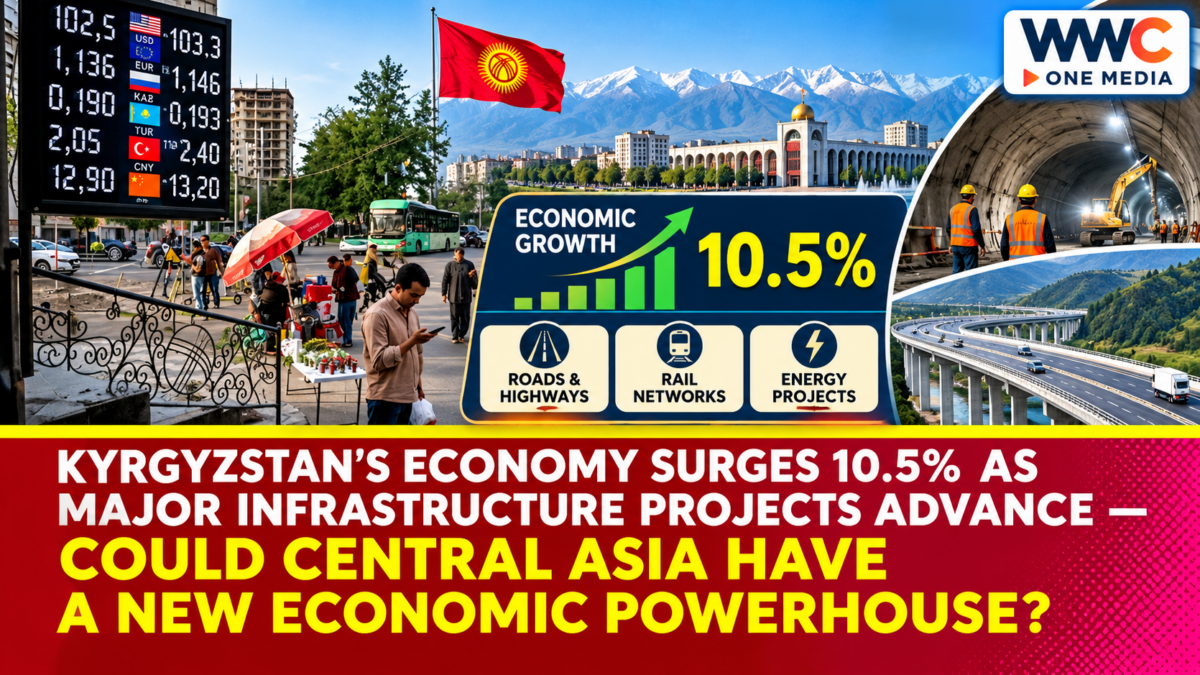
BISHKEK, KYRGYZSTAN — Kyrgyzstan is recording another year of rapid economic expansion, with gross domestic product growing by 10.5% during the first ten months of 2026 as construction, industrial development and capital investment support the country’s economic transformation.
Preliminary national economic figures released on Nov. 16 placed GDP at approximately 1.866 trillion Kyrgyz soms for the January–October period, while investment in fixed assets increased by 62.9%.
Under President Sadyr Zhaparov, the Central Asian nation is pursuing a development strategy centred on international connectivity, energy security and economic modernisation.
However, rising consumer prices and substantial infrastructure financing requirements present challenges that could determine whether the country’s impressive growth translates into lasting prosperity.
Kyrgyzstan economic growth extends beyond gold mining
One of the most significant developments in Kyrgyzstan’s latest economic figures is the strength of activity outside its major Kumtor gold mining operations.
Excluding enterprises involved in developing the Kumtor deposit, economic growth reached 12.3% during January–October 2026.
This suggests that the country’s recent expansion extends beyond its prominent gold industry, although further diversification remains important for long-term economic resilience.
Key economic indicators include:
| Economic indicator | January–October 2026 growth |
|---|---|
| Gross domestic product | 10.5% |
| GDP excluding Kumtor-related enterprises | 12.3% |
| Fixed asset investment | 62.9% |
| Construction output | 61.5% |
| Industrial output | 5.2% |
| Agricultural output | 4.7% |
| Retail trade, excluding motor vehicles | 14.8% |
The figures demonstrate particularly strong momentum in construction and capital expenditure.
Nevertheless, rapid investment growth does not automatically establish that every project will produce commercially sustainable returns.
The economic contribution of new infrastructure ultimately depends on its utilisation, operating costs and ability to support productive activities.
China’s railway partnership could reshape Kyrgyzstan’s economic geography
The China–Kyrgyzstan–Uzbekistan railway represents one of the most strategically important infrastructure initiatives in the country’s development agenda.
The three governments signed their intergovernmental railway agreement on June 6, 2024, establishing a framework for developing a new international transport corridor.
A formal project commencement ceremony followed in December 2024.
The railway is intended to improve connectivity between China and Central Asia while creating opportunities for expanded commercial links with Europe and other international markets.
For Kyrgyzstan, the potential benefits extend beyond transportation.
An operational railway could support logistics facilities, industrial development, warehousing, tourism and cross-border commerce.
Businesses may also benefit from additional options for transporting goods to overseas markets.
Similar regional connectivity ambitions are examined in WWC ONE MEDIA’s coverage of Nepal and India’s new economic partnership roadmap, where cross-border infrastructure and commercial cooperation remain central policy priorities.
However, announcing a transport corridor is different from operating a commercially competitive railway.
Construction progress, customs coordination, freight demand, financing costs and international agreements will ultimately determine the project’s economic value.
Kambarata-1 hydropower project could strengthen Central Asian energy security
Kyrgyzstan is also pursuing a major expansion of its electricity generation infrastructure through the Kambarata-1 Hydropower Plant.
The project involves cooperation between Kyrgyzstan, Kazakhstan and Uzbekistan.
Planned engineering specifications include a generation capacity of 1,860 megawatts and annual electricity production of approximately 6,000 gigawatt-hours.
The development could help address electricity shortages while supporting industrial activity and regional electricity trading.
The proposed ownership arrangement envisages Kyrgyzstan holding 34% of the joint venture, with Kazakhstan and Uzbekistan each holding 33%.
These ownership percentages describe a planned structure rather than confirmation that the final arrangement has been fully implemented.
The potential commercial significance of cross-border electricity partnerships is also examined in WWC ONE MEDIA’s analysis of Nepal–India power cooperation.
Generating electricity is only one part of energy security. Transmission networks, operating arrangements and commercial agreements must also support reliable delivery to households and businesses.
Kyrgyzstan’s hydropower ambitions therefore represent both a domestic development opportunity and a regional cooperation challenge.
Investment boom creates opportunities — and financial risks
Capital investment is emerging as one of the most important features of Kyrgyzstan’s current expansion.
Fixed asset investment reached approximately 422.9 billion soms during the first ten months of 2026.
Growth was supported by both domestic and external financing.
Around 80% of total fixed asset investment was directed towards a combination of transportation and storage facilities, energy infrastructure, mining, education and residential construction.
These investments could improve the country’s productive capacity if the projects are completed efficiently and generate sufficient economic value.
However, total fixed asset investment should not be confused with foreign direct investment alone. The figures include expenditure financed through multiple domestic and external channels.
Kyrgyzstan’s energy ambitions also form part of a wider Asian investment environment, examined in WWC ONE MEDIA’s coverage of China’s US$940-billion energy investment outlook.
Attracting capital is an important milestone, but ensuring that investment produces reliable infrastructure and sustainable public finances is a separate challenge.
Inflation remains a threat to household purchasing power
Despite strong economic performance, Kyrgyzstan faces persistent price pressures.
Consumer prices in October 2026 were 8.8% higher than in December 2025 and 11.1% higher than in October 2025.
These figures measure different comparison periods and should not be treated as interchangeable inflation rates.
An expanding economy can create employment opportunities and support higher incomes. However, rising prices can reduce the purchasing power of households when earnings fail to keep pace with living costs.
The International Monetary Fund’s June 2026 economic assessment identified concerns involving inflation, rapid credit expansion and potential overheating.
Its assessment also emphasised the importance of responsible public investment, stronger financial oversight and reforms supporting private-sector development.
These challenges illustrate why headline GDP growth alone cannot establish whether ordinary households are experiencing sustainable improvements in living standards.
Can President Zhaparov’s 2030 development strategy deliver lasting prosperity?
Kyrgyzstan’s National Development Plan, launched in 2025, targets upper-middle-income status by 2030.
The strategy prioritises infrastructure, regional connectivity, agriculture, renewable energy and environmentally sustainable tourism.
The country’s development ambitions could help broaden its economic base and improve access to international markets.
However, achieving upper-middle-income status requires more than announcing large infrastructure investments.
Future progress will depend on productivity improvements, effective public administration, competitive businesses and the quality of education and employment opportunities.
Greater economic diversification could also help reduce vulnerability to external shocks affecting commodity markets, international trade and remittance flows.
The next phase of Kyrgyzstan’s transformation will therefore require balancing infrastructure expansion with financial discipline and improvements in household welfare.
The country’s double-digit economic growth provides a promising foundation. Whether it becomes a lasting regional economic success will depend on what happens after the current investment boom.
Frequently asked questions
How fast is Kyrgyzstan’s economy growing in 2026?
Kyrgyzstan’s GDP increased by 10.5% during January–October 2026 compared with the corresponding period in 2025.
How much is Kyrgyzstan’s GDP in 2026?
Preliminary GDP reached approximately 1.866 trillion Kyrgyz soms during the first ten months of 2026. This is not the final full-year GDP figure.
What major infrastructure projects is Kyrgyzstan developing?
Key strategic initiatives include the China–Kyrgyzstan–Uzbekistan railway and the proposed 1,860-MW Kambarata-1 Hydropower Plant.
What is Kyrgyzstan’s inflation rate?
Consumer prices in October 2026 were 11.1% higher than a year earlier and 8.8% higher than in December 2025.
What is Kyrgyzstan’s economic goal for 2030?
The National Development Plan targets upper-middle-income status by 2030 through infrastructure development, economic diversification and stronger regional integration.