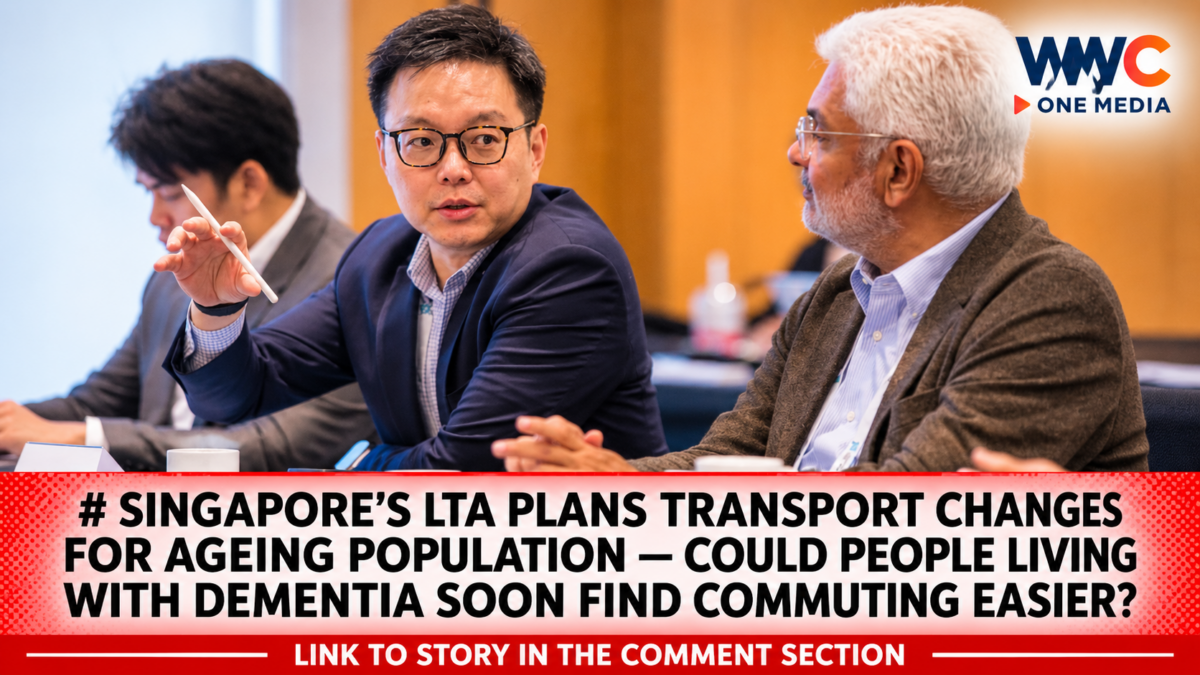
SINGAPORE — November 6, 2026 — Singapore’s public transport system may be heading towards a more people-centred transformation, with the Land Transport Authority (LTA) studying ways to make journeys easier for older commuters and people experiencing cognitive decline.
The plans go beyond the familiar improvements of installing lifts, ramps and wheelchair-accessible facilities. LTA is also examining how transport environments can better support people who may experience difficulties with memory, orientation, decision-making and navigating unfamiliar surroundings.
Speaking to the media at Singapore Urban Mobility Week 2026 on November 5, LTA chief operating officer Lim Zhi Jian said the authority is working with research institutions, universities and other government agencies to understand the needs of commuters experiencing cognitive decline, including people living with dementia.
The research is intended to identify further improvements that could make public transport easier and more comfortable for people with different needs.
The announcement comes as Singapore officially enters the category of a super-aged society, with 21.4 per cent of its citizen population aged 65 and above in 2026.
As the number of older residents increases, transport planners face a challenge that cannot be solved simply by expanding the rail network or adding more buses.
A transport system may be physically accessible but still difficult to navigate for someone who struggles to remember directions, recognise signs or process a busy environment.
LTA’s latest direction suggests that the next stage of Singapore’s transport planning will increasingly consider these less visible barriers.
LTA Studies How Public Transport Can Better Support People With Dementia
One of the most important developments highlighted by Lim is LTA’s research into the transport needs of people experiencing cognitive decline.
Cognitive difficulties can affect how someone understands information, remembers routes, recognises locations or responds to unexpected changes during a journey.
For an older commuter, a crowded interchange with multiple signs, announcements, platforms and connecting routes may become particularly challenging.
Someone who is unfamiliar with a station may struggle to identify the correct exit. Another person may become confused if a regular route changes because of maintenance work or a service disruption.
These difficulties do not necessarily mean that an individual cannot travel independently. They do, however, highlight why transport environments need to be designed with a wider range of human needs in mind.
Lim said LTA is working with research institutions, universities and other government agencies to explore what additional improvements could be introduced.
The authority has not announced a complete list of new dementia-specific transport features or a nationwide implementation timetable. The current work is focused on understanding the needs and identifying suitable enhancements.
That distinction is important: the research signals a direction for future planning, not confirmation that a new set of dementia-friendly facilities is already being rolled out across every station and interchange.
Quiet Corners and Friendly Streets Are Already Part of the Approach
Although the latest research is still developing, LTA has already introduced measures intended to make journeys more comfortable and accessible.
One example is the provision of quiet corners in commuter care rooms at bus interchanges.
These spaces can offer commuters who need additional assistance a calmer environment away from the busiest parts of a transport facility.
Another initiative is Friendly Streets, introduced in 2023.
The programme aims to make everyday walking and cycling journeys safer, more convenient and more comfortable.
Its approach includes improvements to pedestrian crossings, walking routes and the surrounding street environment.
These measures can benefit older people, families with young children, persons with disabilities and other pedestrians who may need more time or support when moving around.
The wider principle is that accessibility should not stop at the entrance of an MRT station or bus interchange. A journey often begins with a walk from home and ends with another walk to a destination.
Improving those connections can make public transport more practical for people who might otherwise find the journey difficult.
Singapore Is Now Officially a Super-Aged Society
The urgency behind LTA’s work is closely connected to Singapore’s changing population.
According to the Population in Brief 2026 report released on September 25, people aged 65 and above accounted for 21.4 per cent of Singapore’s citizen population in June 2026.
That is an increase from 20.7 per cent in 2025 and 13.7 per cent in 2016.
The number of citizens aged 80 and above has also increased substantially, reaching 152,000 in 2026 compared with 95,000 a decade earlier.
Singapore has therefore crossed the 21 per cent threshold used to describe a super-aged population.
The demographic change is expected to continue.
The Government estimates that more than one in four Singapore citizens will be aged 65 and above by 2035.
This creates new demands across several areas, including healthcare, housing, community services and public transport.
Older residents may need more direct connections to hospitals, clinics, community centres and everyday amenities.
They may also require transport facilities that accommodate different mobility levels and make navigating unfamiliar places less stressful.
For LTA, the challenge is to ensure that the transport network remains useful and welcoming as the population grows older.
Read more: Singapore Officially Becomes a Super-Aged Society as Seniors Reach 21.4% of Citizens.
More Lifts and Better Access as Older MRT Lines Are Rejuvenated
LTA’s work is not limited to research into cognitive needs.
Lim also highlighted improvements to transport infrastructure, including the provision of more lifts along the Thomson-East Coast Line and the rejuvenation of older rail lines.
The aim is to ensure that existing infrastructure continues to meet the needs of an ageing population.
Lifts are particularly important for commuters who cannot comfortably use stairs or escalators, including wheelchair users, people with mobility difficulties and some older passengers.
However, accessibility also involves the connections between different parts of a journey.
A station may have lifts, but a commuter can still face difficulties if the route to the station includes unsafe crossings, uneven pathways or poorly connected pedestrian infrastructure.
In a written parliamentary reply on August 5, Transport Minister Jeffrey Siow said all MRT and LRT stations and almost all bus stops were barrier-free.
He also highlighted improvements such as lifts at pedestrian overhead bridges near public transport nodes and healthcare institutions, as well as near areas with larger senior populations.
At Friendly Streets, features such as longer pedestrian crossing times and raised zebra crossings are intended to make walking journeys safer and more comfortable.
LTA has also been engaging seniors and people with reduced mobility to understand their experiences and improve transport provisions.
The next challenge is to make these facilities work together as one accessible journey rather than as separate improvements.
Singapore’s Transport Network Is Expected to Expand From 270km to 360km
Alongside the ageing population, Singapore must also accommodate a growing overall population.
According to the September 2026 Population in Brief report, Singapore’s total population reached a record 6.21 million as of June 2026, representing a 1.6 per cent increase from the previous year.
The growth was driven mainly by an increase in the non-resident population.
Lim said Singapore currently has approximately 270km of rail network, which is expected to expand to around 360km within the next decade.
Bus services and connections have also been developed to serve different parts of the island.
The expansion is intended to improve connectivity and provide commuters with more travel options.
However, a larger network does not automatically mean a more comfortable journey.
New stations and rail connections must be supported by reliable services, convenient transfers, sufficient capacity and accessible facilities.
The challenge becomes more complicated when a transport network must serve commuters with very different needs.
A younger commuter may prioritise journey speed, while an older passenger may place greater importance on direct routes, clear signs, seating and predictable travel conditions.
LTA’s planning therefore needs to balance expansion with the quality of the experience for people using the system.
LTA Says Crowding Is Also About Managing Peak-Hour Demand
Population growth has raised concerns about overcrowding on trains and buses.
However, Lim explained that crowding is not determined by population size alone.
He said transport systems must also manage periods when large numbers of people travel at the same time.
For example, commuters heading to work and school often travel during similar morning peak periods, while many people make their return journeys in the evening.
This creates concentrated demand even when the overall transport network has sufficient capacity at other times.
Lim pointed to programmes intended to encourage travel outside peak periods, including free off-peak travel on the North-East Line.
Such incentives can help distribute passenger demand more evenly throughout the day.
If more commuters travel earlier or later where their schedules allow, the pressure on the busiest services could be reduced.
That could benefit passengers who have less flexibility, including people travelling to medical appointments or other essential destinations during busy periods.
The aim is not simply to move more people through the system, but to make better use of existing capacity while reducing the most uncomfortable periods of crowding.
Singapore’s Land Transport Master Plan Is Moving Beyond Basic Connectivity
Lim also discussed the broader direction of Singapore’s Land Transport Master Plan (LTMP).
He compared the development of the transport system with Maslow’s hierarchy of needs, which describes how basic needs form the foundation for higher-level needs.
In his explanation, Singapore’s transport system has already made substantial progress in areas such as safety, security and hygiene.
The next level involves reliability, predictability and convenience.
The third level focuses on the overall experience of travelling.
This includes making journeys comfortable, pleasant, easy and seamless.
Lim said the current Land Transport Master Plan is focused on improving this experience, rather than concentrating only on the basic availability of transport services.
The distinction is important.
A transport system can be safe and operational but still leave passengers frustrated by confusing transfers, crowded platforms, long waits or uncomfortable journeys.
The next phase of improvements is intended to address these everyday experiences.
For older commuters, that could mean clearer navigation, more predictable journeys and facilities that reduce the stress of travelling independently.
Public Transport Courtesy Is Another Part of the Challenge
LTA’s plans also recognise that a better transport experience depends on commuter behaviour.
Lim highlighted the importance of a culture in which passengers look out for one another and show appreciation for transport workers.
For example, giving way to someone who needs more time to board, keeping priority seating available for those who need it and allowing passengers to move through crowded areas can make a journey easier.
He also encouraged commuters to show appreciation to bus captains and other frontline transport workers.
This is relevant because the comfort and safety of a journey are influenced not only by infrastructure but also by how people share public spaces.
Singapore introduced new rules against nuisance and disruptive behaviour on public transport from September 23, 2026.
The rules cover certain conduct on buses, at bus interchanges and terminals, with penalties for specified offences.
The regulations are intended to improve the commuting environment, but Lim’s remarks also point to the importance of everyday consideration.
A respectful commuting culture can make public transport more welcoming for older passengers, persons with disabilities, families and frontline workers.
Read more: Singapore Tightens Public Transport Rules From Sept 23 — These Everyday Behaviours Could Now Cost You.
Bus and MRT Improvements Must Address More Than Infrastructure
The discussion about ageing commuters comes as Singapore continues to improve its bus and rail services.
Recent initiatives include upgrading bus interchanges, using technology to improve bus operations and expanding the rail network.
LTA announced in August that six bus interchanges—Bishan, Bukit Batok, Bukit Merah, Eunos, Punggol and Tampines—would undergo upgrading works from 2027.
The planned improvements include better ventilation, lighting, seating and accessibility features.
They also include priority queue zones, wheelchair-accessible toilets, commuter care rooms, tactile guided paths and Braille signs on handrails.
These facilities could improve the experience for older commuters and people who require additional assistance.
Technology is also being introduced to address operational problems.
SBS Transit, for example, is testing an AI-powered decision-support system called FlowOS to help controllers identify bus delays and bunching.
The technology is intended to help keep buses more evenly spaced and improve the reliability of services.
Read more: SBS Transit Turns to AI to Tackle Bus Bunching and Delays Across Singapore.
These initiatives address different parts of the commuter experience, but they share a common objective: making journeys more dependable, comfortable and accessible.
What Could a More Dementia-Friendly Transport System Look Like?
LTA has not announced a final design or implementation plan for new dementia-specific transport facilities.
However, the research into cognitive needs points towards several areas that transport planners may need to examine.
Clearer wayfinding: Signs and directions that are easy to understand can help commuters identify platforms, exits and connecting routes.
More predictable journeys: Consistent information about train and bus arrivals can reduce uncertainty for passengers who find unexpected changes difficult to manage.
Calmer spaces: Quiet areas can offer a place for people who feel overwhelmed in crowded or noisy environments.
Better assistance: Staff who understand the needs of older commuters and people experiencing cognitive difficulties can help passengers when they become confused or need additional support.
Safer walking connections: Better crossings, accessible pathways and clear routes can make it easier to travel between stations, bus stops and nearby destinations.
These are possible areas for further consideration, not confirmed new LTA measures. The authority’s research will help determine which enhancements are most appropriate.
The larger principle is that an inclusive transport system should account for more than physical mobility.
It should also consider how people understand, navigate and experience their surroundings.
What Happens Next?
LTA’s research with universities, research institutions and other government agencies will help the authority identify what additional changes may be needed.
The findings could inform future improvements to stations, bus interchanges, pedestrian connections and commuter-support facilities.
The wider Land Transport Master Plan refresh is also intended to respond to changes in Singapore’s population, travel habits, technology and climate.
The plan is being developed through public engagement, with LTA gathering feedback from commuters and stakeholders about connectivity, comfort and community.
In July 2026, LTA said more than 7,000 members of the public had been engaged since November 2025 through online responses, focus group discussions, youth engagements and community outreach.
The authority has also conducted shadowing studies to better understand the practical challenges faced by different commuter groups.
These included people with visual impairments, families with young children, people living with dementia and persons with disabilities.
The refreshed Land Transport Master Plan is targeted for release in 2027.
The Bigger Question: Can Singapore Build a Transport System That Works for Every Generation?
Singapore’s transport network is entering a new stage of development.
The country must expand its rail and bus infrastructure while preparing for an older population, changing travel patterns and growing expectations about comfort and convenience.
For older commuters, the ability to travel independently can make a significant difference to daily life.
It affects access to healthcare, social activities, family visits, shopping and community services.
But independence depends on more than having a nearby station or bus stop.
Passengers also need to understand where they are going, feel confident navigating the network and know that assistance is available when something unexpected happens.
LTA’s latest research signals an effort to address these less visible challenges.
The next test will be whether the findings translate into practical improvements that make everyday journeys easier for seniors and commuters with different needs.
Singapore has spent decades building a transport network that connects the island. Its next challenge is making sure that people of every age and ability can use that network with confidence.