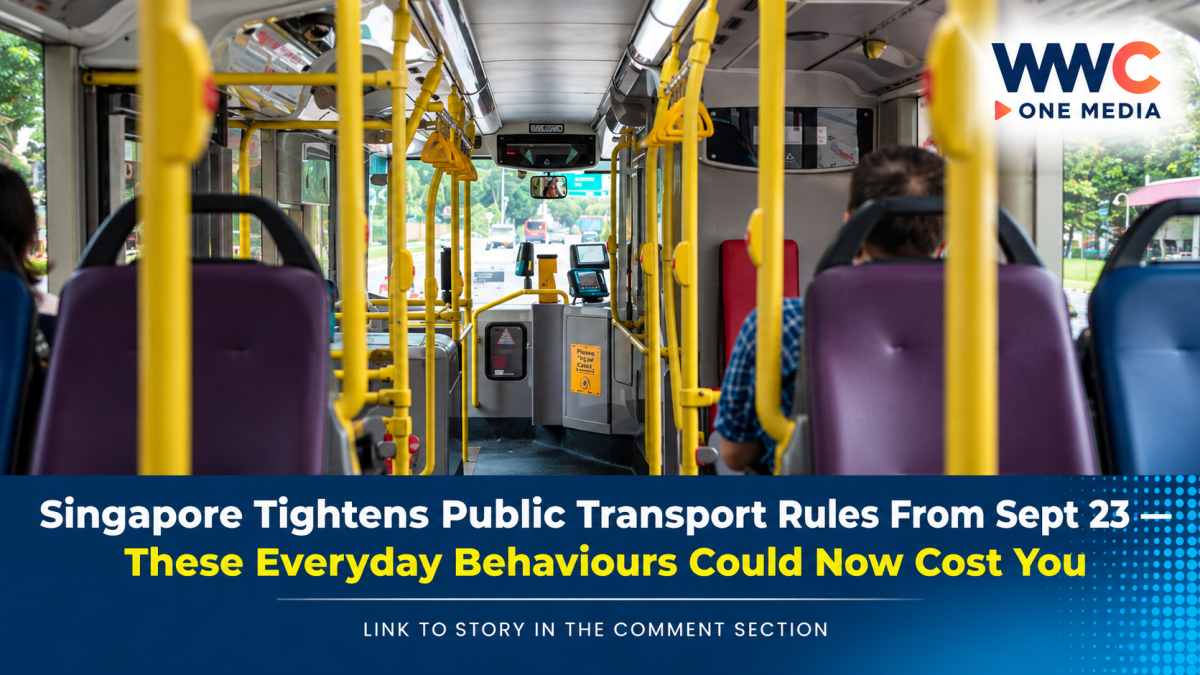
Singapore commuters will face tougher rules on public buses and at bus interchanges and terminals from Sept 23, with certain nuisance and disruptive behaviours becoming offences punishable by fines.
The new regulations, introduced under amendments to the Transport Sector framework, are intended to bring the rules governing commuter behaviour on buses more closely in line with those already applying to Singapore’s rail system.
Among the behaviours that can result in a fine of up to S$500 are placing one’s feet on bus seats, playing audio at loud volume, littering, and eating or drinking onboard buses.
More serious conduct can carry a much higher maximum penalty of S$5,000. This includes causing an obstruction or creating danger for other commuters at bus interchanges or terminals, as well as soiling any part of a public bus, interchange or terminal.
The changes follow the Transport Sector (Miscellaneous Amendments) Act, which Parliament passed in October 2025. The legislation was designed to align the regulatory framework for nuisance and disruptive behaviour across Singapore’s bus and train networks.
Under the new system, authorised staff such as ticket inspectors and bus interchange staff can issue Administrative Notifications of Offences to people suspected of committing an offence. The Land Transport Authority will then conduct investigations.
Bus captains will not be authorised to issue these notifications because their primary responsibility is to operate buses safely. However, they can still tell passengers to stop disruptive behaviour and require passengers who refuse to comply to get off the bus.
If a situation becomes particularly serious, bus captains can seek assistance from the bus operations control centre or the police.
The new rules come after Singapore had already introduced measures encouraging more considerate behaviour on public transport. Signs reminding commuters to keep noise down and avoid other inconsiderate behaviour have been rolled out on buses and trains in recent years.
The authorities have also stressed that enforcement will involve discretion and fairness, particularly when dealing with commuters whose behaviour may be linked to physical or mental health conditions.
The changes mean that behaviours that might previously have been treated mainly as breaches of operator conditions can now carry specific legal penalties.
For Singapore’s millions of daily public transport users, the message is becoming clearer: what happens on a bus or at an interchange is no longer simply a matter of commuter etiquette when the behaviour crosses into nuisance, disruption, obstruction or danger.