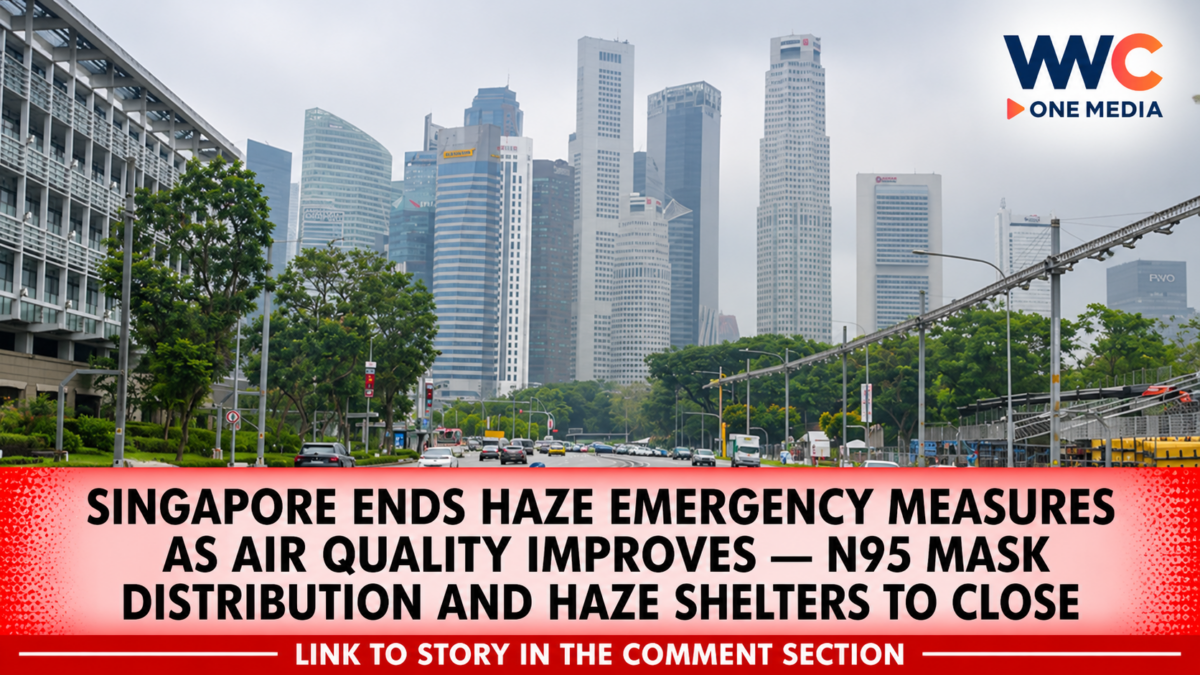
SINGAPORE — Singapore is preparing to wind down most of its 2026 haze response after weeks of air-quality concerns, with the Government announcing that N95 mask distribution, designated haze shelters and additional workplace precautions will end on November 7.
The National Environment Agency (NEA) announced on November 5 that improving weather conditions, including the onset of inter-monsoon conditions and more frequent showers, have reduced the likelihood of transboundary haze affecting Singapore.
The decision marks a significant shift from the heightened alert earlier in October, when pollution readings climbed and authorities prepared additional measures to protect residents, particularly vulnerable groups.
However, not every programme will end at the same time. The Ministry of Health (MOH) will deactivate the Haze Subsidy Scheme (HSS) and Public Health Preparedness Clinic (PHPC) Scheme from November 12, giving eligible residents a few more days to access subsidised treatment.
N95 Mask Distribution and Haze Shelters to Close on November 7
According to NEA’s November 5 advisory, the distribution of N95 or equivalent masks through People’s Association Community Clubs, selected public transport hubs, Social Service Offices and other designated venues will conclude at 6pm on Saturday, November 7.
Air-conditioned rooms designated as haze shelters at Community Clubs and selected Residents’ Committee and Residents’ Network centres will also close at 6pm that day.
The Government will likewise stop issuing its daily haze situation updates after its final advisory for the current haze season on November 7.
The Ministry of Manpower will also stand down its additional haze-related measures for outdoor workers from the same date. Employers may resume outdoor work without the extra haze precautions introduced during the period of deteriorating air quality.
The inter-agency Haze Task Force, which coordinated the Government’s response, will also be stood down.
These measures are being withdrawn because authorities assess that the risk of transboundary haze is expected to remain low for the rest of the year.
Haze Subsidy Scheme Ends on November 12 — What Residents Should Know
While most protective measures will end on November 7, subsidised medical support will remain available for a few additional days.
MOH confirmed that both the Haze Subsidy Scheme and PHPC Scheme will be deactivated with effect from November 12, 2026.
Introduced on October 12, the Haze Subsidy Scheme was designed to make medical treatment for haze-related conditions more affordable for eligible Singapore citizens.
Under the programme, eligible patients visiting participating Public Health Preparedness Clinics could receive treatment with medical fees capped at S$10. Public Assistance cardholders were entitled to full subsidies, while Pioneer Generation and Merdeka Generation members paid no more than S$5.
Eligibility at participating GP clinics included children aged 18 and below, seniors aged 65 and above, and individuals supported under specified assistance schemes. These included Public Assistance, Pioneer Generation, Merdeka Generation, CHAS Blue and Orange cards, and Medical Fee Exemption Cards.
MOH reported that, as of October 31, more than 1,300 PHPCs had participated in the scheme. More than 100,000 visits had been made at participating GP clinics, with another 60,000 visits recorded at polyclinics.
The figures demonstrate the scale of healthcare support activated during the haze episode.
Residents who may need treatment should take note of the November 12 end date and check their eligibility and available services with the relevant clinic or polyclinic.
Why Singapore Is Ending Its Haze Response
The decision follows a marked improvement in Singapore’s air quality.
In its November 5 update, NEA said showers had fallen over many parts of Singapore. At 7pm, one-hour PM2.5 readings ranged from 6 to 17 micrograms per cubic metre, within the normal band.
The 24-hour Pollutant Standards Index (PSI) ranged from 56 to 64, placing the readings in the moderate category.
For November 6, NEA forecast a PSI range of 51 to 80, also within the moderate range.
The agency said showers and variable winds expected over Singapore and surrounding areas during the following days should help keep haze conditions suppressed.
These conditions represent a considerable improvement from the earlier weeks, when smoke from regional fires contributed to deteriorating air quality.
October’s Haze Episode Triggered a Major Government Response
Singapore’s haze preparations intensified in October as authorities warned that air quality could deteriorate further.
On October 9, the Government’s Haze Task Force announced additional measures after the 24-hour PSI reached 192 in central Singapore — the highest reading recorded in the country at that point in 2026.
The task force, led by NEA and involving 28 government agencies, prepared N95 mask distribution, haze shelters and health advisories.
CNA reported that authorities had set aside N95 masks for vulnerable residents if the 24-hour PSI entered the very unhealthy range. Eligible groups included members of the Pioneer and Merdeka generations, CHAS Blue and Orange cardholders, Medical Fee Exemption Card holders and ComCare recipients.
Pregnant women, children aged seven to 16 and people with conditions such as asthma were also included in the arrangements to collect masks at designated People’s Association venues.
The Government subsequently began distributing masks on October 14 after one-hour PM2.5 readings entered the very high range.
The distribution was later expanded, including additional eligibility for Singaporeans aged 60 and above.
The episode showed how quickly regional smoke pollution can create public-health and operational challenges for a densely populated city.
Indonesia’s Fires Remain Part of the Wider Regional Concern
Although Singapore’s immediate haze conditions have improved, the broader environmental problem extends beyond its borders.
Reuters reported in October that fires across Indonesia had contributed to hazardous haze in parts of Southeast Asia, with smoke originating largely from forest and peatland fires in Sumatra and Borneo.
The report described unusually hot and dry conditions associated with a strong El Niño as factors that intensified the fire threat.
The regional situation has also prompted cross-border discussions. The Associated Press reported last week that Singapore and Indonesia had agreed to establish a joint task force to strengthen cooperation against illegal land burning, a recurring contributor to transboundary haze.
The wider challenge is that smoke pollution does not respect national borders. Wind direction, rainfall, the location of fires and the condition of peatlands can all influence whether smoke reaches neighbouring countries.
Singapore’s decision to stand down its emergency measures therefore reflects an improvement in the immediate outlook — not the permanent elimination of the regional haze threat.
What the End of the Measures Means for Residents
For residents, the announcement means that several temporary services and precautions will soon no longer operate.
The key dates are:
- November 7, 6pm: N95 mask distribution ends.
- November 7, 6pm: Designated community haze shelters close.
- November 7: NEA issues its final daily haze update for the current season.
- November 7: Additional haze-related measures for outdoor workers are stood down.
- November 12: Haze Subsidy Scheme and PHPC Scheme are deactivated.
The end of mask distribution does not mean N95 masks will disappear from shops. CNA reported that authorities had previously said sufficient stocks remained in retailers’ warehouses and Government stockpiles.
Residents should continue to consult official air-quality information when planning outdoor activities. NEA’s haze website and myENV app provide updates on PSI, one-hour PM2.5 readings and health advisories.
A Welcome Break — But Not the End of Southeast Asia’s Haze Challenge
Singapore’s decision to end its emergency haze measures is a welcome development after weeks of monitoring, public advisories and additional healthcare support.
The improvement in air quality has allowed authorities to withdraw temporary arrangements that were introduced when the risk of worsening haze was more serious.
But the regional causes of transboundary haze remain a long-term concern. Indonesia’s forest and peatland fires, prolonged dry spells and the movement of smoke across borders continue to require attention and cooperation.
For now, Singapore is moving out of heightened haze preparedness. The more important question is whether the region can prevent another severe episode when dry conditions return.
The air may be improving, but the challenge of preventing transboundary haze is far from over.
Related WWC ONE MEDIA Coverage
Singapore Haze Crisis Deepens as PSI Crosses 100 — And Indonesia’s Fires Could Make It Worse
WWC ONE MEDIA previously reported on Singapore’s deteriorating air quality and the Indonesian fires contributing to the regional haze threat. The earlier report provides context for the emergency response now being wound down.
Singapore’s Haze Just Eased — But the Smoke Threatening the City May Not Be Over Yet
This report examined an earlier improvement in Singapore’s air quality while highlighting the continuing risk posed by fires and dry weather elsewhere in Southeast Asia.