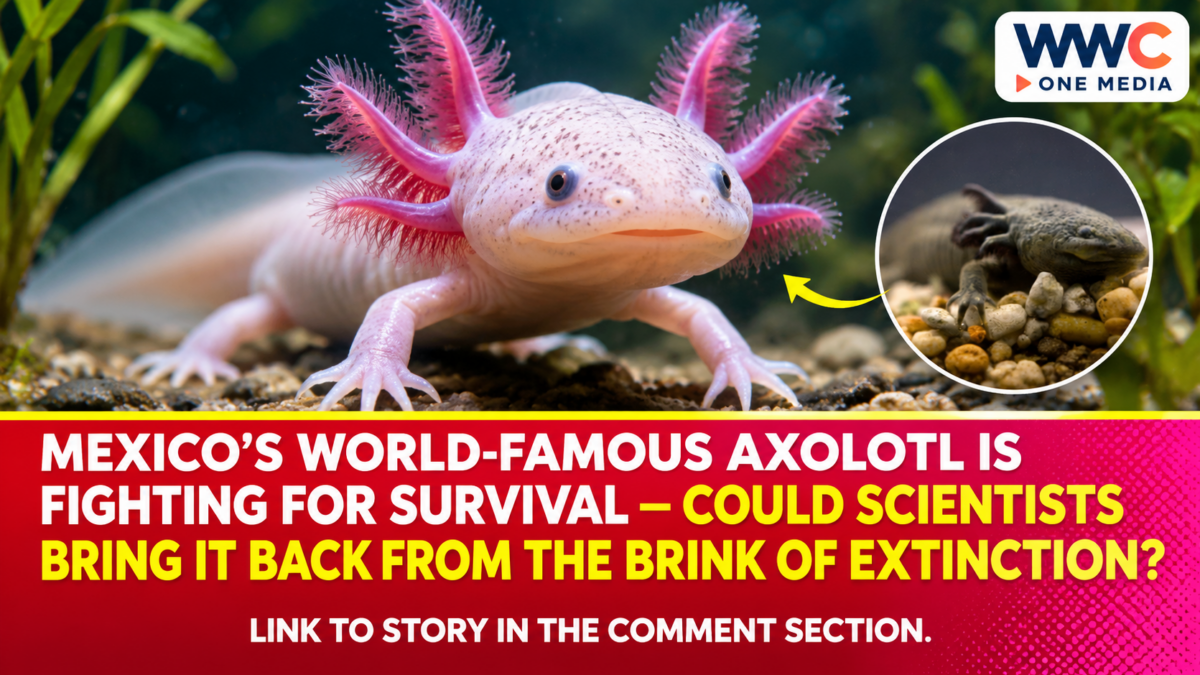
MEXICO CITY, MEXICO — One of the world’s most extraordinary amphibians is facing a struggle for survival in its native habitat, even as scientific research offers renewed hope that carefully managed conservation efforts could prevent its disappearance from the wild.
The Mexican axolotl, scientifically known as Ambystoma mexicanum, has become internationally recognised for its distinctive appearance and remarkable ability to regenerate lost limbs.
Yet the animal’s popularity has not resolved the environmental crisis threatening its natural home in the wetlands of Xochimilco, southern Mexico City.
Research examining the survival of captive-bred axolotls in restored and artificial wetlands has produced encouraging results. However, scientists still face the considerably more difficult challenge of establishing sustainable, naturally reproducing populations.
The future of Mexico’s iconic salamander may ultimately depend less on breeding additional animals and more on repairing the ecosystem that originally sustained them.
Mexico axolotl conservation: Why the species is disappearing
The axolotl’s natural environment has undergone extensive transformation as urban development and agricultural activities have altered the Xochimilco wetland system.
Deteriorating water quality, habitat fragmentation and the introduction of invasive fish have contributed to the species’ decline.
Non-native carp and tilapia present particular challenges because they can prey on axolotls while competing for essential resources.
Protecting individual animals without addressing these environmental pressures is unlikely to deliver a sustainable recovery.
The conservation challenge reflects a wider tension between urban expansion and biodiversity protection, also evident in Mexico’s environmental enforcement measures involving mangrove habitats in Quintana Roo.
Although mangroves and freshwater wetlands are different ecosystems, both demonstrate the importance of protecting the habitats on which wildlife depends.
Scientists discover promising results from experimental releases
A scientific study published in 2025 examined the behaviour of captive-bred axolotls introduced into two aquatic environments in southern Mexico City.
Researchers selected a restored agricultural wetland within Xochimilco and an artificial wetland at La Cantera Oriente.
Using radio-tracking technology, the research team monitored the animals’ movements and habitat use.
Axolotls recaptured during the investigation had gained weight, providing an encouraging indication that the selected environments could support their nutritional requirements.
However, two animals were subsequently lost to bird predation after the study concluded.
The results suggest that carefully selected and managed habitats could support future conservation releases, but they do not establish that unrestricted releases into existing canals would succeed.
Wildlife reintroduction requires careful habitat assessment, a principle also highlighted in the rehabilitation and release of rescued wildlife into suitable natural habitats.
For Mexico, the next challenge is determining whether experimental survival can translate into self-sustaining populations over multiple generations.
Scientists search for genetic traces of surviving axolotls
Another important development in axolotl conservation involves environmental DNA, commonly known as eDNA.
Animals leave genetic material in their surroundings through biological processes. By collecting and analysing environmental samples, researchers can investigate whether particular organisms have been present without necessarily capturing them.
A conservation survey led by the National Autonomous University of Mexico (UNAM), with support from Conservation International-Mexico, covered 115 monitoring locations across approximately 2,500 hectares of the protected Xochimilco area.
Separately, a 2025 scientific investigation detected genetic evidence of axolotls from the Ambystoma genus in a wildlife refuge but did not detect them at the sampled wild locations.
The findings offer evidence that protected refuges can play an important conservation role.
However, failing to detect a species does not necessarily establish its absence. Similarly, detecting genetic material does not provide a reliable population count on its own.
The challenges associated with studying elusive wildlife have also been examined in research expanding the known distribution of Philippine tarsiers.
For axolotl researchers, genetic monitoring could complement traditional field surveys and help determine where habitat restoration should receive greater attention.
Why traditional Mexican farming could help save the axolotl
The Xochimilco conservation strategy involves more than laboratory research and captive breeding.
Scientists are working with local farmers who maintain traditional agricultural plots known as chinampas.
Restoration initiatives seek to rehabilitate the canals surrounding these plots, improve environmental conditions and establish protected areas where aquatic wildlife can survive.
This approach connects species conservation with agricultural sustainability.
Instead of treating local communities as separate from environmental restoration, the strategy recognises their potential role in maintaining a healthier wetland ecosystem.
For participating farmers, more sustainable agricultural practices could support the continued productivity of their land while helping protect surrounding waterways.
The success of the programme will depend on whether these improvements can be maintained and expanded over time.
A small number of suitable refuges may provide immediate protection, but wider ecological restoration would be necessary to establish a more resilient wild population.
Why breeding axolotls in captivity is not enough
Captive breeding and wild conservation address different environmental objectives.
Breeding programmes can maintain living animals in controlled conditions. Reintroducing those animals into restored habitats, however, requires suitable water conditions, adequate food, protection from excessive predation and appropriate genetic management.
A growing captive population does not necessarily demonstrate an improvement in the species’ conservation status in nature.
This distinction is essential when discussing the axolotl’s future.
Simply releasing additional animals without addressing the environmental conditions responsible for the original decline could undermine conservation investments.
A stronger approach combines habitat restoration, carefully monitored releases and continued assessment of population health.
What happens next for Mexico’s iconic salamander?
The evidence reviewed so far supports cautious optimism rather than a declaration of victory.
Experimental releases indicate that appropriately managed wetlands can support captive-bred axolotls. Genetic monitoring also provides researchers with another method of investigating the species’ persistence.
The decisive test will be whether restored habitats can sustain healthy populations capable of reproducing without continuous human intervention.
Long-term monitoring could help determine whether conservation refuges should be expanded, connected or managed differently.
For Mexico, protecting the axolotl is also an opportunity to preserve the distinctive wetland ecosystem that supports its survival.
The salamander’s remarkable regenerative abilities have made it internationally famous. But its ability to regenerate lost limbs cannot protect it from the disappearance of its natural habitat.
That responsibility remains with the people and institutions working to restore Xochimilco.
Frequently asked questions
Is the Mexican axolotl endangered?
Yes. The Mexican axolotl, or Ambystoma mexicanum, is considered critically endangered in its natural environment.
Where do wild axolotls live?
Their remaining native habitat is associated with the Xochimilco freshwater wetland and canal system in southern Mexico City.
Why are axolotls disappearing from the wild?
Major threats include habitat degradation, declining water quality, urban development and invasive fish species such as carp and tilapia.
Can captive-bred axolotls survive after being released?
Experimental research indicates that captive-bred axolotls can survive in selected restored and artificial wetlands. Long-term population recovery has not yet been established.
Can Mexico still save the axolotl?
Scientific findings suggest that recovery remains possible through habitat restoration, carefully managed breeding and release programmes, genetic monitoring and cooperation with local communities. Success is not guaranteed.