
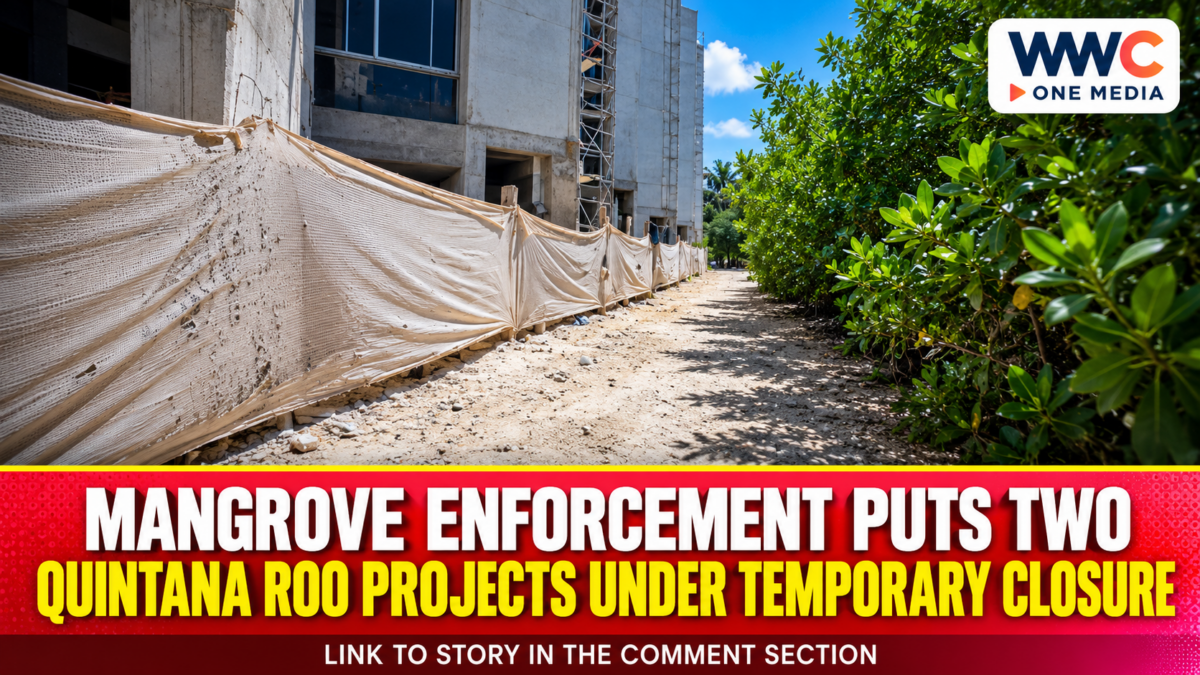
CANCÚN, Mexico — Mexico’s environmental enforcement agency imposed temporary total closures on two construction projects in Quintana Roo after inspections between Oct. 26 and Nov. 4, 2026, documented direct impacts to mangrove vegetation and the absence of demonstrated federal environmental impact authorisations. A separate inspection in Puerto Morelos recorded changes along the coastline and tourist equipment on a beach, but did not result in a closure.
The actions place three coastal locations under different levels of regulatory scrutiny: a T-shaped pier under construction at Laguna Nichupté, a five-level building project on Isla Holbox, and a beach area in Puerto Morelos. The distinction matters because the agency announced enforcement measures for the first two sites while reserving further technical and legal assessment for the third.
For businesses operating in coastal destinations, the cases illustrate a central development risk: construction activity near sensitive ecosystems can face regulatory intervention when the required federal environmental authorisations cannot be demonstrated.
What the PROFEPA inspections found in Quintana Roo
The Procuraduría Federal de Protección al Ambiente, commonly known as PROFEPA, said its inspections covered the municipalities of Benito Juárez, Lázaro Cárdenas and Puerto Morelos.
At Laguna Nichupté in Benito Juárez, inspectors examined a T-shaped pier with side platforms. The structure occupied 1,195.346 square metres within a total inspected area of 8,766 square metres. The agency reported direct impacts to surrounding mangrove vegetation.
On Isla Holbox, inspectors visited a property on Caguama Street on Oct. 28. They documented a five-level building, a concrete slab and structural preparations for a swimming pool. The works occupied 667 square metres of a 982-square-metre property described as surrounded by mangrove vegetation.
PROFEPA said the operators had not demonstrated the required federal environmental impact authorisations. It therefore imposed a measure described as a temporary total closure on the pier works and on the building and associated pool works.
The agency’s announcement does not identify the developers or property owners in the published text. It also does not state that the administrative proceedings have reached a final determination of responsibility.
Why the Holbox and Nichupté cases are not the same as Puerto Morelos
The third inspection took place on Nov. 4 in Puerto Morelos, opposite Hotel Breathless, within an area of the Federal Maritime Terrestrial Zone, known by its Spanish abbreviation Zofemat.
Inspectors documented changes in the coastline and recorded beach equipment that included palapas, loungers, wooden structures, kayaks, tables and a lifeguard lookout.
The agency did not announce a closure at this location. Instead, it said it had prepared an official record of the conditions observed and would conduct a technical analysis of the Zofemat boundary. That work is intended to help determine the legal status of the equipment and facilities on the beach.
Treating all three sites as if they received the same sanction would misstate the enforcement record. The two construction projects were subject to temporary total closures; Puerto Morelos was placed under further technical and administrative review.
The permit question behind coastal construction
Federal environmental impact authorisation is a separate regulatory requirement from local construction or land-use permissions. A project may therefore need to satisfy more than one approval process, depending on its location and the nature of the proposed activity.
This distinction is particularly relevant when works may affect wetlands, mangroves or other coastal ecosystems. The environmental review process allows the competent federal authority to assess potential impacts before activities proceed where authorisation is required.
In its announcement, PROFEPA said projects and activities that may affect mangroves and coastal dunes must obtain prior environmental impact authorisation from the Environment and Natural Resources Secretariat, known as SEMARNAT, when applicable.
The agency’s stated basis for the two closures was that the required federal authorisations had not been demonstrated during the inspections. That is a description of the enforcement action, not a substitute for the complete administrative case files or a final ruling on any appeal.
The distinction between a missing or unproven authorisation and a final finding of liability is important for fair reporting. The public announcement does not provide the full inspection records, the identities of the parties involved, or any response from the project operators.
Mangroves carry environmental and economic importance
Mangroves are not simply vegetation beside a construction site. PROFEPA identified their role in protecting coastlines from weather events, capturing carbon and providing habitat for plant and animal species.
Those functions can have implications beyond conservation. Coastal ecosystems form part of the natural environment on which tourism, fishing and shoreline communities depend. Damage to them can create longer-term environmental management challenges, although the agency has not yet published a quantified assessment of the damage at either closed site.
The restoration question is therefore significant. PROFEPA said it would evaluate the impacts to mangroves in Laguna Nichupté and Holbox before determining corrective measures and, where appropriate, ecological restoration actions.
The issue also connects with wider questions about how coastal destinations balance development and ecosystem protection. WWC previously examined the permit questions surrounding a proposed Playa Mamitas development in Playa del Carmen, where the central concern was the need to distinguish historical statements about approvals from a project’s current permit status.
The practical challenge is not limited to preventing unauthorised work. Restoration itself requires assessment of the affected area and the ecological conditions needed for recovery. A Philippine example, a community-backed mangrove restoration programme in Alaminos, shows how rehabilitation can also involve local livelihoods and long-term coastal resilience.
What the enforcement action means for coastal development
For developers, the immediate business implication of a temporary total closure is that the affected works cannot simply be treated as routine construction activity while the enforcement measure remains in force. Project timelines, contractor arrangements and capital commitments may be affected.
However, the published announcement does not quantify the financial exposure of either project. It provides no construction budget, estimated delay, penalty amount or projected restoration cost. Any claim about the commercial losses would therefore be premature.
For local authorities and tourism businesses, the cases reinforce the importance of checking whether a project has the approvals applicable to its location before construction begins. Environmental compliance is not only a matter for the developer; it can affect contractors, investors, property operators and the wider destination.
WWC has also reported on how environmental user fees are debated as a tool for managing coastal destinations. That policy debate is different from an enforcement case, but both raise the question of how tourism activity and environmental safeguards are managed in places whose natural assets support local economic activity.
What happens next
PROFEPA said it would continue the administrative proceedings related to the Laguna Nichupté and Holbox projects. It will assess the mangrove impacts and determine which corrective measures and, if appropriate, restoration actions should follow.
In Puerto Morelos, the next stated step is a technical review of the Zofemat boundary, taking account of the observed coastline changes. That analysis is intended to clarify the legal status of the beach equipment and facilities.
The agency has not announced final responsibility findings, financial penalties, a restoration timetable or a final outcome for the Puerto Morelos review in the published communiqué.
The next meaningful update will therefore be the release of further administrative or technical findings—not an assumption that the closures already settle every legal question surrounding the projects.
Frequently asked questions
1. Which projects did PROFEPA temporarily close in Quintana Roo?
The agency imposed temporary total closures on a T-shaped pier under construction at Laguna Nichupté and on a five-level building project with associated swimming-pool works on Isla Holbox.
2. When were the inspections conducted?
PROFEPA said the inspection programme ran from Oct. 26 to Nov. 4, 2026. The Nichupté inspection took place on Oct. 26, the Holbox inspection on Oct. 28, and the Puerto Morelos inspection on Nov. 4.
3. Was the beach area in Puerto Morelos also closed?
No closure was announced for the Puerto Morelos location. PROFEPA recorded the site conditions and said it would conduct a technical analysis of the Zofemat boundary.
4. Why did PROFEPA close the Nichupté and Holbox works?
The agency said the required federal environmental impact authorisations had not been demonstrated during the inspections. It also reported direct impacts to mangrove vegetation at Laguna Nichupté.
5. Have the developers been ordered to restore the mangroves?
The published announcement does not identify a final restoration order or timetable. PROFEPA said it would assess the impacts and determine corrective measures and, where appropriate, ecological restoration actions.










